
The World’s First Seamless Paper Bag Making Machine — No Bottom Seam
ZHENGWEI’s seamless paper bag making machine replaces gluing and folding with precision die-cutting — the first process in the world to produce a luxury paper bag without a bottom seam. In 2019, ZHENGWEI filed the world’s first patent for a machine capable of producing three-dimensional paper bags without a bottom seam. The result: a cleaner bag, faster to produce, with a distinctly higher perceived value at the point of sale.
Two processes, one difference your customers can see
Traditional paper bag machines form the bag starting from a paper tube with a glued side seam — a weak point that remains visible on the finished product. ZHENGWEI’s seamless paper bag making machine starts from pre-die-cut sheets and forms the bag without ever creating that seam.
Traditional Process
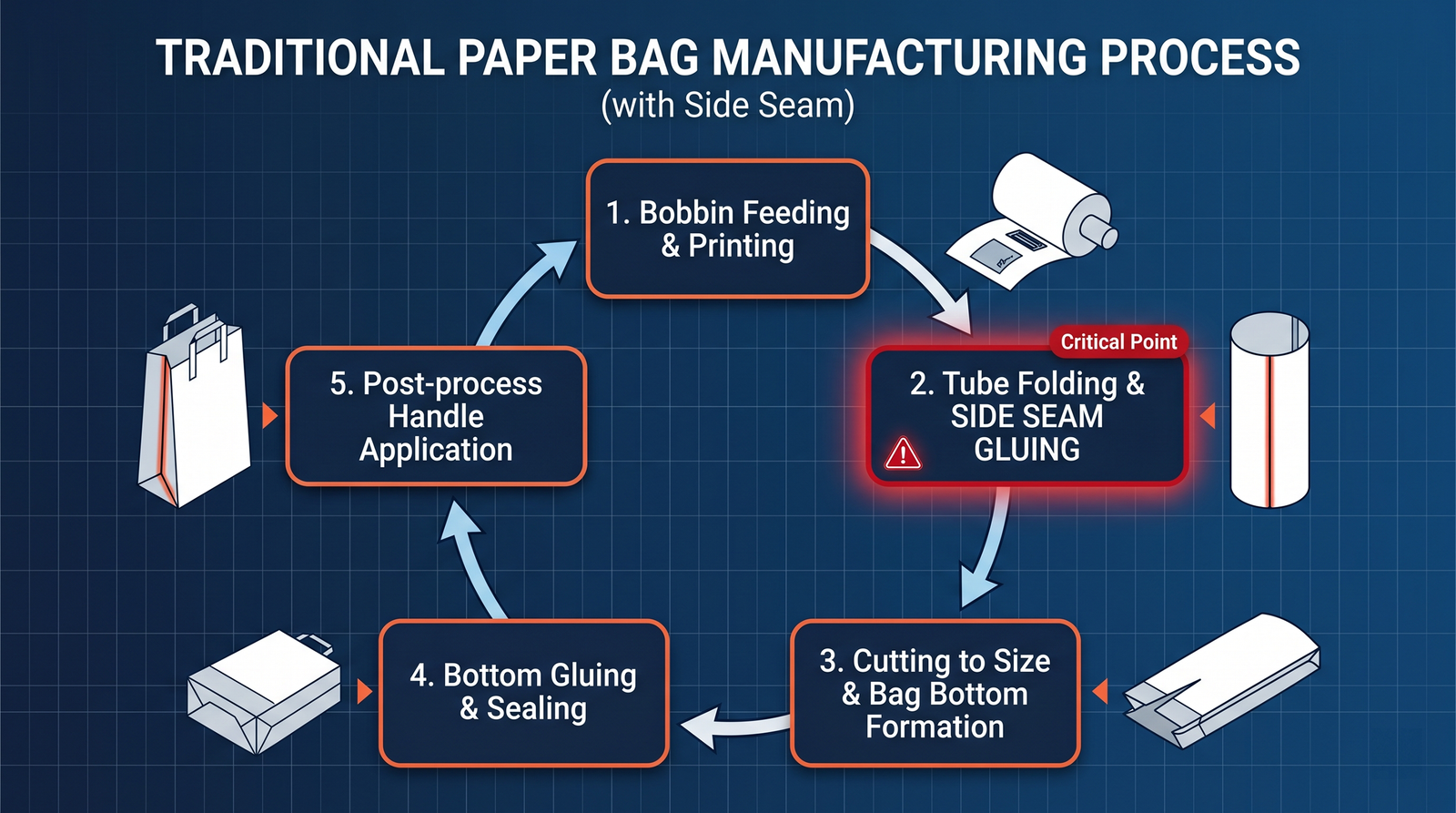
The critical point is step 2: tube folding with glued side seam. The seam line remains visible on the finished bag and represents the most common source of production defects.
ZHENGWEI Process
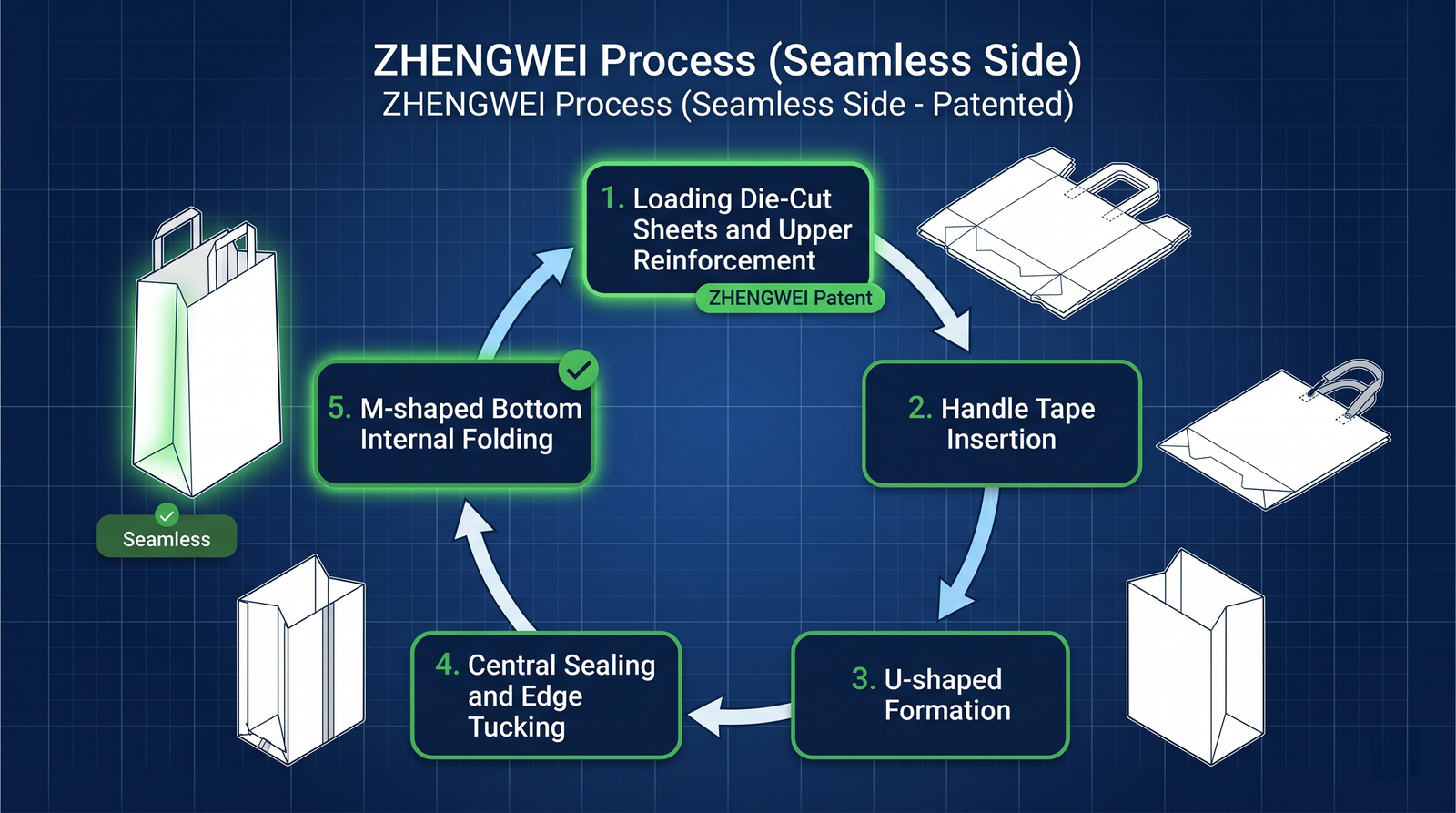
The process starts from pre-die-cut sheets: the bag shape is already defined before folding begins. There is no bottom-seam step — and therefore no seam line. The final bag has continuous side walls.
Why the side seam is the real bottleneck
For decades, the side seam was accepted as a necessary evil. In reality, it is the single element that limits speed, quality, and commercial value across the entire paper bag production industry.
Visible aesthetic defect
The vertical glue line is perceived by premium brands as a defect. For luxury shopping bags and gift packaging, the seam immediately lowers the perceived value of the product — and with it, the retail positioning.
Production bottleneck
Glue application and drying take time. This is the slowest phase of the cycle and the leading cause of machine downtime from jams, delamination, and alignment corrections.
Structural weak point
Under load or humidity variation, the side seam is always the first point to fail. The die-cutting process eliminates this weak point at the root — significantly reducing scrap rates and customer returns.
Precision die-cutting: the key to eliminating the bottom seam
The secret behind the ZHENGWEI process is the application of know-how matured across 20 years of producing three-dimensional non-woven bag machinery: precision die-cutting. Instead of forming a paper tube and then closing it, the bag is die-cut flat and then folded along millimeter-accurate creasing lines.
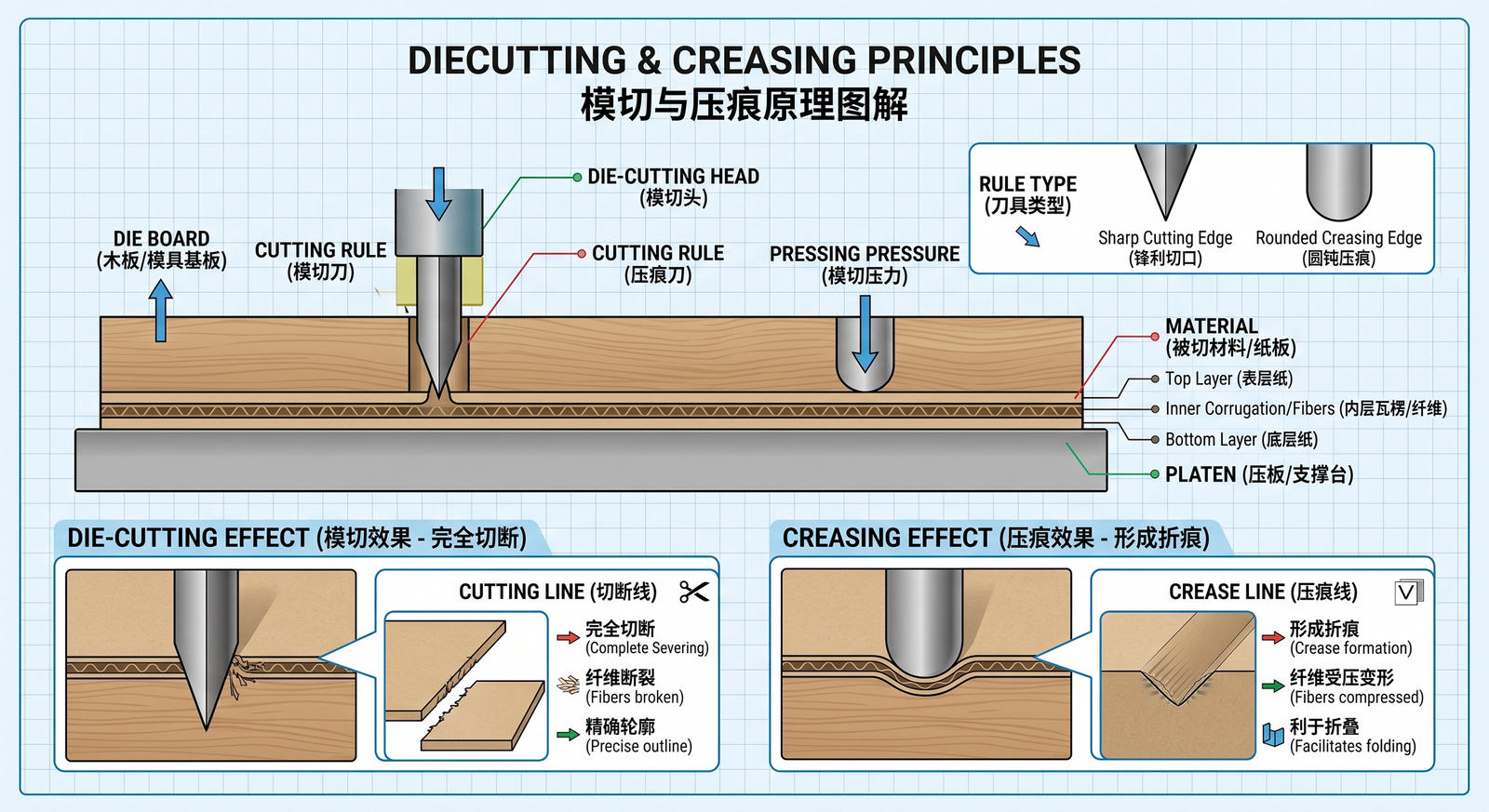
Two blades, two distinct functions
Sharp blades execute complete cuts, separating the sheet along the exact contour of the unfolded bag. Rounded blades do not cut: they compress the fibers, creating creasing lines that guide the subsequent folding with absolute precision.
This is the same approach used in non-woven bag machinery — the category ZHENGWEI originated in. Bringing it to paper was the breakthrough that made it possible to eliminate the side seam entirely.
The structure of a seamless paper bag
A ZHENGWEI bag has continuous side walls, an M-shaped bottom formed by folding — not by side gluing — and a reinforced top edge. Every detail is engineered for strength, aesthetics, and production speed.
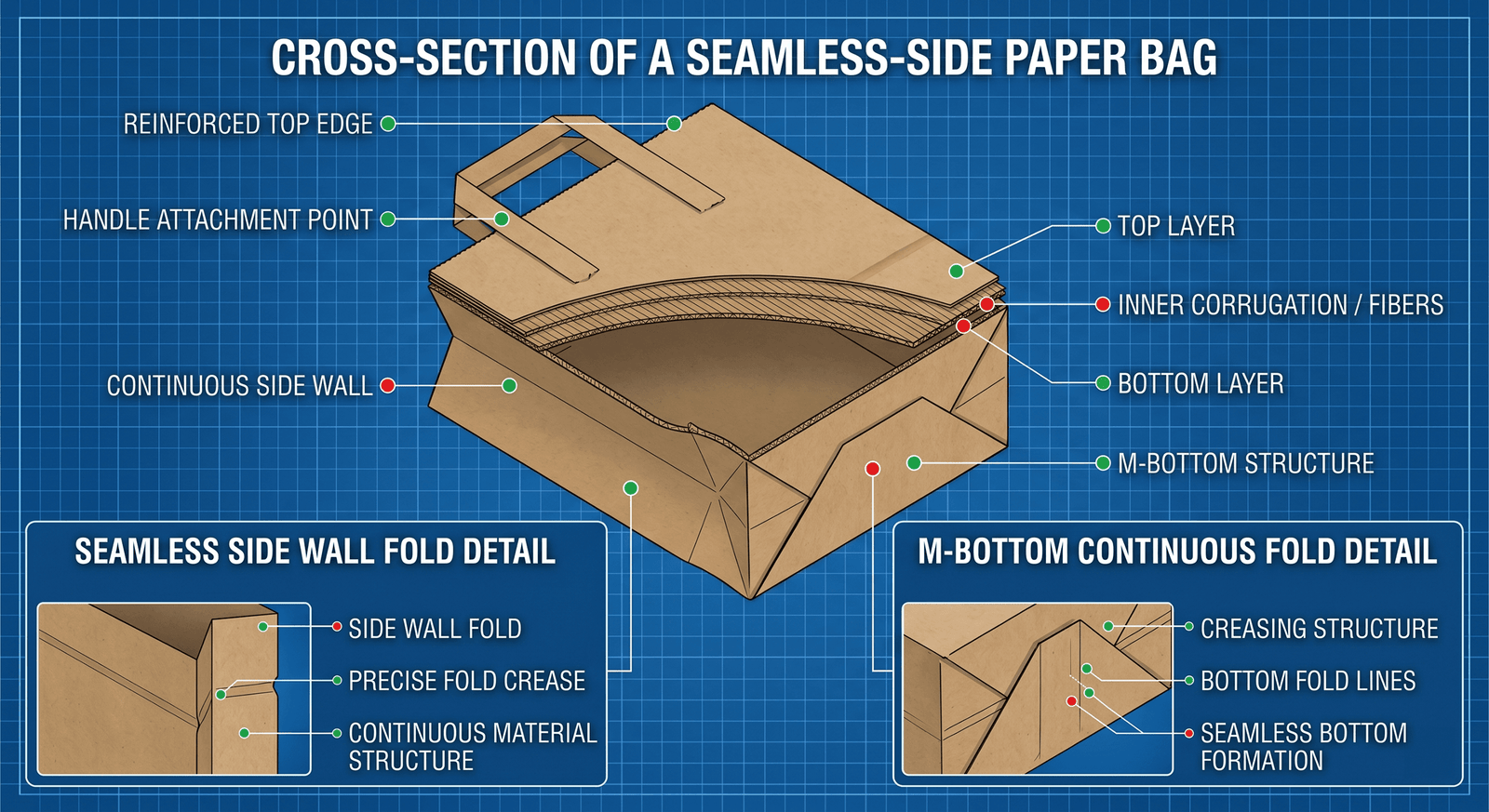
Continuous side wall
No vertical seam line. The side wall is formed by a single fold, delivering flawless aesthetics and uniform mechanical strength across the full height of the bag.
M-fold bottom from folding
The bottom is formed by geometrically precise folds that interlock with each other — a more resistant and more stable structure than traditional bottom-gluing methods.
Reinforced top edge
The top reinforcement is applied in the first phase, while the sheet is still flat — producing a cleaner, more uniform fixation of the reinforcement cardboard and a stronger handle anchor point.
What this means for your bottom line
Seamless technology is not just a technical innovation — it is a margin multiplier. Three concrete impacts on the profitability of your production:
More bags per shift
Eliminating the side-seam and glue-drying steps shortens the machine cycle. At the same operating hours, hourly output grows by more than half — directly increasing the throughput of your production line.
Labor costs cut in half
The integrated process reduces manual intervention points. One trained operator can monitor the line, with a second operator dedicated only to reel changeover and quality control — typical payback under 18 months on labor savings alone.
Access to the premium segment
Fashion and luxury brands pay a significant premium for shopping bags without bottom seams. Without this technology, your product competes only in the commodity segment — with seamless production, you enter the high-margin luxury packaging market.
Frequently asked questions about our seamless paper bag making machine
The most common questions from engineering and purchasing teams evaluating our seamless paper bag making machines for the first time.
See the technology in action
Request a live video demonstration of the seamless paper bag making machine in production, or order a free bag sample. Response within 24 hours.