Seamless Paper Bag Machine vs Traditional: Which One Pays Back Faster in 2026?
You already know your machine. That’s exactly why this matters.
If you’re reading this, chances are you’re not new to the paper bag business. You’ve probably been running a side-seam machine for years — maybe a European brand, maybe a well-established Asian one. You know your throughput. You know your reject rate. You know which operator can coax an extra 5% out of the line on a good day.
So this article isn’t going to teach you how paper bags are made. What it will do is walk through the shift toward the seamless paper bag machine that’s quietly reshaping the luxury segment — and help you decide whether it’s time to act on it, or wait.
The question this answers Does a seamless paper bag machine make sense for your business in 2026, or should you keep your current line running for another cycle?
The side seam isn’t a flaw. It’s a structural requirement.
Here’s something worth saying upfront, because it frames everything that follows: the side seam on a traditional paper bag isn’t a quality defect. It’s a consequence of how traditional machines are built.
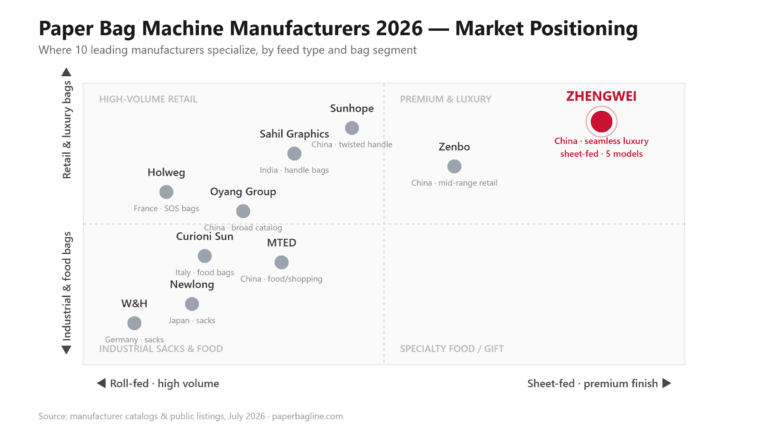
For decades, European manufacturers like Windmöller & Hölscher, Newlong, and Curioni Sun Teramo have set the global benchmark for paper bag production. Their machines are engineered with precision, and any factory running them has made a serious investment in quality. The same is true of well-established Asian and Indian manufacturers serving the commodity segment.
But every one of these machines — regardless of brand or price tag — shares a common architectural constraint: the side seam.
The reason comes down to how the bag is formed. In conventional paper bag production, a continuous paper web is folded into a tube. To close that tube, one edge has to overlap the other by several millimeters, and that overlap has to be glued. It’s a mature, well-understood process, and it works. But it produces a bag with a visible vertical seam running down one side, where the overlap sits.
This isn’t a design choice any engineer could have avoided. It’s a physical requirement of tube-forming paper bag production.
Why the seam has become a commercial problem
For standard retail paper bags — grocery bags, takeaway bags, mid-market shopping bags — the side seam is a non-issue. The bag carries goods, the seam does its job, nobody cares.
Where it becomes a problem is the luxury and premium retail segment, and this is where the economics have shifted over the last five years.
Luxury brands now treat the paper bag as part of the product experience. When a customer walks out of a flagship store with a bag, that bag is photographed, shared, and becomes part of the unboxing ritual. Brand owners have responded by tightening their packaging specifications — and the side seam is increasingly on the list of things their QC teams flag.
Three issues come up repeatedly:
- Print disruption across the seam. A logo, pattern, or metallic foil printed across the overlap zone will almost always show a subtle interruption where the two paper edges meet. For a mass-market bag, this is acceptable. For a €4,000 handbag’s carrier, it’s a rejection.
- Gluing consistency under scrutiny. Weak or inconsistent side-seam bonding is one of the most commonly flagged defects in paper bag QC audits — and this is documented widely across the industry, not just by machine vendors. Even at top-tier factories, maintaining perfect seam consistency across a million-unit order is a daily battle.
- The seam as a perceived authenticity marker. In luxury authentication culture, stitching and seam quality have become part of how consumers (and resellers) judge whether a product — and its packaging — is genuine. A visible, imperfect seam on a paper bag now carries brand-signal weight that didn’t exist a decade ago.
And then there’s the commercial reality that follows from all of this. Packaging buyers at luxury brands now routinely pay a 30–50% premium for paper bags produced without a bottom seam, compared to conventional equivalents of the same paper weight and print complexity. That premium isn’t arbitrary — it reflects both the perceived quality uplift and the smaller supplier base capable of delivering it. For factories positioning themselves as premium suppliers, this is where the margin is.
None of this is the fault of the machines. It’s a mismatch between a mature 20th-century production process and a 21st-century luxury market that has quietly raised its standards.
What a seamless paper bag machine actually changes on the production floor
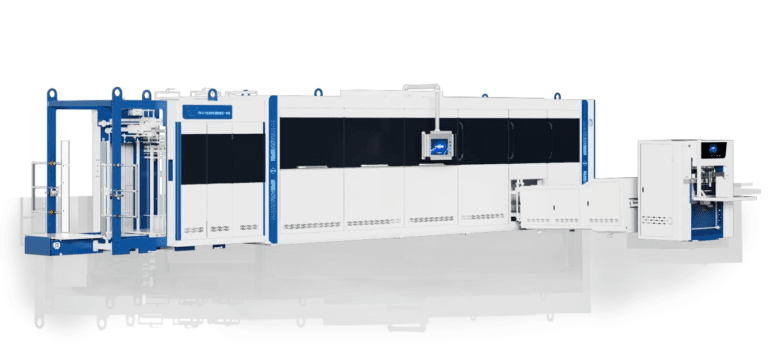
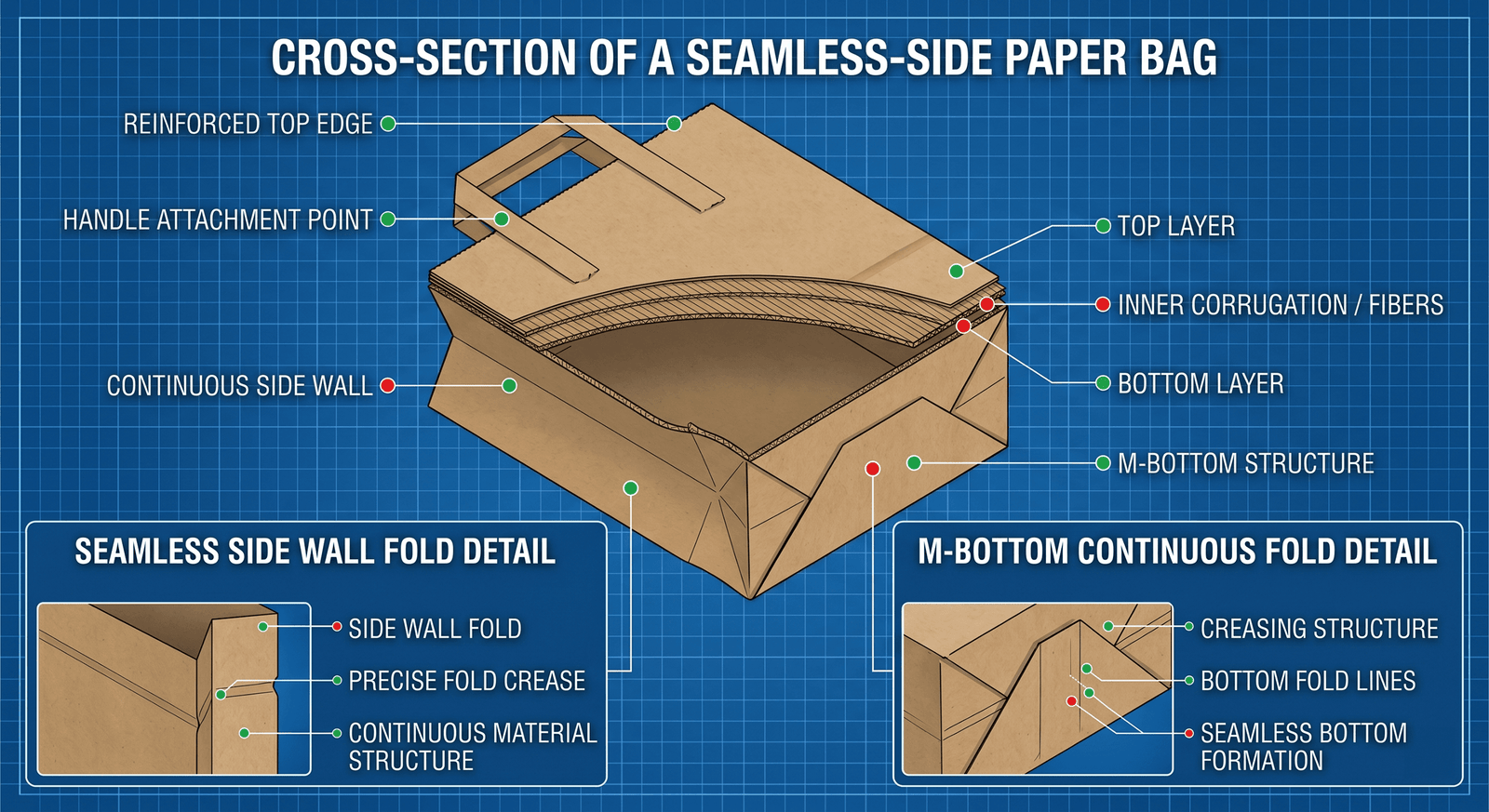
Seamless paper bag production takes a fundamentally different approach. Instead of forming a tube from a continuous web, the process starts with a die-cut sheet — the bag’s full outline is stamped out flat, then folded and sealed inward from the bag’s interior.
The result: no vertical overlap zone on the bag’s exterior surface. The side wall is one continuous piece of paper, from top to bottom.
For anyone who’s run a bag line for years, it’s worth sitting with what that changes:
- The entire front, back, and side panels become uninterrupted print surfaces. Foils, gradients, and pattern work can run across the full bag without a seam break.
- The overlap-zone adhesive — and the quality variance it introduces — is gone entirely.
- Because there’s no tube-forming station, the mechanical architecture of the machine is simpler in certain ways, though different in others.
The key framing Seamless isn’t a better version of side-seam production. It’s a different process. It doesn’t replace traditional machines for every use case — but for the luxury segment, it removes a constraint that the old process can’t work around.
If you want the technical details of how Zhengwei’s seamless machines accomplish this — the die-cutting mechanism, the inward folding sequence, the 6-step process flow — you can read the full technical breakdown on our Technology page.
Seamless paper bag machine vs traditional: the numbers that matter
Enough framing — let’s get to the data factory owners actually use to make decisions.
The following figures compare a typical older-generation side-seam production line against Zhengwei’s current seamless lineup (ZW-A11 series). Where you see ranges, they reflect variation across machine condition, operator skill, and product specification:
| Metric | Traditional Side-Seam (older lines) | Zhengwei Seamless (ZW-A11 series) |
|---|---|---|
| Production speed | 25–30 bags/min | 40–45 bags/min |
| Output per 8-hour shift | ~14,400 bags | ~21,600 bags |
| Operators per line | 3 (feeder, seam supervision, QC) | 1–2 |
| Side-seam glue application | Required (wear-prone nozzles) | Not applicable |
| Market segment access | Commodity + mid-market | Mid-market + premium/luxury |
| Typical premium pricing | Baseline | +30–50% vs commodity equivalents |
A few things worth highlighting:
On speed: The 60%+ throughput gain comes from eliminating the side-seam gluing and drying step entirely. In a traditional tube-forming line, that step is the cycle-time bottleneck — glue viscosity, ambient temperature, and nozzle condition all affect it. Remove the step, and the cycle compresses. At volume, a ~7,200 bag/shift difference compounds into hundreds of thousands of bags per year without adding labor or overtime.
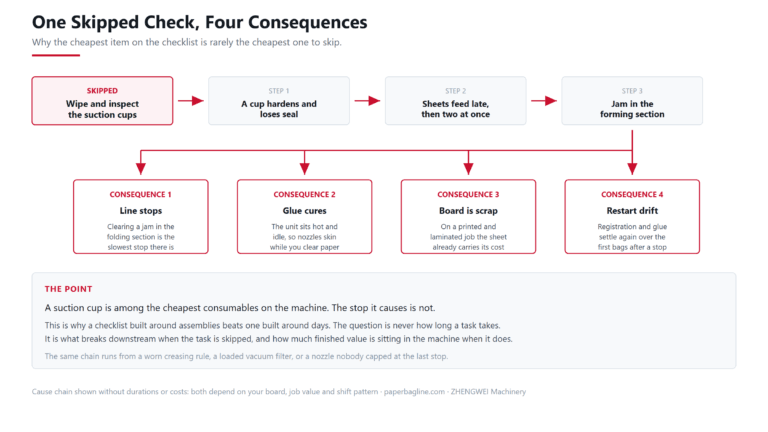
On labor: The reduction isn’t about working operators harder — it’s about removing production stations. No seam-gluing station means no operator dedicated to monitoring it. This also cuts the most common source of unplanned downtime on traditional lines: glue nozzle maintenance, adhesive clogs, and seam re-runs.
An honest caveat on the 25–30 bags/min baseline: This figure is typical of older-generation side-seam machines still in widespread use across Asia and parts of Europe. Well-maintained premium European equipment can run faster than this under optimal conditions. If your current line is at the high end of traditional performance, the ROI math changes — but the structural seam constraint remains.
When does a seamless paper bag machine actually pay back?
This is the question every factory owner actually cares about, so let’s be honest about it.
The ROI case for seamless is strongest under three conditions. The more of these that apply to you, the faster the payback:
1. Your customer mix is tilting toward premium and luxury
If your order book is increasingly made up of clients who care about print fidelity, finish quality, and bag-as-brand-asset — fashion OEMs, cosmetics packagers, high-end retail chains, luxury boutique networks — a seamless paper bag machine is no longer optional on a 5-year horizon. These customers will eventually standardize on seamless, and the suppliers who already offer it will win the contracts.
2. Your existing line is approaching end-of-life or major overhaul
A well-maintained traditional machine can run for 20–30 years. But every 8–12 years, most factories face a capital decision: major overhaul, or replacement? If you’re in that window and your market is shifting premium, a seamless paper bag machine becomes the natural next investment rather than pouring capital into extending a process that’s structurally limited.
3. You’re losing bids on seam-quality grounds
If you’ve recently lost an RFQ — or had a batch rejected, or seen a client slowly reduce order volume with no clear reason — and seam visibility or seam consistency came up in the conversation, that’s a signal that’s worth acting on, not filing away.
If none of these apply to you — if you run a commodity business, your customers are price-sensitive, and your margins depend on absolute lowest per-bag cost — seamless is probably not for you right now, and that’s fine. Traditional side-seam machines will remain the right tool for the commodity segment for a long time to come.
Five questions to ask yourself before deciding
When you sit down to evaluate whether seamless is the right next investment, these are the questions we’ve seen factory owners work through:
- What percentage of my current revenue comes from clients who would specify “no visible seam” if they knew it was an option? If it’s above 30%, you’re at risk of losing them to a competitor who offers it. If it’s below 10%, you have more time.
- Can my sales team win new luxury accounts with a “seamless capability” pitch? In practice, having a seamless paper bag machine on the floor becomes its own sales asset — it opens doors that a side-seam line cannot.
- What’s my current reject rate on premium orders, and how much of it traces back to seam issues? If you don’t track this specifically, start. It’s usually higher than factory owners assume.
- How does a seamless paper bag machine fit alongside my existing machines? Most factories don’t replace their traditional lines — they add seamless as a parallel capability for premium orders, keeping traditional for standard volume. This is usually the lowest-risk path.
- What’s the installation timeline, and can my facility accommodate it? Seamless paper bag machines have different footprint and power requirements. Worth checking against your current plant layout before deep commercial discussions.
A real-world pattern we see
Without naming the client, here’s a pattern that’s come up more than once:
A Turkish luxury packaging client had been running European side-seam equipment for over a decade, supplying carrier bags to fashion houses across the EU. They were winning on print quality and service, losing on seam-related rework. Their decision wasn’t to replace the European line — it was to add a seamless paper bag machine for their top-tier luxury SKUs, while keeping the traditional equipment running for everything else. Within the first year, the new line was running at capacity, and the old line’s reject rate dropped because it was no longer being pushed onto jobs it was never well-suited for.
The lesson For most factories, this isn’t a replacement decision. It’s a capability-expansion decision.
Where to go from here
If you’ve read this far, you’re probably already somewhere on the decision curve. A few suggestions for next steps, depending on where you are:
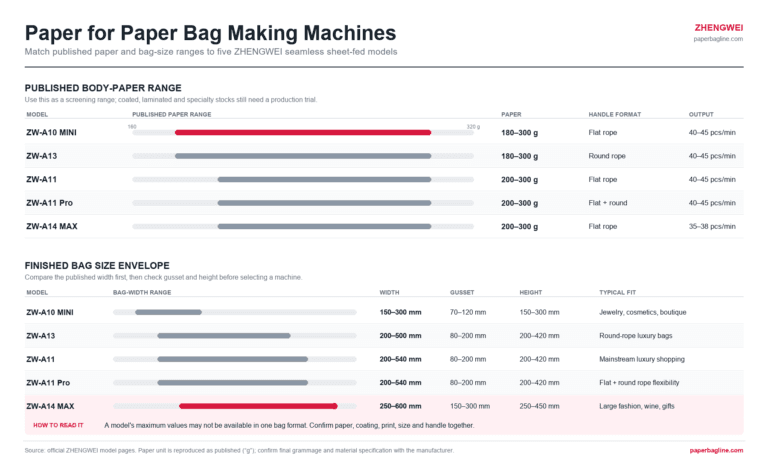
- If you’re still evaluating: Browse our five luxury paper bag machines to understand which seamless paper bag machine configuration would fit your current product mix and production volume.
- If you want a technical deep-dive: Our Technology page walks through how seamless die-cutting works, with cross-section diagrams and a full process flow.
- If you’re ready to talk specifics: Request a personalized consultation with Michelle Zhang, our Sales Manager. She’ll work with you on sizing, timeline, and how a seamless paper bag machine would integrate with your existing operation.
Talk to us about your line
You’ll hear back within 24 hours, in English or Chinese, with a response tailored to your factory’s specific situation — not a generic brochure.
Request a Quote →Zhengwei Machinery specializes in seamless paper bag machines for luxury production. Our machines are CE-certified and serve customers across Europe, Latin America, the Middle East, and Asia.
────────────────────────────────────────────────── –>