
Roll Fed Paper Bag Making Machine for Kraft and Food Bags
Our roll fed paper bag making machine range unwinds a kraft reel and delivers finished bags in one pass, with twisted or flat rope handles applied inline. Fifteen models across four series cover retail shopping bags from 120 to 550 mm wide and bakery bags on paper as thin as 35 g/m².
What Is a Roll Fed Paper Bag Making Machine?
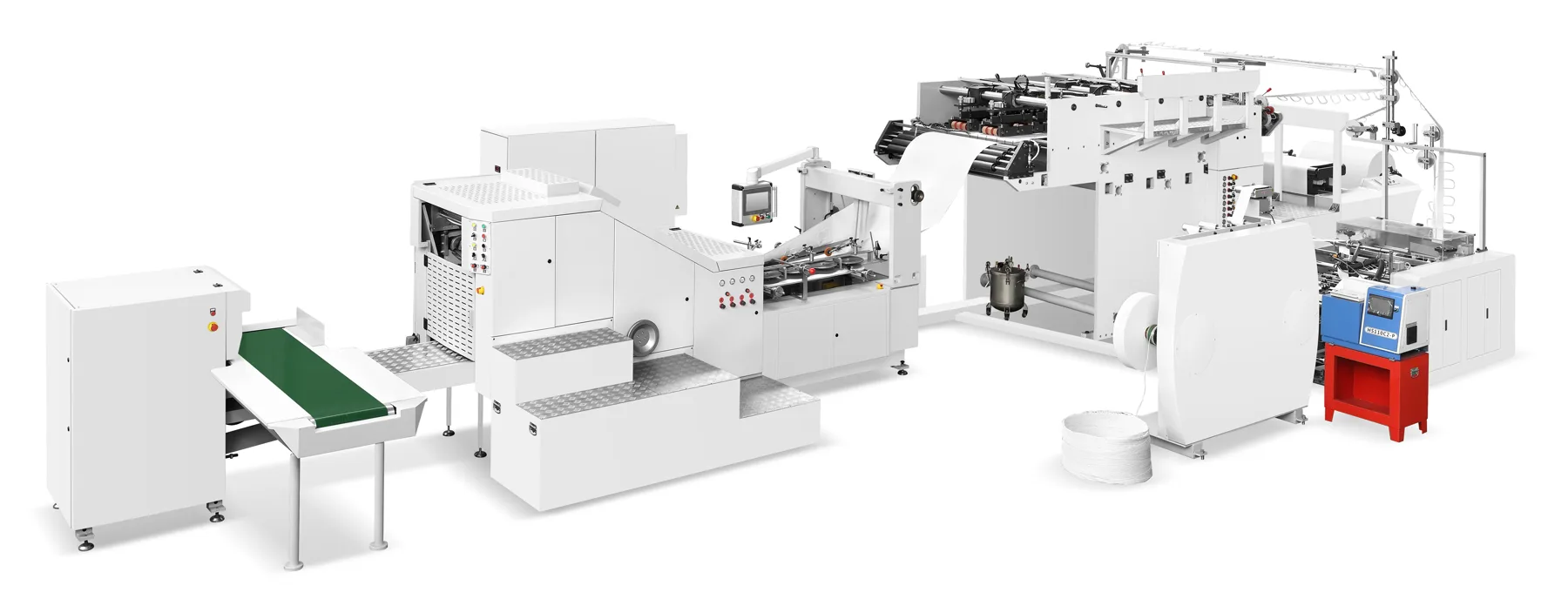
A roll fed paper bag making machine converts a reel of kraft paper into finished bags in a single continuous pass. The web is glued into a tube, cut to length, creased, opened at the bottom and folded into a square or flat base, all while moving. Handle machines run alongside the line and attach twisted or flat paper rope before the bag is formed, so the bag leaves the line ready to pack.
The alternative is sheet-fed, where pre-printed board is die-cut and folded one sheet at a time. Sheet-fed suits luxury handbags in heavy board. Roll-fed suits volume: kraft shopping bags, bakery bags, takeaway bags, anything where the run is long and the paper is light. Our guide to paper bag machine types covers how the two families differ in detail.
Twelve stations on a handle line. The TF family adds an inline printing unit between handle cut-off and patch attachment, which is most of the reason a TF frame draws 52 to 55 kW where a T frame of similar bag width draws 15 to 28 kW.
Three Families, Three Different Businesses
The three families are not three price points of the same machine. Each serves a different customer, and picking a roll fed paper bag making machine by price instead of by end product is the most expensive mistake in this category.
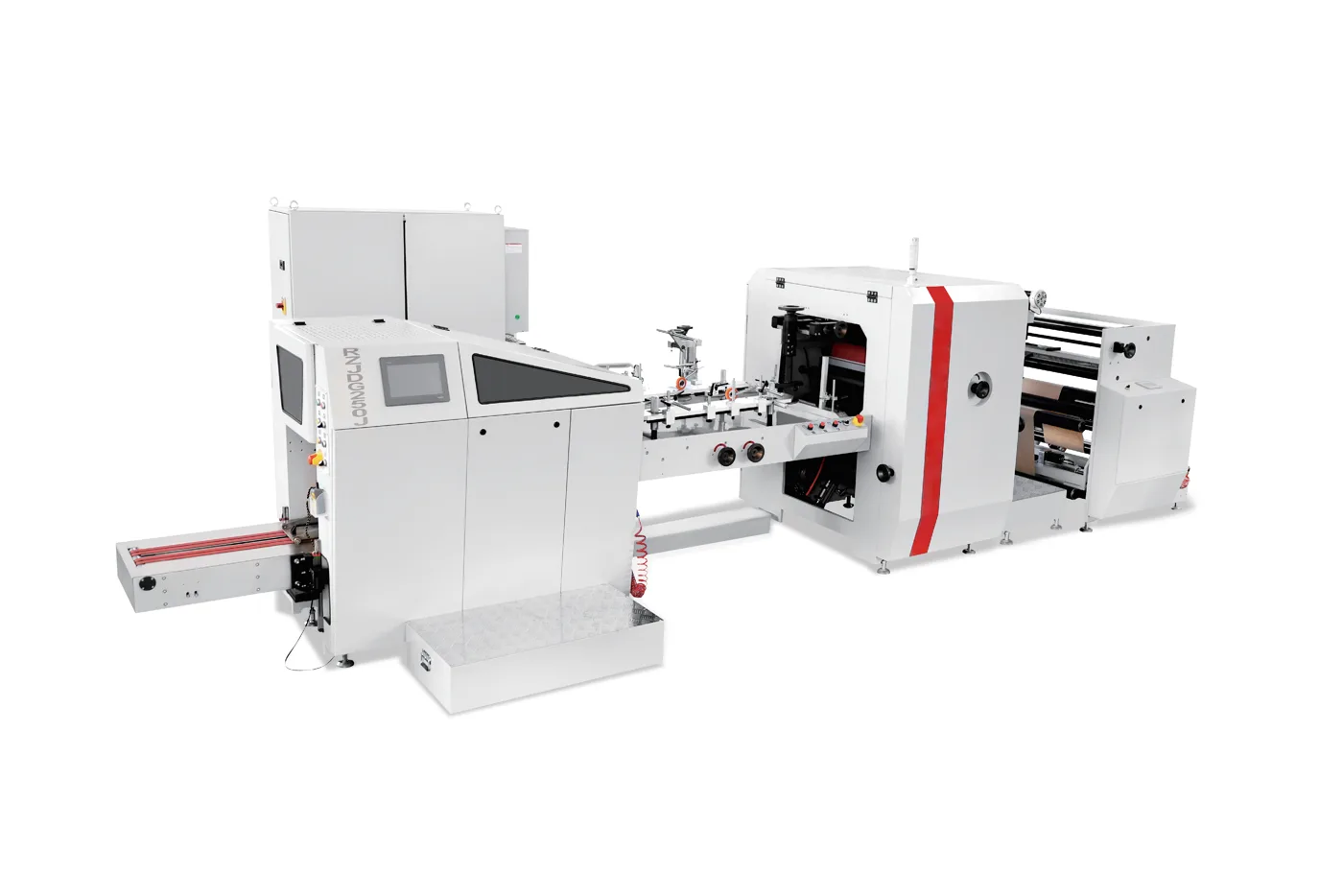
The 550 mm frames are the widest in the range and take a 1,690 mm reel.
RZFD-T: twisted rope handles inline
The retail workhorse and the widest span in the range. Twisted paper rope is formed, cut and glued on inside the line, so branded shopping bags come off finished. Bags from 80 to 550 mm wide, paper from 50 to 150 g/m², 12 to 28 kW. Inline printing is available on the three N frames.
RZFD-TF: twisted and flat rope on one frame
Runs both handle constructions and carries a printing unit. It is a much bigger machine, 52 to 55 kW against 12 to 28 kW, and it also runs unhandled bags at a wider format than the same frame manages with a handle fitted. Worth it when your customer base has not settled on one handle look.
RZJD-G: flat bottom food bags, no handle
A different business entirely. Paper from 35 g/m², up to 580 bags/min or 120 m/min, and an optional inline film station for OPP or PET windows. Customers are bakeries, takeaway chains and food packers, not retail brands. No handle station at all.
Which Roll Fed Paper Bag Making Machine Fits Your Output?
Specify a roll fed paper bag making machine by the widest bag you have to run, then check the paper weight your customers ask for. Every model takes a Φ76 mm core; reel diameter is Φ1200 mm on the lighter frames and Φ1500 mm on the N frames.
RZFD-T: twisted rope handle, square bottom
| Model | Bag width W | Cut length C | Bottom width H | Paper | Max reel | Bag making speed | Power | Weight | Inline print |
|---|---|---|---|---|---|---|---|---|---|
| RZFD-190 | 80–190 mm | 190–370 mm | 50–105 mm | 50–130 g/m² | 620 mm | 30–200/min | 12 kW | ≈5.3 t | No |
| RZFD-250 | 110–250 mm | 240–470 mm | 60–150 mm | 60–140 g/m² | 830 mm | 30–180/min | 15 kW | ≈8 t | No |
| RZFD-330 | 120–330 mm | 270–530 mm | 70–180 mm | 60–140 g/m² | 1050 mm | 30–180/min | 15 kW | ≈8.2 t | No |
| RZFD-450A | 220–450 mm | 300–630 mm | 100–200 mm | 80–140 g/m² | 1330 mm | 30–120/min | 16 kW | ≈8.7 t | No |
| RZFD-400N | 160–400 mm | 300–630 mm | 80–220 mm | 80–150 g/m² | 1270 mm | 30–130/min | 26 kW | ≈9.5 t | Optional |
| RZFD-450N | 180–450 mm | 380–760 mm | 80–260 mm | 80–150 g/m² | 1450 mm | 30–120/min | 28 kW | ≈10 t | Optional |
| RZFD-550N | 240–550 mm | 380–760 mm | 120–280 mm | 80–150 g/m² | 1690 mm | 30–110/min | 28 kW | ≈11 t | Optional |
Twisted rope diameter Φ3–5 mm across the family. Supply 380 V / 50 Hz / 3-phase 4-wire.
RZFD-450A and RZFD-450N both make 450 mm bags, and they are not interchangeable. The A frame is the lighter build: Φ1200 mm reels, 16 kW, no printing option, bags from 220 mm wide. The N frame takes Φ1500 mm reels, adds inline printing, reaches 760 mm cut length and starts at 180 mm wide, for 28 kW and 1.3 tonnes more machine. If you change reels often or want printing on the line, the extra reel diameter alone usually settles it.
RZFD-TF: twisted and flat rope, with printing
| Model | Bag width, handled | Bag width, unhandled | Cut length, handled | Max reel | Reel dia. | Bag making speed | Power | Weight |
|---|---|---|---|---|---|---|---|---|
| RZFD-330TF | 200–330 mm | 120–330 mm | 270–430 mm | 1050 mm | Φ1200 | 30–150/min | 52 kW | ≈18 t |
| RZFD-450ATF | 240–450 mm | 220–450 mm | 300–530 mm | 1330 mm | Φ1200 | 30–110/min | 55 kW | ≈20 t |
| RZFD-450BTF | 240–450 mm | 220–450 mm | 380–660 mm | 1370 mm | Φ1200 | 30–110/min | 55 kW | ≈20 t |
| RZFD-400NTF | 200–400 mm | 160–400 mm | 300–530 mm | 1270 mm | Φ1500 shaftless | 30–110/min | 55 kW | ≈20 t |
| RZFD-450NTF | 240–450 mm | 180–450 mm | 380–660 mm | 1450 mm | Φ1500 shaftless | 30–110/min | 55 kW | ≈20 t |
| RZFD-550NTF | 240–550 mm | 240–550 mm | 380–660 mm | 1690 mm | Φ1500 shaftless | 30–100/min | 55 kW | ≈20.5 t |
Paper 80–140 g/m² with a handle fitted, from 60 g/m² unhandled on the 330TF. Twisted rope Φ3–5 mm, flat handle 12 mm wide.
Every TF model carries two format ranges, and the handled one is always the narrower. The RZFD-330TF runs 120 to 330 mm without a handle but only 200 to 330 mm with one. The reason is web geometry: the handle patch has to be laid and glued inside the tube blank, so the narrow end of the range gets used up by the patch itself.
Specify against the range you actually need handles on. Choosing a roll fed paper bag making machine on its unhandled figure and then finding that your 150 mm gift bag will not take a rope is an expensive way to learn this.
RZJD-G: flat bottom food bags
| Model | Bag width W | Cut length C | Bag length L | Gusset G | Paper | Feed width | Bag making speed | Power | Weight |
|---|---|---|---|---|---|---|---|---|---|
| RZJD-G250J | 70–250 mm | 110–460 mm | 100–450 mm | 20–120 mm | 35–80 g/m² | 100–760 mm | 50–500/min (90 m/min) | 19 + 5 kW | ≈5 t |
| RZJD-G350J | 70–350 mm | 175–715 mm | 170–710 mm | 20–120 mm | 35–80 g/m² | 100–960 mm | 50–580/min (120 m/min) | 27 + 5 kW | ≈6 t |
Power is quoted as main machine plus a separate 5 kW hot-melt unit, two supplies rather than one combined rating. Mouth height 15 or 20 mm. Optional window unit takes OPP or PET film 50–200 mm wide at 0.022–0.035 mm. Working air 0.6–1.2 MPa at more than 0.12 m³/min.
Kraft Paper Weights and Grades This Line Runs
The series feeds kraft from 35 to 150 g/m², and no single model covers that whole span. Food bag frames take the thin end, handled retail frames take the middle and the top, and the moment a rope handle goes on the line the usable window narrows again. Specify against the grade your customers actually order, not against the widest figure in the range.
| Series | Paper window | What that covers in practice |
|---|---|---|
| RZFD-T, twisted rope, square bottom | 50–150 g/m² | White and natural kraft carrier bags for retail, 80 g/m² and up once a handle is fitted |
| RZFD-TF, twisted and flat rope with inline print | 80–140 g/m² handled, from 60 g/m² unhandled on the 330TF | Printed kraft retail bags, where the reel goes in plain and comes out finished |
| RZJD-G, flat bottom food bags | 35–80 g/m² | Bakery, takeaway and grocery bags, with or without an OPP or PET window |
Every frame takes a Φ76 mm core. Reel diameter is Φ1200 mm on the lighter frames and Φ1500 mm on the N frames.
Two reels at the same 100 g/m² do not run the same. Virgin white kraft holds tension and takes glue predictably. Natural brown kraft behaves close to it. Recycled kraft is the one that moves: tear strength varies from reel to reel and the surface carries more dust, and both show up first at the handle patch, where the bond has the least open time to form.
That is why a paper window on a spec sheet is a starting point rather than an acceptance test. Send a reel of the grade you actually buy and we will run your bag on it before either side commits to a speed. If you are still choosing a grade, our guide to kraft paper gsm for bags sets out what each band is used for.
What a Kraft Paper Bag Making Machine Makes, and One Bag It Does Not
These lines make square bottom kraft carrier bags with twisted or flat rope handles, flat bottom food bags with or without a film window, and unhandled grocery and bakery bags. All of them come off a single reel in one pass, which is what separates a kraft paper bag making machine from the sheet fed frames that build luxury board bags one blank at a time.
- Retail carrier bags. 80 to 550 mm wide across the RZFD frames, with twisted rope formed, cut and glued inside the line.
- Printed retail bags. Inline flexo on the N and TF frames, so a plain reel goes in and a printed, handled bag comes out.
- Flat bottom food bags. 70 to 350 mm wide on the RZJD-G frames, no handle station at all, up to 580 bags per minute.
- Window bags. Optional OPP or PET film station on the RZJD-G, film 50 to 200 mm wide at 0.022 to 0.035 mm.
Multi-wall kraft sacks are a different machine class. The 20 to 30 kg sacks used for cement, flour and animal feed are built from three to six plies on a tuber and bottomer line, not on a single web former, and no model on this page will produce them. If that is your product, say so in the first message and we will tell you directly rather than quote you something that will not do the job.
Read the Speed Figure Before You Plan Capacity
Every speed quoted for a roll fed paper bag making machine on this page is bag making speed, which is what the line sustains once handle attachment, bottom gluing and stacking all have to keep up. It is not the same as the drive train figure some suppliers quote, and the gap between the two is where most disappointed buyers end up. Plan a shift on the higher number and you will be short every day.
Three things pull the sustained figure down further in practice. A longer handle patch needs more glue open time. Paper below 100 g/m² needs the web tension backed off. And the bottom of a stated range is a real operating point, not padding: a 550 mm bag on the RZFD-550N runs closer to the 30 end than the 110 end. Send a real reel and a target bag and we will run it before either of us commits to a number.
Two Configurations Worth a Closer Look
Most enquiries about a roll fed paper bag making machine come down to one of these two questions: can it print the bag as well as make it, and can it hold thin food-grade paper at speed.
RZFD-330TF — Inline Printing, Both Handle Types
30–150 bags/min · bag 200–330 mm handled, 120–330 mm unhandled · cut length 270–430 mm · reel 1,050 mm at Φ1200 · 80–140 g/m² · 52 kW · ≈18 t · 13,800 × 8,000 × 2,500 mm
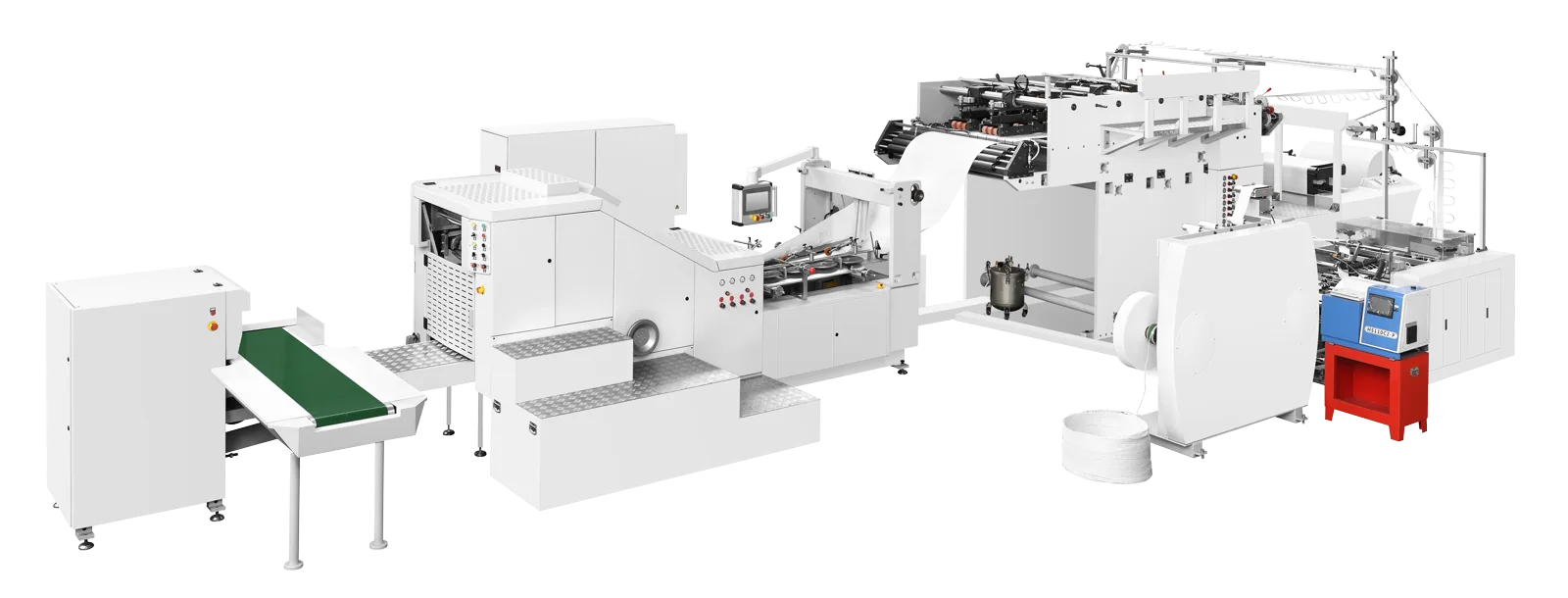
The printing unit sits between handle cut-off and patch attachment, so a plain kraft reel goes in and a printed, handled bag comes out. That removes a separate press pass and the work in progress that goes with it.
The same frame switches between twisted rope at Φ3 to 5 mm and 12 mm flat rope, which matters if your customer base has not settled on one look. It is also the fastest frame in the TF family at 30 to 150 bags per minute, where the wider TF models sustain 30 to 110.
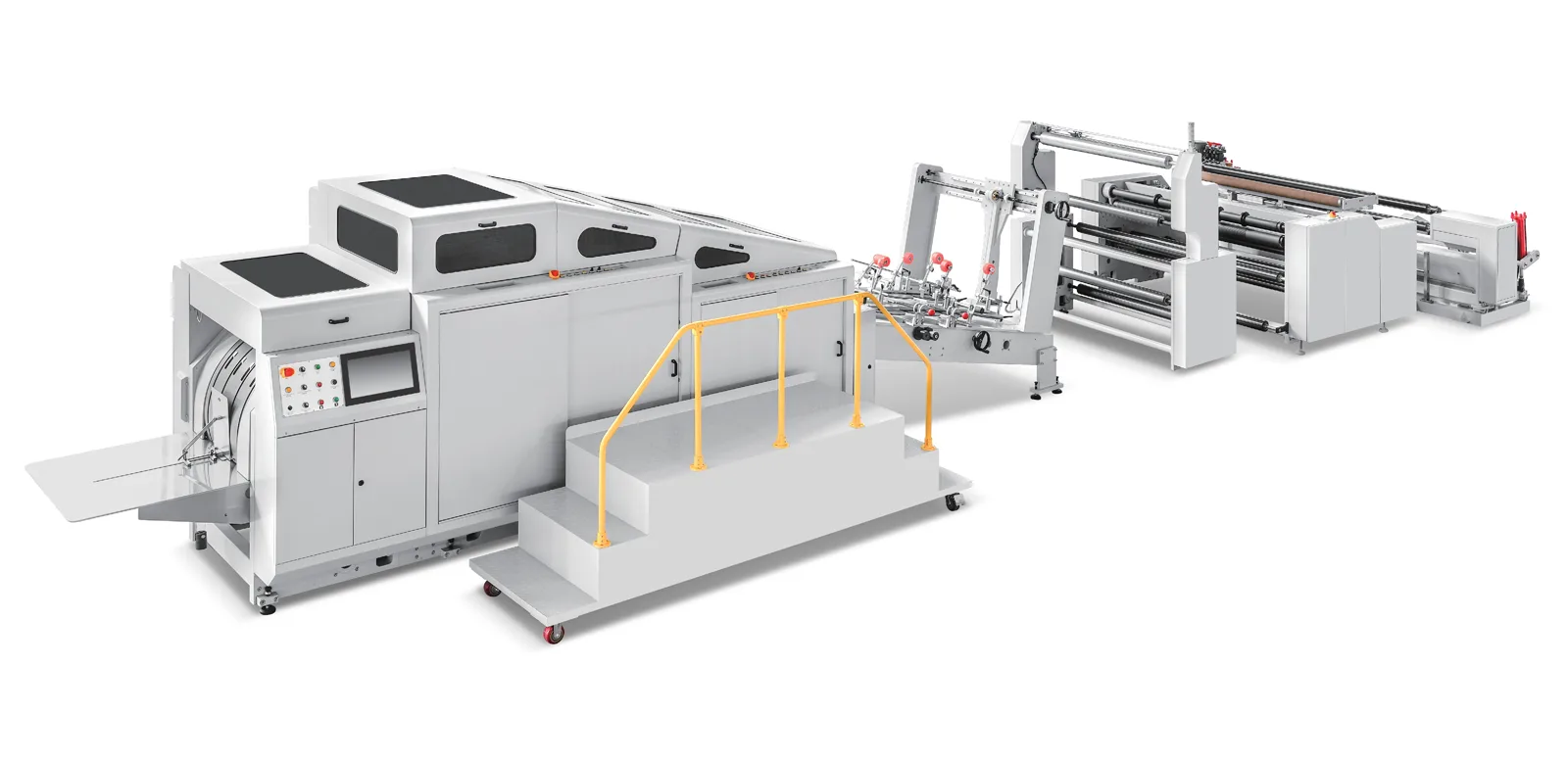
RZJD-G350J — Flat Bottom Food Bags at 580 per Minute
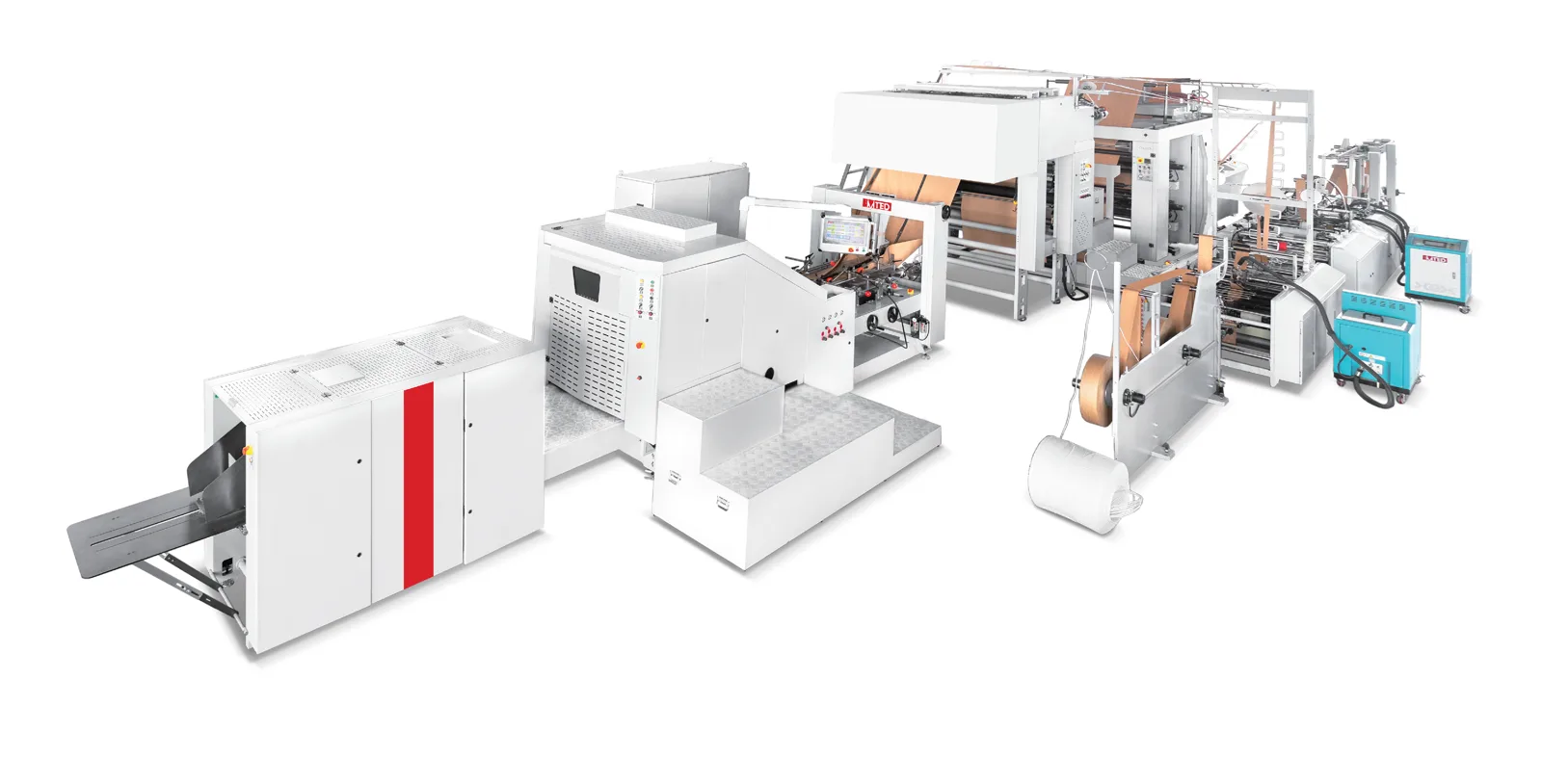
50–580 bags/min or 120 m/min · bag 70–350 mm wide · cut length 175–715 mm · 35–80 g/m² · gusset 20–120 mm · 27 + 5 kW · 6,000 kg · 7,000 × 2,900 × 2,000 mm
Thirty-five gram paper is the specification that opens the food bag market, and it is the one most shopping bag frames cannot hold. This line runs it at 120 metres a minute and takes an inline film station for OPP or PET windows from 50 to 200 mm wide, at 0.022 to 0.035 mm. Bakery, takeaway and produce packers buy on cost per thousand, so the combination of thin stock and high sustained speed is the whole argument.
What the Line Is Built From
Component choice is checkable in a way that adjectives are not, so here is what sits inside a roll fed paper bag making machine on this platform, rather than a claim about quality:
- SCHNEIDER touch screen HMI, French built
- LENZE motion controller, German original, integrated over optical fibre for stable high-speed running
- LENZE servo motors with SICK photoelectric eye correction, tracking printed bag registration
- SELECTRA web guiding from Italy on the unwind, which is what cuts reel alignment time between jobs
- Hydraulic auto-lift reel loading and automatic constant-tension unwind
Upstream and downstream units run on the same platform: RZYS two, four and six colour flexographic presses, RZSW-10M twisted rope handle makers, RZBS-180M flat handle makers, RZZS-10M and 20M paper rope machines, RZFQ slitters and RZFJ rewinders. If you already run a sheet-fed line and are adding roll-fed capacity, the line configuration page sets out how output targets map to equipment. Bags that need cotton or ribbon handles threaded after forming are a separate operation, covered on our rope threading machine page.
Roll Fed Paper Bag Making Machine — FAQ
What purchasing and production teams ask before specifying a roll-fed line.
What is the difference between a roll fed paper bag making machine and a sheet-fed one?
Roll-fed unwinds a paper reel, glues it into a tube and cuts individual bags from the running web. Sheet-fed takes pre-printed board and forms one bag per sheet. Roll-fed wins on volume and on light paper, which is why kraft shopping bags and bakery bags are made that way. Sheet-fed wins on heavy board and short luxury runs. The two are complementary rather than competing, and plenty of converters run both.
How fast is a roll fed paper bag making machine in real production?
Every published figure is bag making speed, the rate the line sustains in production rather than a drive-train number. Twisted rope frames run 30 to 200 bags per minute on the narrow RZFD-190 and 30 to 110 on the 550 mm RZFD-550N. Dual handle TF frames sustain 30 to 150 on the RZFD-330TF and 30 to 100 on the widest. Food bag lines are different equipment and reach 580 bags per minute, or 120 metres per minute, on the RZJD-G350J.
What paper weights and bag sizes does the range cover?
Twisted rope frames run 50 to 150 g/m² and make bags 80 to 550 mm wide, 190 to 760 mm cut length, with bottoms 50 to 280 mm. Dual handle TF frames run 80 to 140 g/m² with a handle fitted. Food bag frames run 35 to 80 g/m² at 70 to 350 mm wide. Reels sit on a 76 mm core at 1200 mm diameter on the lighter frames and 1500 mm on the N frames, while the food bag line takes 200 to 1200 mm reels.
Can the line print the bag as well as form it?
The TF series carries an inline printing unit between handle cut-off and patch attachment, so a plain reel becomes a printed, handled bag in one pass. If you print offline instead, RZYS flexographic presses in two, four and six colour configurations feed the same platform. Inline printing is what separates a 52 to 55 kW TF frame from a 15 to 28 kW T frame of comparable bag width. The three N frames in the T family also take printing as an option.
Which models make twisted rope handles and which make flat handles?
RZFD-T models make twisted rope handles only, at Φ3 to 5 mm rope. RZFD-TF models make both, switching between the same Φ3 to 5 mm twisted rope and a 12 mm wide flat handle on one frame. Note that a TF frame runs a narrower bag with a handle fitted than without, because the handle patch uses up web width. The RZJD-G food bag line has no handle station at all.
What is included and how long is delivery?
Quotations cover the forming line, handle unit where fitted, tooling for your bag formats and commissioning on site with operator training. Send your target bag dimensions, paper weight and monthly volume and we will come back within 24 hours with the model, the configuration and a lead time. We also run your own reel and send back sample bags before you commit.
Get a Roll Fed Paper Bag Making Machine Quote in 24 Hours
Send the bag you want to make, the paper weight and your monthly volume. We will name the model, quote the configuration and run your reel for samples. Budgeting rather than specifying? Start with the 2026 price guide, or compare the whole equipment range on the machine range page.
Request a Quote → WhatsApp