Kraft Paper for Bags: GSM, Grades and What Your Machine Can Run (2026)
Most paper bags are made from kraft between 35 and 300 gsm, and the right weight for a given bag is the easy half of the question. The harder half is that your machine has a feed window, and a reel outside that window will not run at any price. A bag designed at 60 gsm cannot be produced on a line that starts at 80.
This guide covers what kraft paper gsm actually measures, which band suits which bag, the feed window of each machine class in our range, and why two reels with the same number printed on the label can behave completely differently on the same line.
What kraft paper gsm actually measures
GSM is grams per square metre, so it is a measure of mass, not thickness. Two reels at 120 gsm can differ noticeably in caliper depending on how the sheet was formed and calendered. That difference is what your feed section and your folding stations feel.
The formal term is grammage, and it is the one number every mill will quote without being asked. It is also the only number many buyers ask for, which is where specification problems start. Grammage tells you nothing about fibre, treatment or moisture.
Kraft itself refers to the pulping process rather than the colour. Unbleached kraft is the familiar brown. Bleached kraft is white, and the bleaching stage shortens the fibre, so white kraft is generally weaker than brown at the same grammage. If a brand switches a bag from brown to white and keeps the weight, the bag gets weaker.
Kraft paper gsm bands and what each one makes
Five bands cover almost all bag production. The boundaries are soft, and where a bag sits inside a band depends on its size and what it carries.
| Band | Typical bags | Handles | Machine class |
|---|---|---|---|
| 35–60 gsm | Bakery, food service, flat bottom food bags | None | Roll fed food bag line |
| 60–90 gsm | Grocery, takeaway, pharmacy, light carriers | None or light tape | Roll fed, narrow formats |
| 90–140 gsm | Kraft shopping bags, retail carriers | Twisted rope or flat tape | Roll fed with handle unit |
| 150–200 gsm | Small gift bags, mouth patches, entry board | Rope | Sheet fed, lower end |
| 200–300 gsm | Luxury retail, cosmetics, wine, fashion | Flat or twisted rope | Sheet fed luxury |
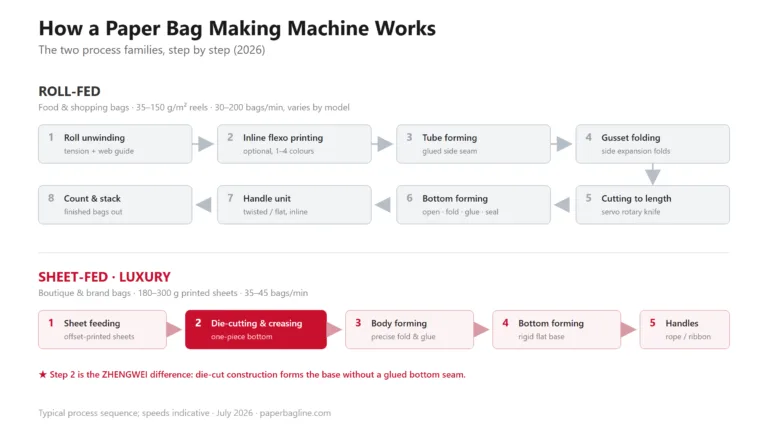
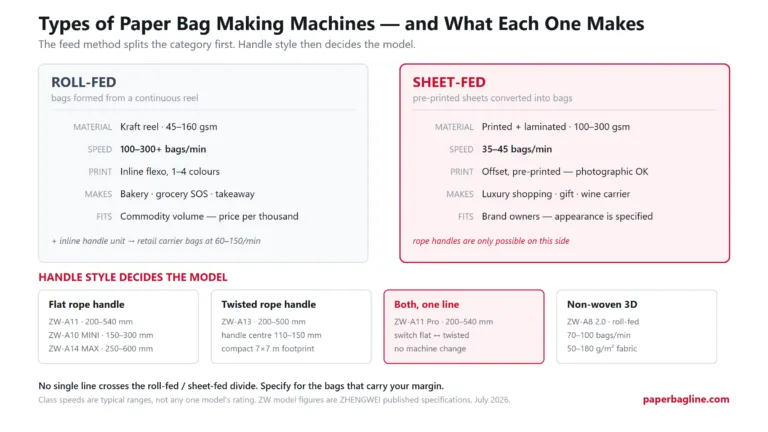
The step that surprises new converters is between 140 and 180. It is not a gradual increase in quality. It is the point where the production route changes from a reel to a printed sheet, and with it the machine, the print method, the speed and the customer. Anyone comparing paper bag gsm across those two routes is comparing two different businesses.
The kraft paper gsm your machine can actually feed
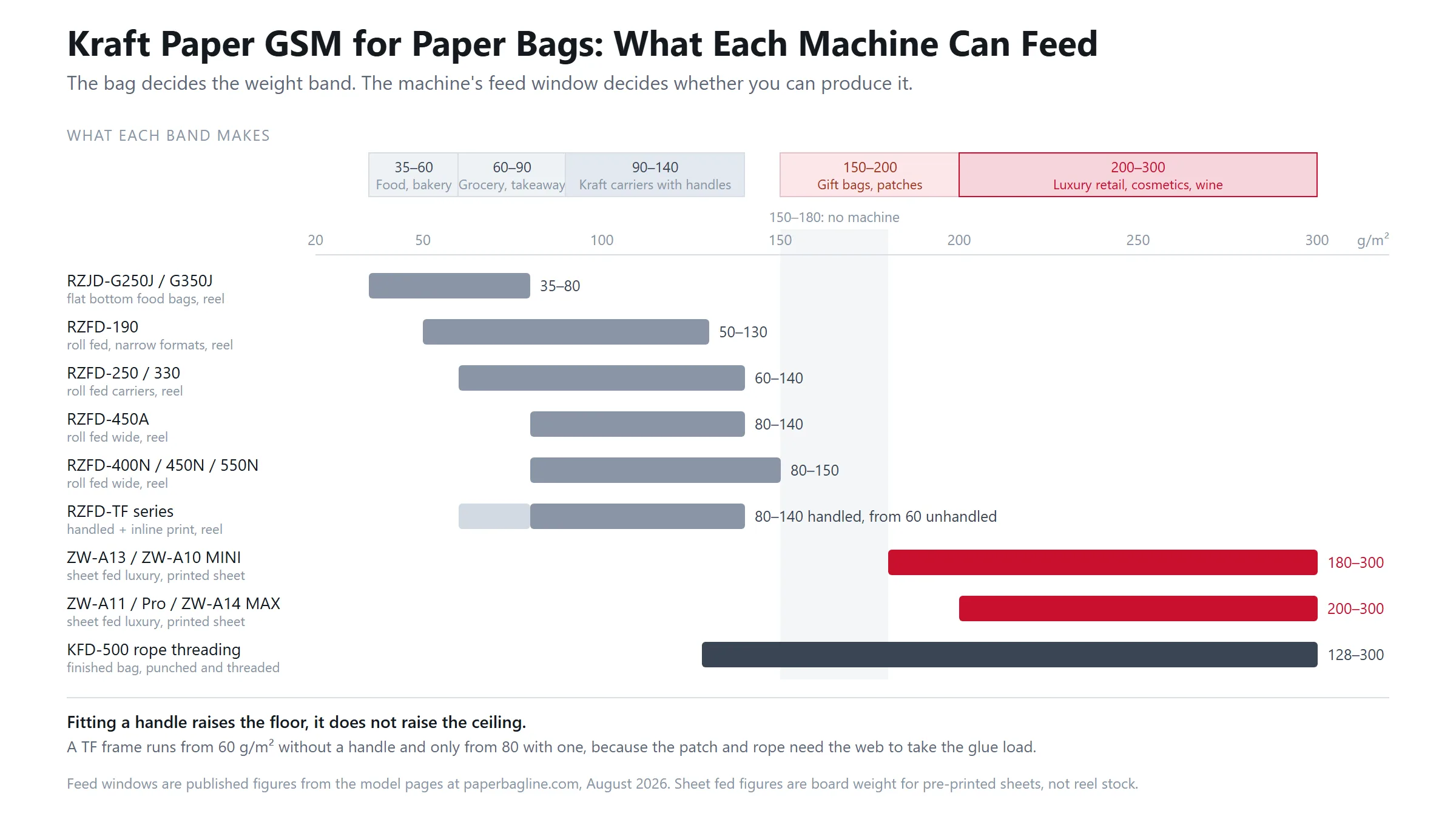
This is the table nobody publishes, and it is the one that decides whether a job is quotable. Every figure below is the published feed window from the model pages, not a class average.
| Machine | Feed window | Feed form | What it means in practice |
|---|---|---|---|
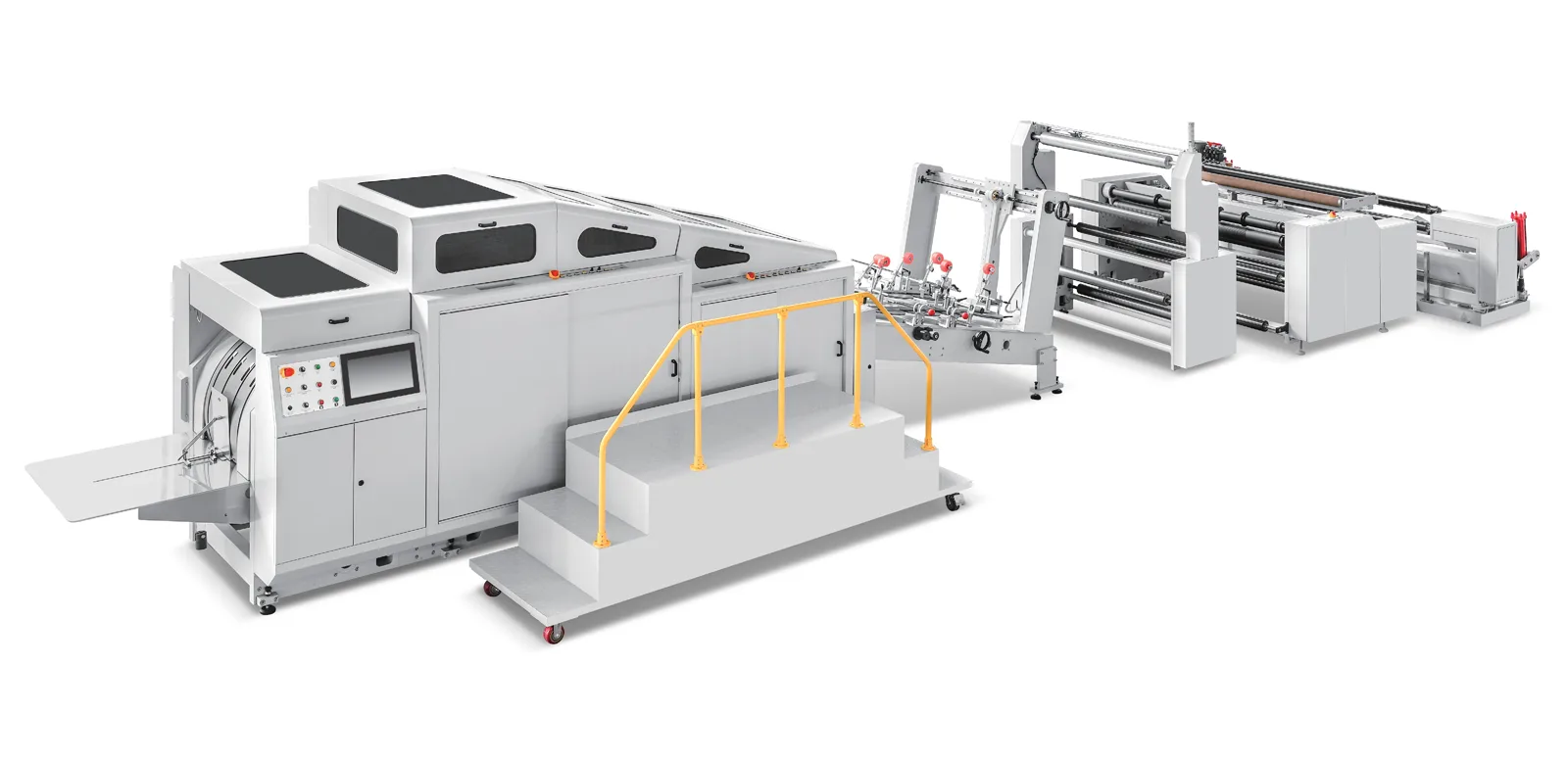
| Flat-bottom food bag lines | 35–80 g/m² | Reel | Food and bakery only. Will not run carrier board |
| Narrow reel carrier frames, 190 mm class | 50–130 g/m² | Reel | The widest low-end window in the range |
| Mid-width reel carrier frames, 250–330 mm | 60–140 g/m² | Reel | General kraft carrier work |
| Wide geared reel frames, 450 mm | 80–140 g/m² | Reel | Wide bags need the extra body |
| Shaftless wide reel frames, 400–550 mm | 80–150 g/m² | Reel | Heaviest reel weight among roll fed frames |
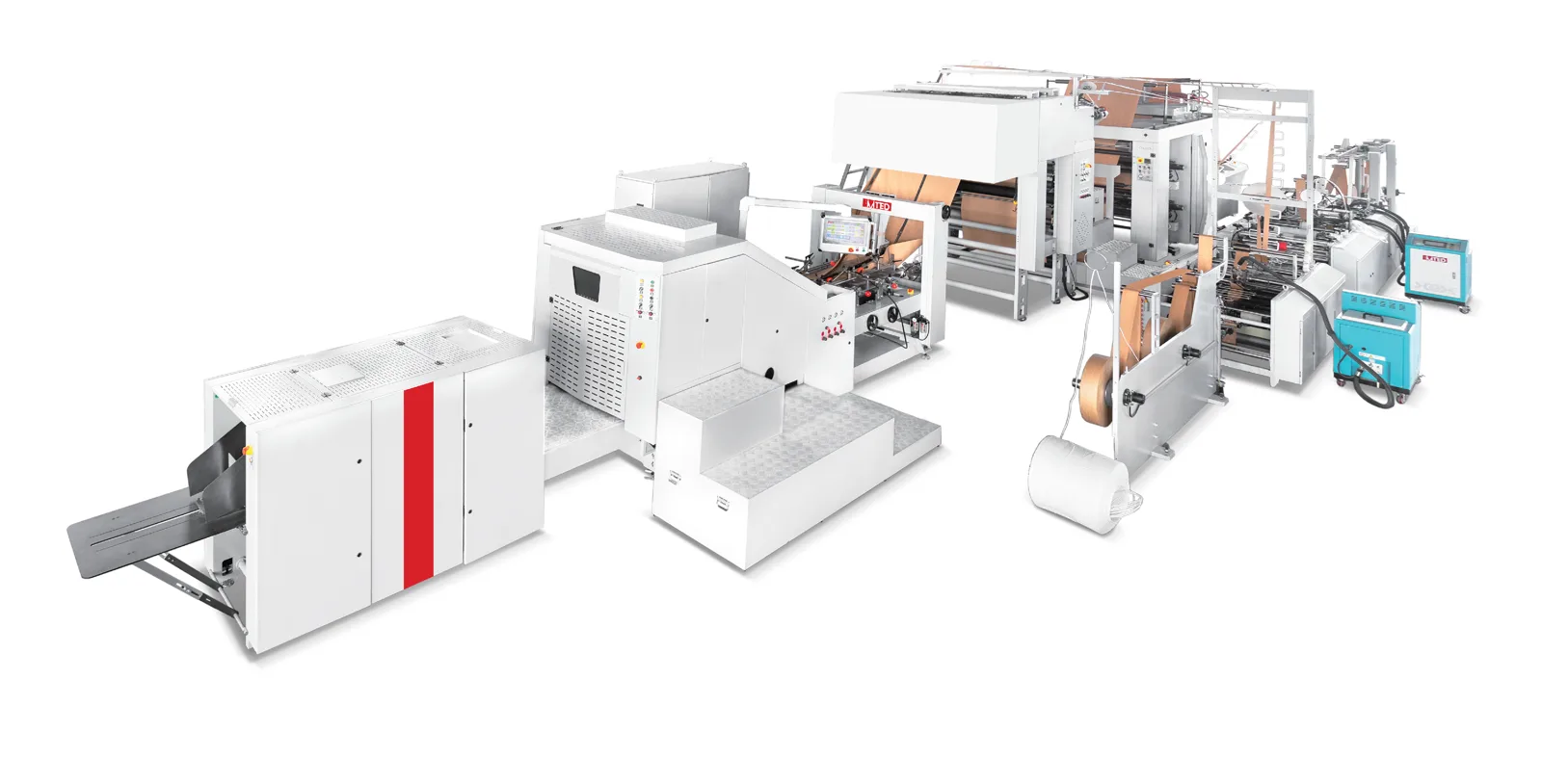
| Reel frames with inline handle unit | 80–140 g/m² handled, from 60 unhandled | Reel | Fitting a handle raises the floor |
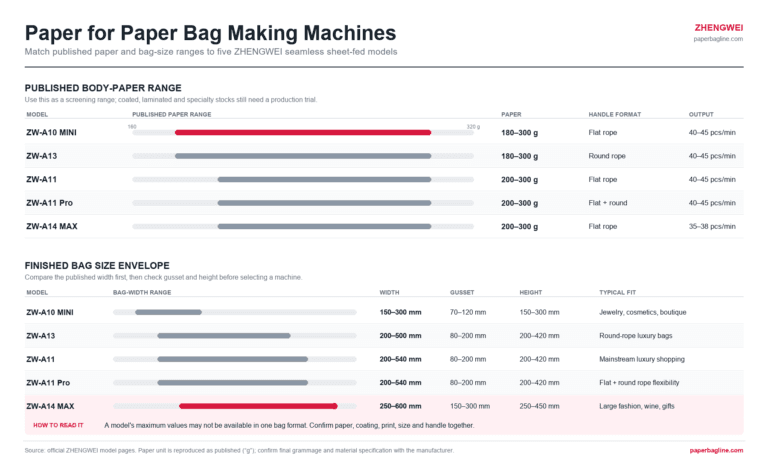
| ZW-A13 / ZW-A10 MINI | 180–300 g | Printed sheet | Entry point for luxury board |
| ZW-A11 / ZW-A11 Pro / ZW-A14 MAX | 200–300 g | Printed sheet | Mouth patch 180–300 g on the same line |
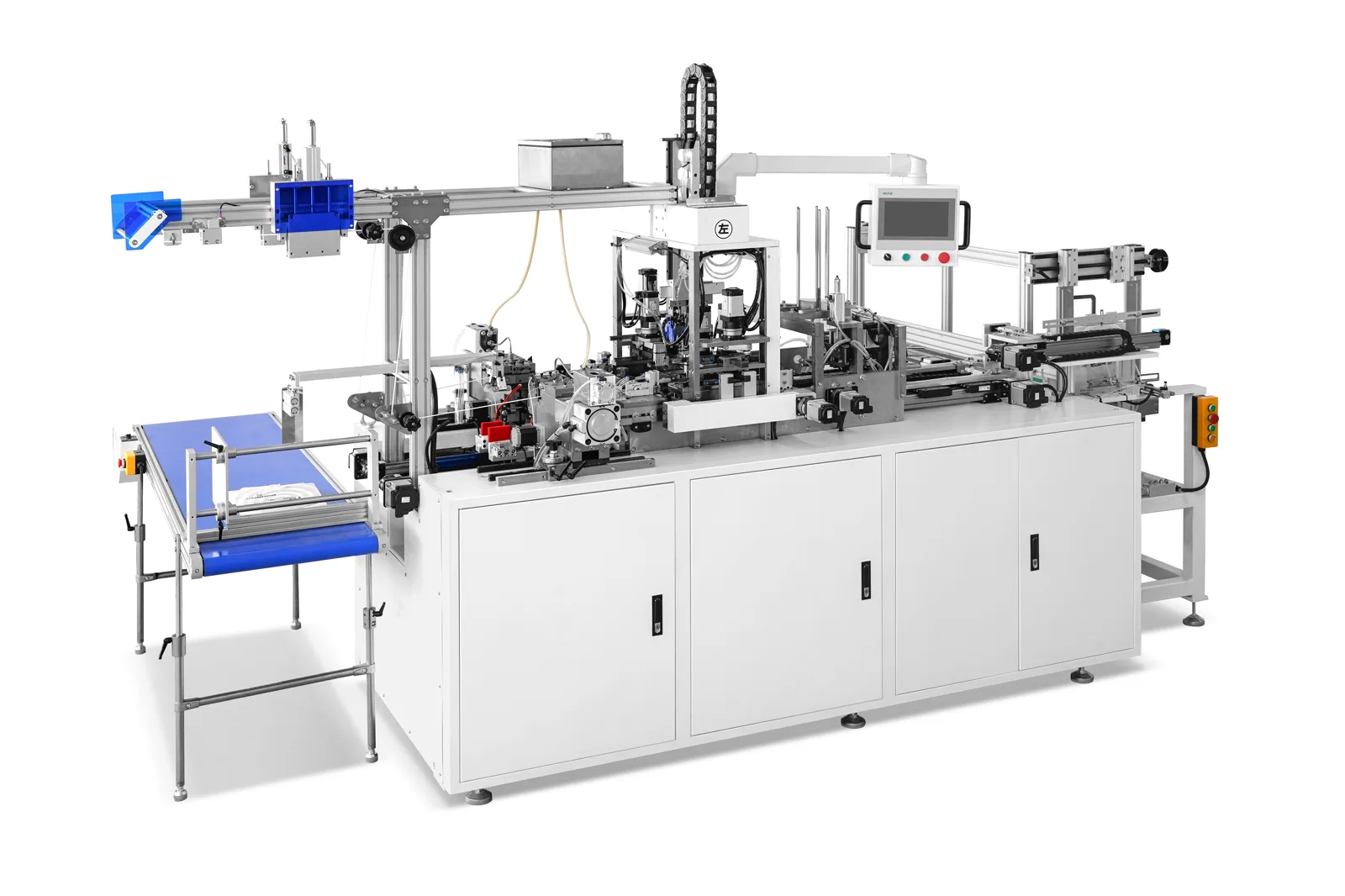
| KFD-500 rope threading | 128–300 g/m² | Finished bag | Threading needs body to punch cleanly |
Read the gap in the middle. Between 150 and 180 g/m² there is no machine in the range, and that is not an oversight. Reel-fed forming loses control of heavy stock, and sheet fed lines need enough stiffness for the sheet to be picked and registered. Bags in that gap exist, but they are awkward to produce on either route.
Tip: Before you quote a new bag, check its weight against the feed window of the specific model on your floor, not the class. A 190 mm carrier frame can run down to 50 g/m² while a 450 mm frame starts at 80, and both are described as roll fed kraft machines. That 30 gram difference is the whole food bag market.
Why two reels at the same kraft paper gsm run differently
Kraft paper gsm is one line on the specification. Four other properties decide how the reel behaves on the machine, and none of them appear in the number your customer quotes at you.
- Virgin or recycled fibre. Recycled kraft carries shorter, more variable fibre. At the same weight it tears more readily at the crease and gives less consistent glue absorption.
- Brown or bleached. White kraft is weaker than brown at equal grammage. Specify a step up in weight when a brand insists on white.
- Burst factor. Mills in Asia commonly quote a burst factor alongside the weight. It measures resistance to bursting rather than mass, and two reels at 100 gsm with different burst factors are not the same paper.
- Moisture and curl. Paper that has sat in a humid warehouse feeds differently, glues differently and creases differently. This is the most common cause of a line that ran fine last month and will not hold registration this week.
Grain direction belongs on the same list. A sheet creased across the grain folds cleanly, and one creased along it cracks at the fold, which shows up as a hairline split on the bag gusset. On heavier luxury board the crack is visible on the finished bag, so grain has to be specified with the sheet, not corrected on the machine.
Tip: When you approve a new paper supplier, run the first reel at your lowest and highest bag width in the same shift rather than on one format. Feed problems from moisture and curl show up at the extremes of the format range first, and a mid-format trial will pass a reel that fails in production two weeks later.
Handles change the paper calculation
A handle raises the floor on the paper, not just the ceiling. On the roll fed TF frames the published window is 80 to 140 g/m² with a handle fitted, but the same 330TF runs from 60 g/m² unhandled. The patch and rope need the web to take the glue load without distorting.
The same logic runs through the sheet fed models. The bag body is 200 to 300 g, and the mouth patch under the handle is separately specified at 180 to 300 g. It is the patch, not the rope, that usually decides how much a bag will carry, which we cover in more depth in twisted handle versus flat handle.
Threading rope into a finished bag has its own floor. The rope threading machines take bags in 128 to 300 g/m² paper, because the punch needs enough body to make a clean hole that will not tear when the rope is knotted.
Print and lamination move the effective weight
Print method follows the paper more than most buyers expect. Reel work is printed inline by flexo in one to four colours, and roll fed machines carry that unit on the printing-capable frames. Sheet work arrives already printed offset, often laminated, which is why the luxury route starts from a printed sheet rather than a reel.
Lamination changes what the board does on the machine. A matt or gloss film adds stiffness and changes how the crease recovers, so a laminated 250 g sheet does not behave like an unlaminated one at the same weight. It also seals the surface, which alters how the handle patch adhesive keys to it.
One consequence worth planning for. If your customer base is moving upmarket, the paper decision arrives before the machine decision, because 300 g laminated board is a different production route rather than a heavier setting. Our types of paper bag making machines guide sets out where that line falls.
How to specify kraft paper to a supplier
A purchase order that states only a kraft paper gsm figure will get you paper that meets it and nothing else. Six lines make a specification your machine can rely on.
- Grammage and tolerance. The weight, plus the percentage variation you will accept.
- Fibre. Virgin, recycled, or a stated blend. Ask for the same source reel to reel.
- Colour and finish. Unbleached, bleached, or clay coated on one side.
- Strength. Burst factor or tensile, whichever your market quotes.
- Reel geometry. Width, diameter and core, matched to your unwind. Reel carrier frames take reels from roughly 620 to 1690 mm wide depending on model.
- Moisture. Stated on the mill certificate, with storage conditions agreed.
Tip: Put the reel diameter limit in the purchase order, not just the width. Frames with an inline handle unit accept Ø1200 on geared models and Ø1500 on shaftless models, and a mill that ships a larger reel because it is cheaper per tonne has just sent you paper you cannot mount.
Choosing the best gsm for paper bags you sell
The best gsm for paper bags is the lightest weight that survives the journey your customer’s product actually takes. Overspecifying is the more common error, and it is expensive at scale because paper is the largest variable cost in a bag.
Three checks settle most cases. What does the bag carry, and how far. What does the brand expect the bag to feel like when it is picked up. And what does the machine on your floor accept, which is the check that stops a quote before it starts. Buyers who specify kraft paper for paper bags without running the third check are the ones who come back asking whether the line can be adjusted, and usually it cannot.
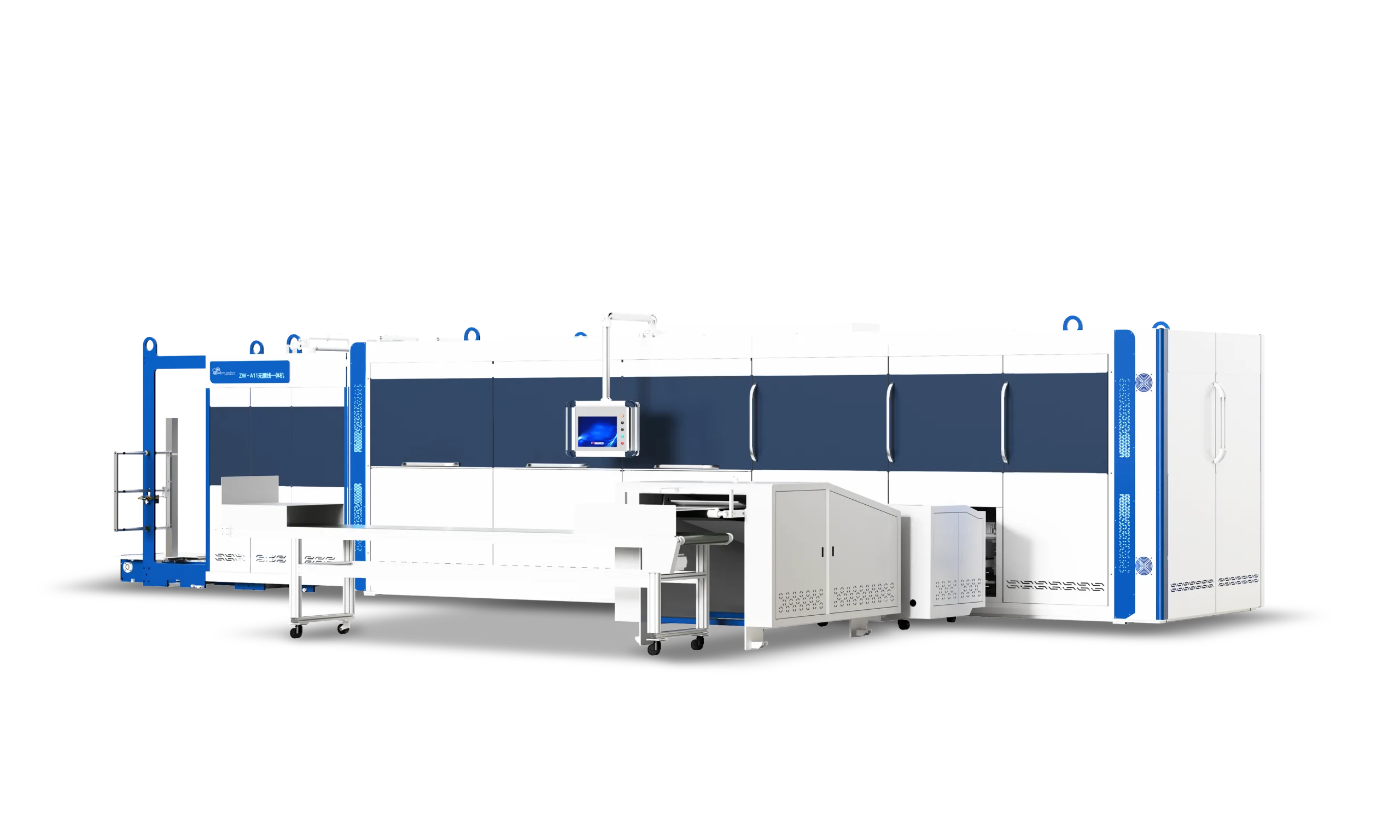
On the luxury side there is a fourth factor specific to our sheet fed range. All five models use ZHENGWEI’s patented seamless construction, which forms the side wall from a single fold rather than gluing an overlap. Removing the overlap removes a layer, so a seamless bag reaches a given strength with less board than a conventional one. You can see the construction on finished work in our bag samples.

For the wider selection framework see how to choose a paper bag making machine, and for what each machine class costs, our price guide gives the public bands. The paper bag manufacturing machine page covers how the lines are configured.
Frequently asked questions
What is the best GSM for paper bags?
There is no single figure, because the band follows the bag. Food and bakery bags run 35 to 60 gsm, grocery and takeaway 60 to 90, kraft shopping bags with handles 90 to 140, and luxury retail bags 200 to 300 gsm. The best gsm for paper bags is the lightest weight that survives the load and journey the bag actually sees, since paper is the largest variable cost in production.
What kraft paper gsm can a paper bag machine run?
Every machine has a published feed window, and it is narrower than most buyers expect. Flat bottom food lines take 35 to 80 g/m². Roll fed carrier lines run between 50 and 150 g/m² depending on model, and fitting a handle unit raises the floor to around 80. Sheet fed luxury machines take printed sheets at 180 to 300 g. A reel outside the window will not run regardless of bag design.
Is 150 gsm or 250 gsm better for a paper bag?
They are not competing options, because they belong to different production routes. At 150 gsm the bag is made from a reel on a roll fed line, printed inline by flexo. At 250 gsm it is made from a pre-printed sheet on a sheet fed line at roughly a fifth of the speed. Choose 250 gsm when the customer is a brand specifying appearance, and 150 gsm when the customer is buying on price per thousand.
What is the difference between virgin and recycled kraft paper?
Virgin kraft has longer, more consistent fibre, so it holds strength at lower weight and creases more predictably. Recycled kraft carries shorter and more variable fibre, tears more readily at the crease and absorbs glue less evenly, which shows up as inconsistent bottom seams. Recycled stock is cheaper and meets sustainability requirements, so many converters run it and compensate by stepping up the grammage.
Does a higher kraft paper gsm always mean a stronger bag?
No. Weight and strength are related but not the same measurement, which is why mills quote burst factor alongside grammage. A 100 gsm sheet with a high burst factor outperforms a heavier sheet with a low one. Construction matters as much: bleached kraft is weaker than brown at equal weight, and on a finished bag the handle patch bond usually fails before the paper does.
What gsm is used for kraft paper shopping bags with handles?
Kraft shopping bags with twisted or flat handles are normally produced from 90 to 140 g/m² on roll fed lines. The handle raises the practical floor: reel frames with an inline handle unit run 80 to 140 g/m² with a handle fitted but accept from 60 g/m² unhandled, because the patch and rope need the web to take the glue load without distorting. Luxury handled bags are a different route entirely at 200 to 300 g.
Not sure your paper and your machine match?
Send us the bag specification you have been asked to quote, including paper weight, grade, bag size and monthly volume, and we will tell you which machine class can feed it, including when the answer is a line we do not build. Configured quotes within 24 hours, and free physical samples produced on the model we recommend.
Related reading: Types of Paper Bag Making Machines · How Does a Paper Bag Making Machine Work? · Our Machines