
Paper Bag Manufacturing Machine: How to Configure a Production Line by Output
A paper bag manufacturing machine is the forming unit at the center of a paper bag production line. Everything else on the floor either feeds it or packs what comes off it. This page maps daily output targets to line configurations, with the floor space, installed power and operator count for each.
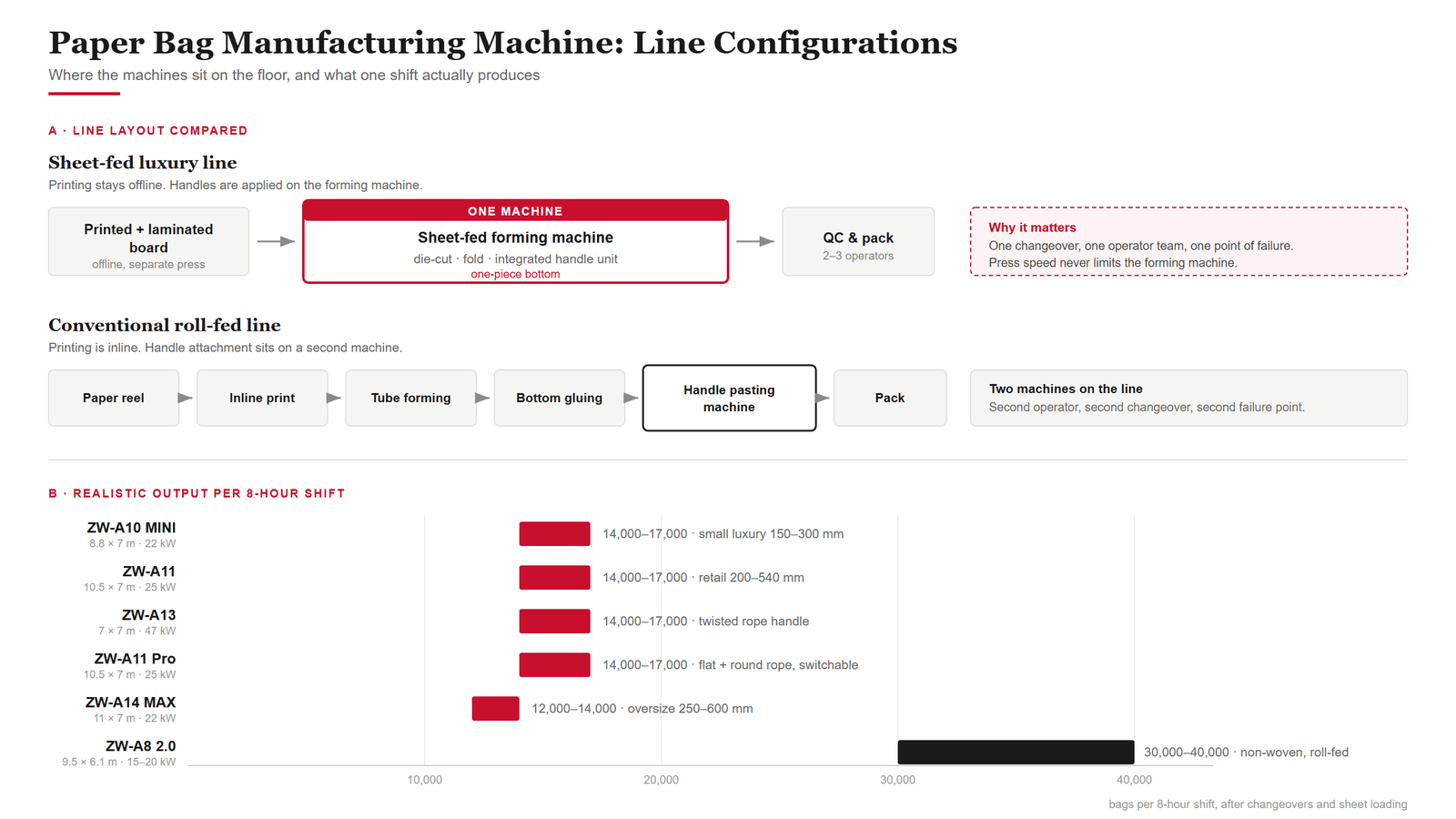
Sheet-fed and roll-fed line layouts compared, with output bands per configuration.
What Is a Paper Bag Manufacturing Machine?
A paper bag manufacturing machine is industrial equipment that converts paper into finished bags through four stages: feeding, forming, bottom construction and handle attachment. Sheet-fed models die-cut and fold a single board sheet, so the finished bag carries no glued bottom seam. Roll-fed models unwind a paper reel, form a tube, glue the overlap and cut individual bags from it.
Suppliers list the same class of equipment as paper bag manufacturing machinery, and some catalogs use the term paper bagging machine. All three describe a machine that makes bags. A paper bag packing machine is a different product entirely: it fills bags that have already been made, and it belongs on a filling line rather than a converting line.
The distinction that matters commercially is feed type. Sheet-fed machines take pre-printed, pre-laminated board and are used for retail and luxury bags. Roll-fed machines take a paper reel and print inline, which suits grocery, bakery and food service volumes.
One Machine or a Full Line?
For sheet-fed luxury bags, one machine is usually the entire converting line. For roll-fed kraft bags, it rarely is. The difference comes down to where printing happens and whether handle attachment is integrated or sits on a second machine.
Where printing happens
Sheet-fed board arrives printed and laminated from a separate press. That work stays offline, so it never limits the forming machine’s speed. Roll-fed lines print inline, which ties press and former together.
Where handles go on
Conventional layouts run a separate handle pasting machine after the former. That adds a second operator, a second changeover and a second point of failure. ZHENGWEI applies handles on the forming machine itself — the same trade-off that decides whether you need a fully automatic paper bag making machine.
How many formats you run
Single-format producers can run one dedicated machine. Converters serving mixed brand specifications need either two machines or one machine with a fast handle changeover.
This is why bag-count comparisons between suppliers are often misleading. A quoted speed describes the forming station, not the production line around it.
Line Configurations by Output Target
At 40–45 bags per minute, one sheet-fed machine produces roughly 19,000–21,000 bags per 8-hour shift at full running speed. Plan on 14,000–17,000 once sheet loading, format changeovers and quality checks are counted. The table below maps realistic shift output to the configuration that delivers it.
| Realistic output per 8 h shift | Bag format | Line configuration | Model |
|---|---|---|---|
| 14,000–17,000 | Small luxury, 150–300 mm | One sheet-fed former, offline printing, integrated flat rope handle | ZW-A10 MINI |
| 14,000–17,000 | Retail shopping, 200–540 mm | One sheet-fed former, offline printing, integrated flat rope handle | ZW-A11 |
| 14,000–17,000 | Rope handle, 200–500 mm | One sheet-fed former with twisted rope handle unit | ZW-A13 |
| 14,000–17,000 | Mixed flat and rope, 200–540 mm | One former, both handle modes, 30–60 min changeover | ZW-A11 Pro |
| 12,000–14,000 | Oversize, 250–600 mm | One wide-format sheet-fed former | ZW-A14 MAX |
| 30,000–40,000 | Non-woven 3D square bottom | Roll-fed servo line, 28 servo axes, automated mold change | ZW-A8 2.0 |
Output figures assume single-shift operation and exclude offline printing and lamination. Speeds are rated figures from each model’s specification page.
Size the line by your slowest format, not your fastest. A 600 mm wine bottle carrier runs at the bottom of the ZW-A14 MAX range of 35–38 bags/min, while a 250 mm bag on the same machine runs at the top. If oversize formats make up more than a third of your order book, plan capacity on the lower figure.
Floor Space, Power and Staffing
A single paper bag production line occupies between 49 and 77 m² of machine envelope and draws 22 to 47 kW. Every sheet-fed model stands 2.6 m tall, so standard industrial ceiling heights are sufficient. Staffing runs 2 to 3 operators per shift across the range.
| Model | Machine envelope (L × W × H) | Average power | Layout note |
|---|---|---|---|
| ZW-A13 | 7 × 7 × 2.6 m | 47 kW (35 + 12) | Smallest envelope in the range, highest power draw |
| ZW-A10 MINI | 8.8 × 7 × 2.6 m | 22 kW | Lowest draw of the sheet-fed models |
| ZW-A8 2.0 | 9.5 × 6.1 × 2.5 m | 15–20 kW | U-shape puts loading and finished-bag output on the same operator side |
| ZW-A11 | 10.5 × 7 × 2.6 m | 25 kW | Standard sheet-fed footprint |
| ZW-A11 Pro | 10.5 × 7 × 2.6 m | 25 kW | Same envelope as ZW-A11, two handle modes |
| ZW-A14 MAX | 11 × 7 × 2.6 m | 22 kW | Longest envelope, reinforced frame for 300 g/m² board |
These are machine envelopes, not bay sizes. Plan additional area on the operator side for board stacks, finished-bag cartons and access for maintenance. The ZW-A8 layout is the exception worth noting: because loading and output sit on one side, it needs less surrounding clearance than a linear box-bag line of comparable output.
Power figures are average draw, not peak. The ZW-A13 total of 47 kW is split across two supplies, 35 kW and 12 kW, which affects how the line is wired rather than what it costs to run.
New, Used or Low-Cost Lines: What Actually Changes
The difference between a new line and a used or low-cost one shows up in changeover time, tooling availability and handle quality. It usually does not show up in rated speed, which is why plate figures alone are a poor basis for comparison.
Listings for a paper bag machine for sale fall into three groups. Ex-production European machines appear on used-equipment marketplaces under brands such as Lemo, Holweg and W&H. Entry-level new machines sit at the low end of the market. Current-generation lines make up the third group.
Used lines
A used machine can be sound value when the format matches what the previous owner ran. Die-sets and molds are format-specific, so a machine without tooling for your bag width becomes a rebuild project.
Low-cost new machines
Entry-level machines commonly leave handle attachment to a separate pasting machine. The saving on the former reappears as a second machine, a second operator and a second changeover on every format switch.
What we do not offer
We do not sell used equipment, and we do not compete at the entry price point. Our range is built for luxury sheet-fed production, where finish quality decides whether the bag is accepted.
Before buying any used line, ask the seller for the die-set and mold list, not just the machine specification. Tooling is quoted per bag format, and a former without tooling for your widths will not run your order book on day one.
Budget ranges by machine class are covered separately in our 2026 paper bag machine price guide. If you are costing a plant rather than a machine, the manufacturing business guide works through site, power and staffing budgets in order.
Where Sheet-Fed Luxury Lines Differ
Sheet-fed luxury lines print and laminate before the bag machine, while roll-fed kraft lines print inline. That single difference reshapes the whole layout: the forming machine becomes a standalone station rather than the middle of a coupled line.
ZHENGWEI machines die-cut and fold each board sheet instead of rolling and gluing a tube. The finished bag has no bottom seam, which removes the usual failure point under load and eliminates the glue application and drying phases. Rated speed on the range is 40–45 bags/min against 25–30 bags/min on traditional glued-seam machines.
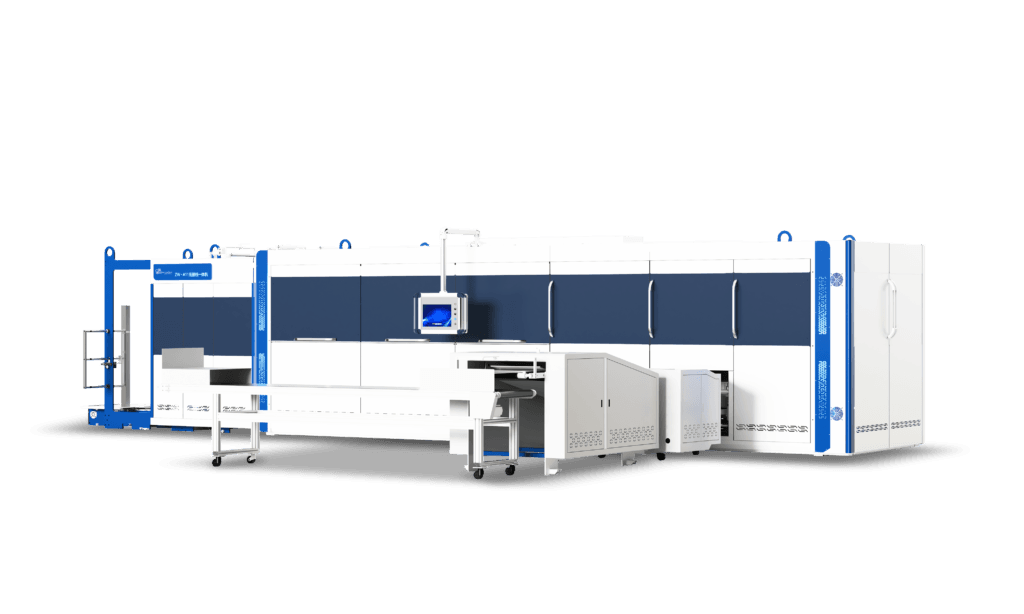
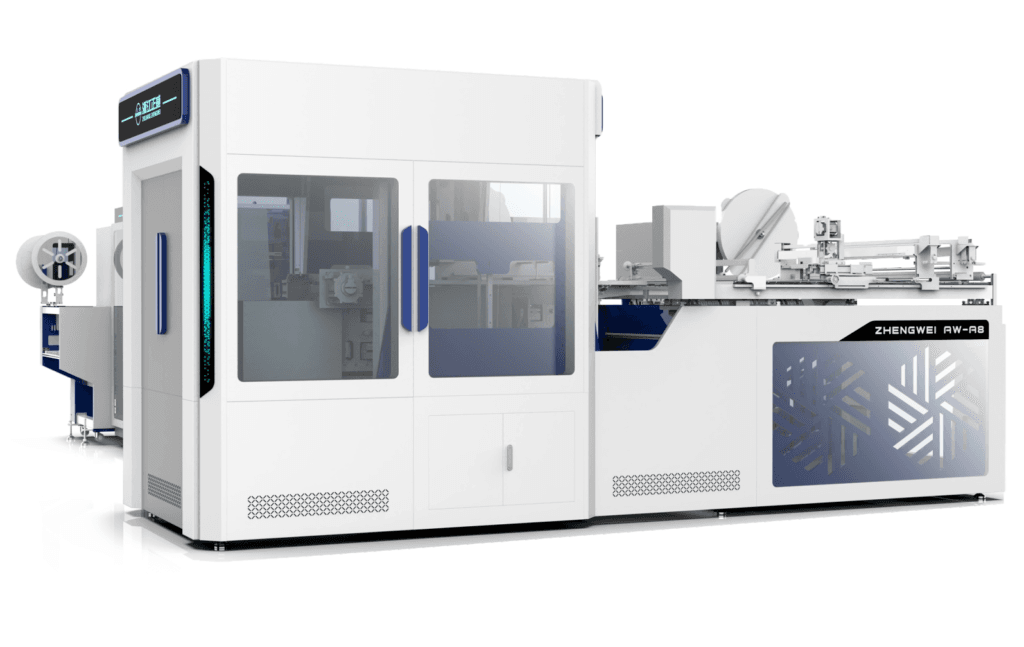
On bag shapes: buyers searching for a v bottom paper bag making machine are describing a square-bottom bag. All five sheet-fed models produce square-bottom bags. The ZW-A8 produces 3D square-bottom bags from roll stock in non-woven, PP film and laminated woven fabric at 50–180 g/m². Gift bag production uses the same forming process as retail bags; format and board weight change, the machine does not.
What this range covers: the models on this page are five sheet-fed luxury bag machines plus the ZW-A8 non-woven machine. SOS grocery and bakery bags formed from a kraft paper reel are a different machine class and are not produced on these sheet-fed frames. The full breakdown of machine categories sits in our guide to types of paper bag making machines, and handle constructions are covered on the paper handbag making machine page.
Sourcing a Paper Bag Manufacturing Machine in China
Sourcing this equipment from China is a commercial decision as much as a technical one. ZHENGWEI has built paper bag machinery since 2006 and holds more than 50 invention patents, including the first patent for a fully automatic paper bag machine without a bottom seam, filed in 2019.
Every machine is CE certified. Standard production time is 45–60 business days from order confirmation, and sea shipment to Europe adds 30–35 days. Installation, operator training and technical support are included, with a 24-hour response commitment.
We do not publish machine prices, because the quotation depends on handle type, format range and tooling. What we do commit to is a detailed quotation within 24 hours and a free bag sample produced on the machine you are considering. Full specifications for the five sheet-fed models and the ZW-A8 are on the machine range page, and the die-cut process is explained on our technology page.
Buyer Questions About Paper Bag Machine Lines
The questions buyers search for most often around this equipment.
Where can I buy a paper bag manufacturing machine for sale?
New machines are bought directly from manufacturers, which is the route that includes tooling, installation and training. Used machines are listed on equipment marketplaces such as Machineseeker, usually as ex-production European lines. Buying direct matters most when your bag formats are outside the seller’s original tooling set.
Should I buy a used paper bag manufacturing machine?
A used machine works well when its existing tooling matches your bag widths and handle type. Die-sets and molds are format-specific and quoted per format, so a mismatch turns the purchase into a rebuild. Ask for the full die-set list before the machine specification.
What does a low cost paper bag making machine leave out?
Most commonly, integrated handle attachment. Entry-level machines form the bag and pass it to a separate handle pasting machine, which adds an operator, a changeover and a second maintenance point. Automated format changeover is the other feature usually absent at the low end.
Can a small paper bag making machine handle gift bags?
Yes. Gift bags use the same forming process as retail shopping bags, with different board weight and format. The ZW-A10 MINI covers 150–300 mm widths at 40–45 bags/min in an 8.8 × 7 m envelope, which suits jewelry, cosmetics and boutique gift formats.
What is a V bottom paper bag making machine?
V bottom is a common way of describing a square-bottom or block-bottom bag, where the base folds flat and opens into a rectangle. All five ZHENGWEI sheet-fed models produce square-bottom paper bags. The ZW-A8 produces 3D square-bottom bags from non-woven and laminated roll stock.
Is a paper bag packing machine the same as a bag making machine?
No. A bag making machine converts paper into empty bags. A packing or bagging machine fills bags that already exist and belongs on a filling line. The terms paper bag machinery and paper bagging machine are generally used for bag making equipment, but packing machine is not.
Why buy a paper bag manufacturing machine in China?
Lead time and total delivered cost are the practical reasons. Standard production is 45–60 business days with 30–35 days sea freight to Europe, against longer lead times for most European-built lines. Verify CE certification and ask for a bag sample produced on the actual model before ordering.
Get a Line Configuration and Quote in 24 Hours
Tell us your target output, bag formats and handle type. We will recommend the configuration, send a detailed quotation and produce a free bag sample on the model we propose.
Request a Quote → WhatsApp