How to Start a Paper Bag Manufacturing Business (2026 Guide)
Starting a paper bag manufacturing business is one of the more forgiving ways into packaging manufacturing: the process is mature, the machinery is well understood, and demand keeps climbing as retailers replace plastic. What trips up most new entrants is not the machine — it is doing the nine steps in the wrong order, usually by buying equipment before deciding which bags they are going to sell.
This guide walks the sequence that works, with the real numbers behind each decision: how to pick a segment, which machine route fits it, what a plant actually costs to set up, what floor space and power you need, and the mistakes that quietly destroy first-year margins. If your question is specifically whether the numbers work, read our companion piece on whether paper bag manufacturing is profitable first — this article assumes you have decided it is, and covers what to do next.
Step 1: Decide which bags you will sell — before anything else
Every downstream decision follows from this one, and it is the step most first-time founders skip. “Paper bags” is not a market; it is four markets with different customers, margins and machines.
| Segment | Typical products | Who buys | Competitive reality |
|---|---|---|---|
| Food service | Bakery bags, grocery SOS, takeaway bags | Bakeries, QSR chains, supermarkets | High volume, thin margins, price-led tenders |
| Retail carrier | Twisted- and flat-handle shopping bags | High-street retail, pharmacy, general trade | Mid volume, handle capability is the moat |
| Luxury / branded | Rope-handle laminated bags, rigid gift bags | Fashion, cosmetics, fragrance, jewellery | Lower volume, highest margin, quality-led |
| Industrial / specialty | Multiwall, valve, seed and hardware bags | Agriculture, construction, chemicals | Niche, long qualification cycles |
The trap is starting in food service because it looks like the biggest market. It is — and it is also where you compete against established converters on price alone, with no product differentiation available. Founders who survive their first two years usually pick a narrower segment where something other than price decides the order.
Step 2: Validate demand before you buy a machine
Talk to twenty potential buyers before you spend anything. Not to sell — to learn their current bag spec, their monthly volume, their current supplier’s lead time, and what annoys them about it. Three things you are listening for:
- Spec details. Bag dimensions, paper weight, handle type, print colours. These convert directly into machine requirements, and getting them from real buyers beats guessing from a catalogue.
- Reorder rhythm. A customer ordering monthly is worth several ordering once. Packaging is a repeat business or it is nothing.
- What they cannot get. Short lead times, small MOQs, a handle style nobody local offers, consistent print registration. This is where a new paper bag manufacturing business actually gets in — not on price.
If you cannot find twenty buyers willing to have this conversation, that is data. It is much cheaper to learn it now than after a machine is on your floor.
Step 3: Match the machine route to the segment
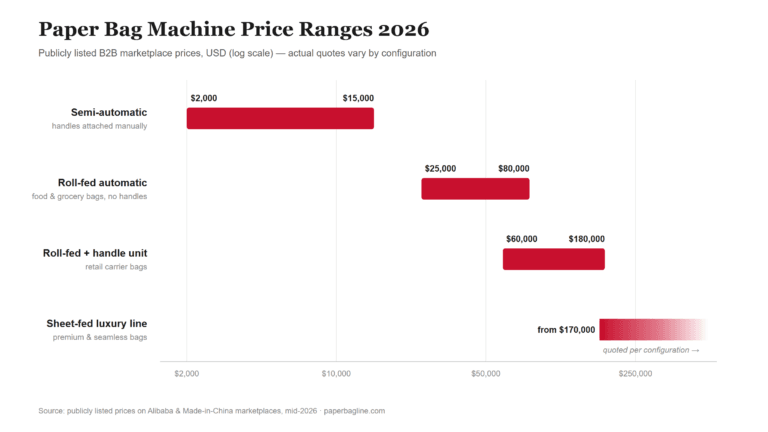
A paper bag manufacturing business has four machine routes open to it, and the segment you chose in Step 1 has already narrowed you to one or two. This is where the capital decision gets made, so it is worth understanding what each route can and cannot produce. Once you have picked a route, our paper bag manufacturing machine guide maps each output target to a specific line configuration.
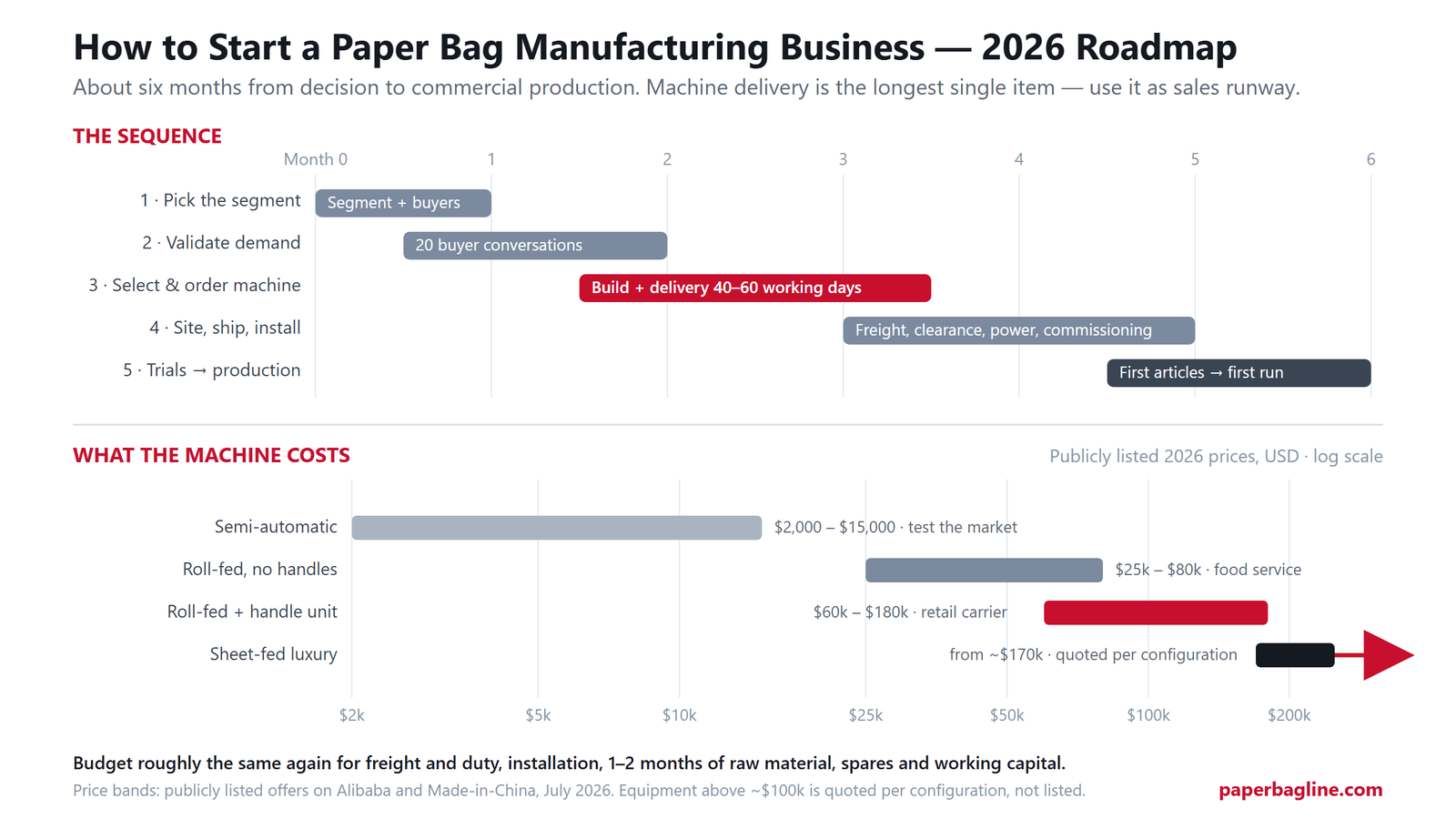
| Route | Public price band (USD) | Output | Fits which segment |
|---|---|---|---|
| Semi-automatic | $2,000 – $15,000 | Flat, satchel, simple SOS; handles attached by hand | Testing the market, very low volumes |
| Fully automatic roll-fed, no handles | $25,000 – $80,000 | Kraft food bags, grocery SOS, bakery bags at 100–300+ bags/min | Food service |
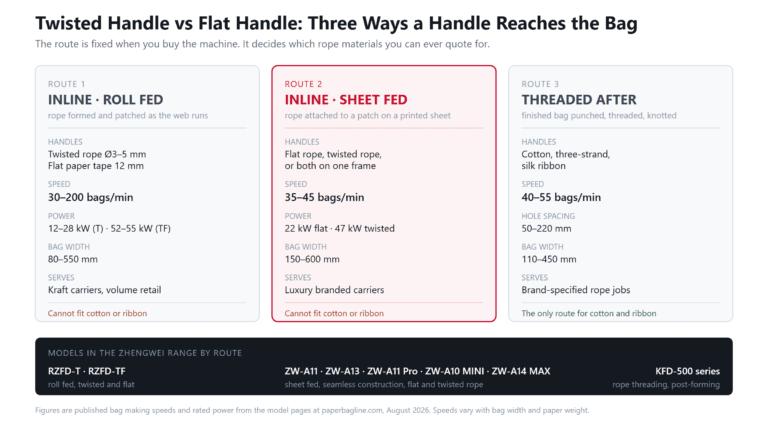
| Roll-fed with inline handle unit | $60,000 – $180,000 | Twisted- and flat-handle retail carrier bags | Retail carrier |
| Sheet-fed luxury lines | from ~$170,000, quoted per configuration | Pre-printed laminated sheets, rope handles, rigid construction | Luxury / branded |
Bands are 2026 publicly listed prices on Alibaba and Made-in-China; serious production equipment above roughly $100,000 is quoted per configuration rather than listed. Our paper bag machine price guide breaks down what moves a quote within each band, and choosing an automatic paper bag making machine works through the labour maths — roughly $27 per thousand bags in manual handle attachment against $1.70 on an automatic line, which is why semi-automatic stops making sense fast once volume arrives.
The most expensive mistake in this step is buying a machine that produces the bag you can make rather than the bag your buyers asked for in Step 2. A twisted-handle unit bolted on later costs $30,000–$100,000 depending on handle type and speed — frequently more than the difference would have been at purchase.
Step 4: Work out the real paper bag manufacturing plant cost
The machine is the headline number, not the total. Budget these buckets before you commit:
- Machine and tooling — the band from Step 3, plus dies and change parts for your bag sizes.
- Freight, duty and clearance — for imported equipment, typically a meaningful percentage on top of FOB. Get this quoted early, not at the port.
- Installation and commissioning — foundation work, three-phase power drop, compressed air, exhaust.
- Raw material float — one to two months of paper, glue and handle rope. This is the bucket new entrants systematically under-budget.
- Working capital — packaging customers pay on terms. Plan for 30–90 days between producing and being paid.
- Spares — a starter kit of wear parts. Downtime in month three with a six-week parts lead time is how young converters lose their first contract.
A useful rule: whatever the machine costs, budget roughly the same again for everything else in year one. A paper bag manufacturing business that spends its entire capital on equipment and none on material float tends to stall right at the point it starts selling.
Step 5: Site, power and environment
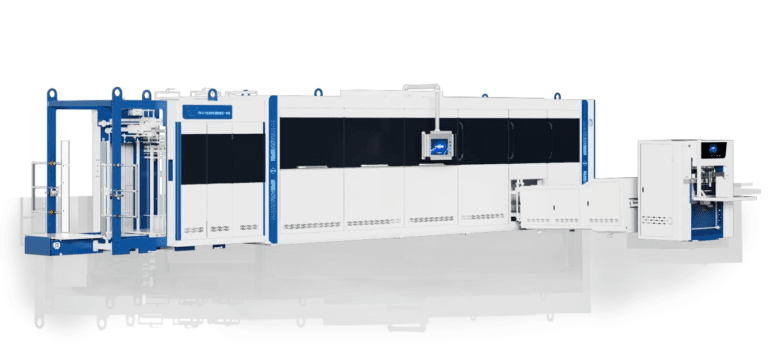
Paper bag machines are long rather than tall — a fully automatic line with feeder, forming section, handle unit and delivery needs a clear run, plus space at both ends for reel handling and finished-goods stacking. Practical requirements:
- Floor — level and load-bearing; these machines weigh several tonnes and registration suffers on an uneven floor.
- Power — three-phase, specified to the machine. Confirm your grid supply matches before shipment; adapting electrics afterwards is avoidable cost.
- Compressed air — clean and dry, sized above peak demand.
- Humidity — paper is hygroscopic. Wild humidity swings cause curl, misfeeds and glue problems, and this is an underrated cause of “the machine is faulty” complaints that turn out to be a storage issue.
- Storage — reels and finished bags both consume more space than people plan for. Finished paper bags are mostly air.
Step 6: Raw materials and supplier relationships
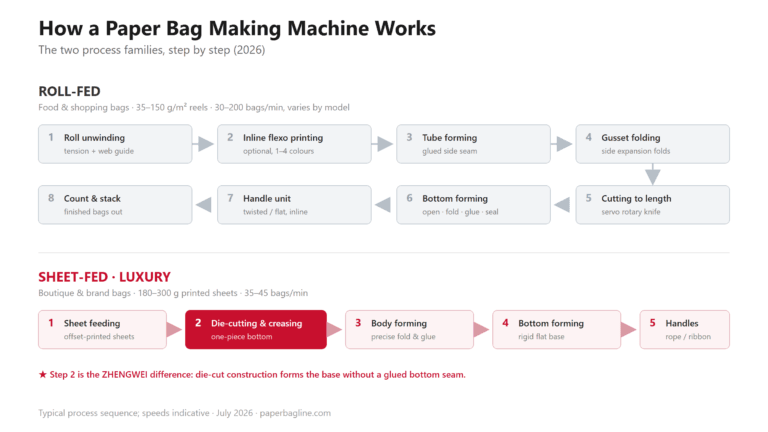
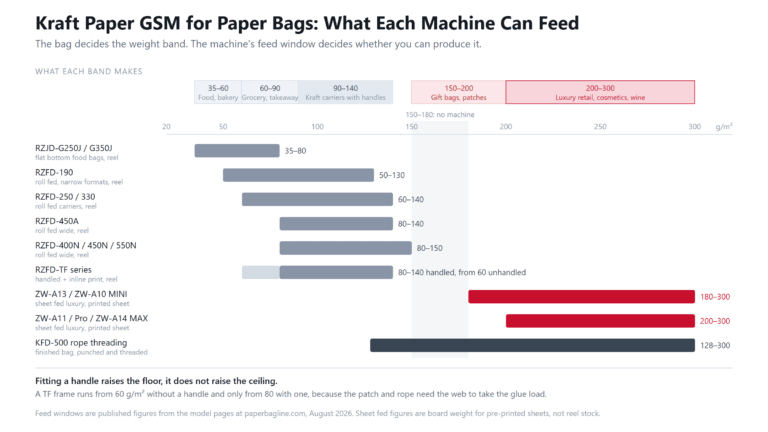
Your main input is kraft paper, typically 45–160 gsm on roll-fed machines and 100–300 gsm for sheet-fed luxury work, plus adhesive, handle rope or paper twist, and reinforcement card. Two things matter more than unit price:
- Consistency. Paper that varies in moisture, caliper or tensile strength between reels will cost you more in downtime and waste than you saved buying it.
- Second source. Qualify a backup supplier before you need one. A single-source paper supply is the most common reason a young plant misses a delivery.
Step 7: Staffing and training
A fully automatic line runs with two to three people per shift: one operator, one on material handling and packing, and a shared mechanic or supervisor. The binding constraint is rarely headcount — it is having someone who can diagnose a misfeed or a glue fault without calling the supplier. Budget for real operator training at commissioning, and make sure at least two people can run the line so a holiday does not stop production.
Step 8: Line up your first customers before the machine arrives
Machine delivery runs about 40–60 working days from a Chinese builder, plus shipping and installation. That window is your sales runway, not a waiting period. Use it to convert the Step 2 conversations into trial orders, and ask your machine supplier for sample bags produced on your chosen model in your chosen paper — physical samples close packaging deals in a way specification sheets never do.
Step 9: Trial runs, then commercial production
Plan for a ramp. First articles, dimensional checks, glue-bond and handle-pull testing, then a controlled first commercial run. Establish your scrap rate baseline early — you cannot cost a job properly without it, and quoting off a theoretical yield is how young converters win unprofitable contracts. From here a paper bag manufacturing business lives or dies on utilisation and repeat orders rather than on anything the machine does.
Mistakes that kill a paper bag manufacturing business in year one
These come up repeatedly from people who have actually done it, and none of them are about the machine’s specification:
- Buying capacity you cannot sell. A 300-bag-per-minute line running at 20% utilisation costs the same to finance as one running at 80%.
- Quoting before knowing your scrap rate. Theoretical yield flatters every costing model.
- Ignoring the handle question. Handle capability decides which segment you can serve, and retrofitting is expensive.
- Skipping the spares kit. Saving a few thousand on wear parts, then losing a contract to a two-week stoppage.
- Competing on price from day one. If price is your only argument, the largest converter in your market wins by default.
- Under-budgeting working capital. Profitable on paper, illiquid in practice, is the most common failure mode in a first-year paper bag business.
A note for buyers in India and other emerging markets
Search demand for this topic is heavily concentrated in India and South Asia, and the economics differ in two ways worth planning for. First, landed cost matters more than FOB price: duty, clearance and inland freight can move the real number substantially, so ask for a landed estimate rather than comparing FOB quotes. Second, local service availability should weigh heavily in your supplier choice — a slightly better spec is worth little if commissioning support is a time zone and a visa away. Ask any prospective supplier directly how many machines they have installed in your country and request a reference you can call.
Where ZHENGWEI fits
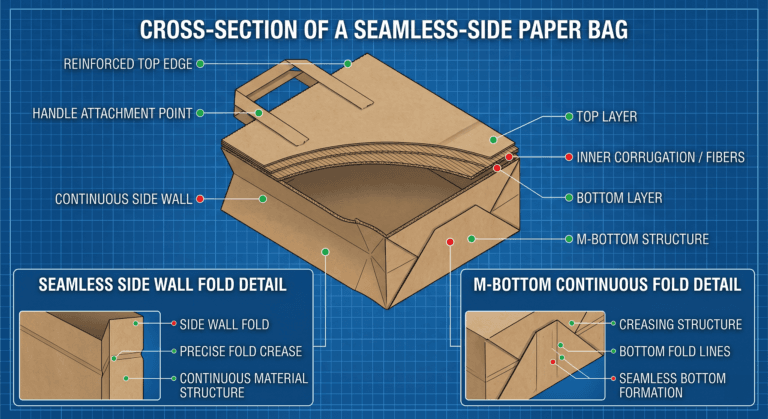
ZHENGWEI has built paper bag machinery since 2006 and holds more than 50 patents, with a range of five seamless paper bag making machine models plus a non-woven bag machine. The seamless models run at 40–45 bags per minute, and the line is built specifically for the luxury and branded segment — the seamless one-piece-bottom construction is a patented process that forms the base without a glued bottom seam, cutting material cost around 30% versus conventional construction.
Model coverage runs from the ZW-A10 MINI for small-format bags from 150 mm up to the ZW-A14 MAX at 250–600 mm, with flat-handle, round-handle and double-handle configurations in between. If the luxury segment is where you are heading, our paper handbag making machine page maps bag types to models, and how to choose a paper bag making machine covers the selection criteria in detail.
We quote per configuration within 24 hours and send free physical bag samples produced on the model you are considering — useful evidence when you are converting your own first customers.
Frequently asked questions
How much does it cost to start a paper bag manufacturing business?
The machine sets the floor: roughly $2,000–$15,000 for semi-automatic, $25,000–$80,000 for a fully automatic roll-fed line without handles, $60,000–$180,000 with an inline handle unit, and from about $170,000 for sheet-fed luxury lines. Then budget approximately the same again for freight and duty, installation, one to two months of raw material, spares and working capital. A realistic total for a small fully automatic food-bag operation is therefore roughly double the machine price in year one.
Is a paper bag business profitable?
It can be, and the margin depends almost entirely on segment rather than efficiency. Commodity food-service bags typically run 10–20% gross margin, retail carrier bags 20–35%, and luxury branded bags 40–60%. Utilisation matters more than machine speed — a fast line running half empty loses to a slower one that is fully booked. We break the numbers down in our article on whether paper bag manufacturing is profitable.
How much space and power does a paper bag plant need?
Plan for a clear linear run for the machine plus reel handling at the infeed and stacking at the delivery, on a level load-bearing floor. You will need a three-phase supply specified to the machine, clean dry compressed air sized above peak demand, and controlled humidity — paper is hygroscopic and swings cause curl, misfeeds and glue faults. Storage for both reels and finished bags is routinely under-estimated; finished paper bags occupy far more volume than the paper they came from.
How long does it take to start production?
Roughly six months from decision to commercial production. Machine build and delivery for a paper bag manufacturing machine is typically 40–60 working days from a Chinese manufacturer, plus sea freight, customs clearance, installation and commissioning, then a trial period before your first commercial run. Treat that window as your sales runway rather than dead time.
Do I need printing capability to start a paper bag business?
Not necessarily. Roll-fed machines can be specified with inline flexo printing for simple one- to four-colour work, which suits food service and general retail. Luxury and branded bags use pre-printed laminated sheets produced offset elsewhere, so a sheet-fed line does not need its own press — you buy printed sheets and convert them. Adding inline print raises machine cost, so decide based on what your Step 2 customers actually order.
Talk to us before you commit capital
Tell us the bag types, sizes and monthly volume you are targeting, and we will tell you honestly which machine class fits — including when a simpler machine than the one you asked about is the right starting point for a new paper bag manufacturing business. Configured quotes within 24 hours, free samples on your own specification.
Related reading: Is Paper Bag Manufacturing Profitable? Real Numbers · Paper Bag Machine Price Guide 2026 · Seamless vs Traditional Paper Bags