Is Paper Bag Manufacturing Profitable? Real Numbers (2026)
Is paper bag manufacturing profitable? It can be, but the result depends on the bag segment, the margin available and how well the machine can be utilised. A factory making low-margin commodity bags faces a different business case from one producing printed shopping bags or luxury retail bags. Machine price matters, but it is only one part of the calculation. Paper, labour, electricity, downtime, selling price and working capital can all change the result.
For factory owners and procurement managers, the useful question is not simply how many paper bags the machine can produce. It is whether the equipment fits the products you need to make, the capacity you can use and the orders you expect to run. The figures below are indicative market figures or stated assumptions where noted. They should be tested against the buyer’s own operating conditions before a purchase decision is made.
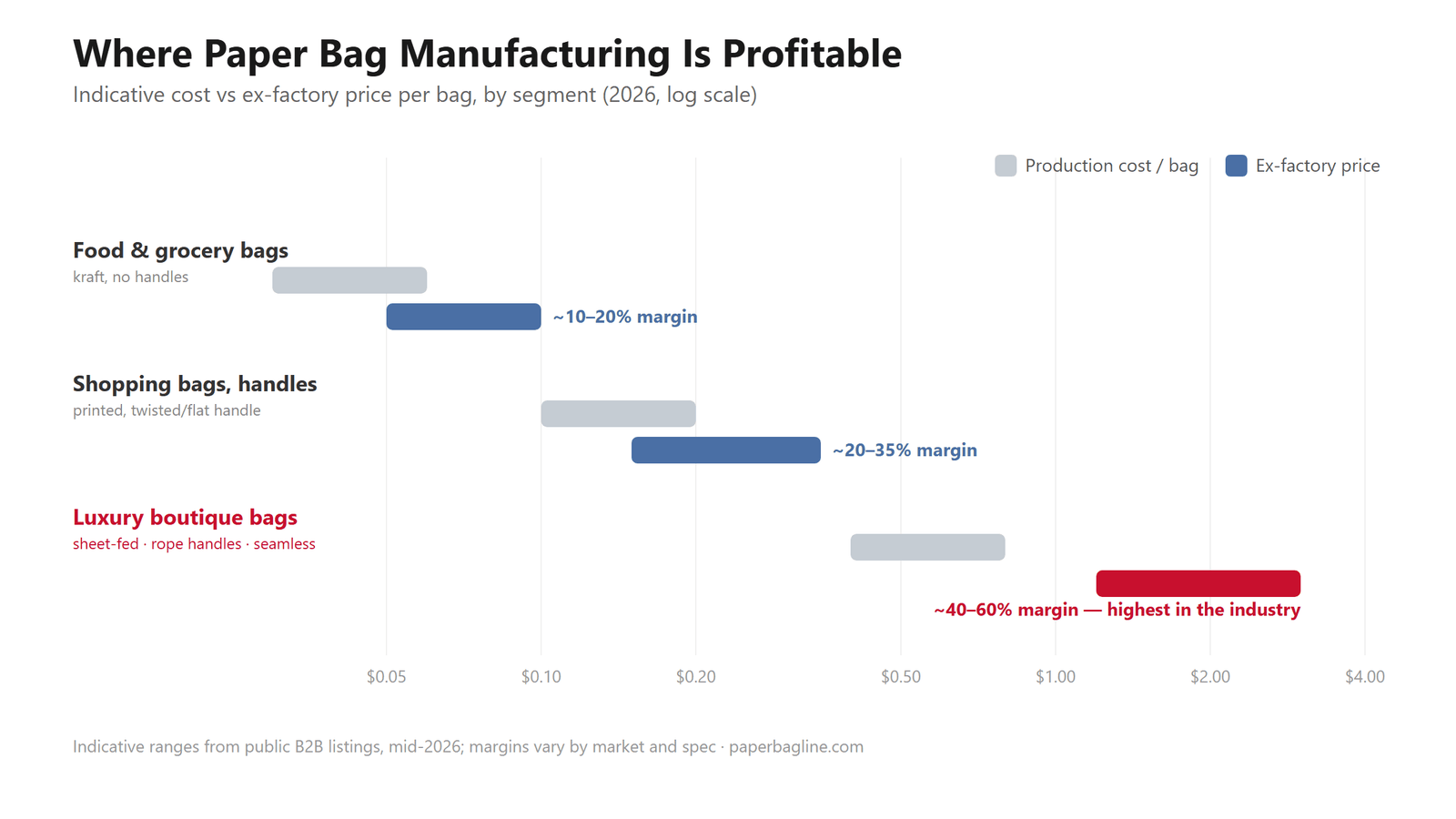
What does a paper bag cost to make and what can you sell it for?
| Segment | Production cost per bag | Ex-factory price per bag | Indicative gross margin |
|---|---|---|---|
| Food and grocery bags, kraft, no handles | $0.03–$0.06 | $0.05–$0.10 | ~10–20% |
| Shopping bags with handles, printed | $0.10–$0.20 | $0.15–$0.35 | ~20–35% |
| Luxury boutique bags, sheet-fed, rope handles | $0.40–$0.80 | $1.20–$3.00+ | ~40–60% |
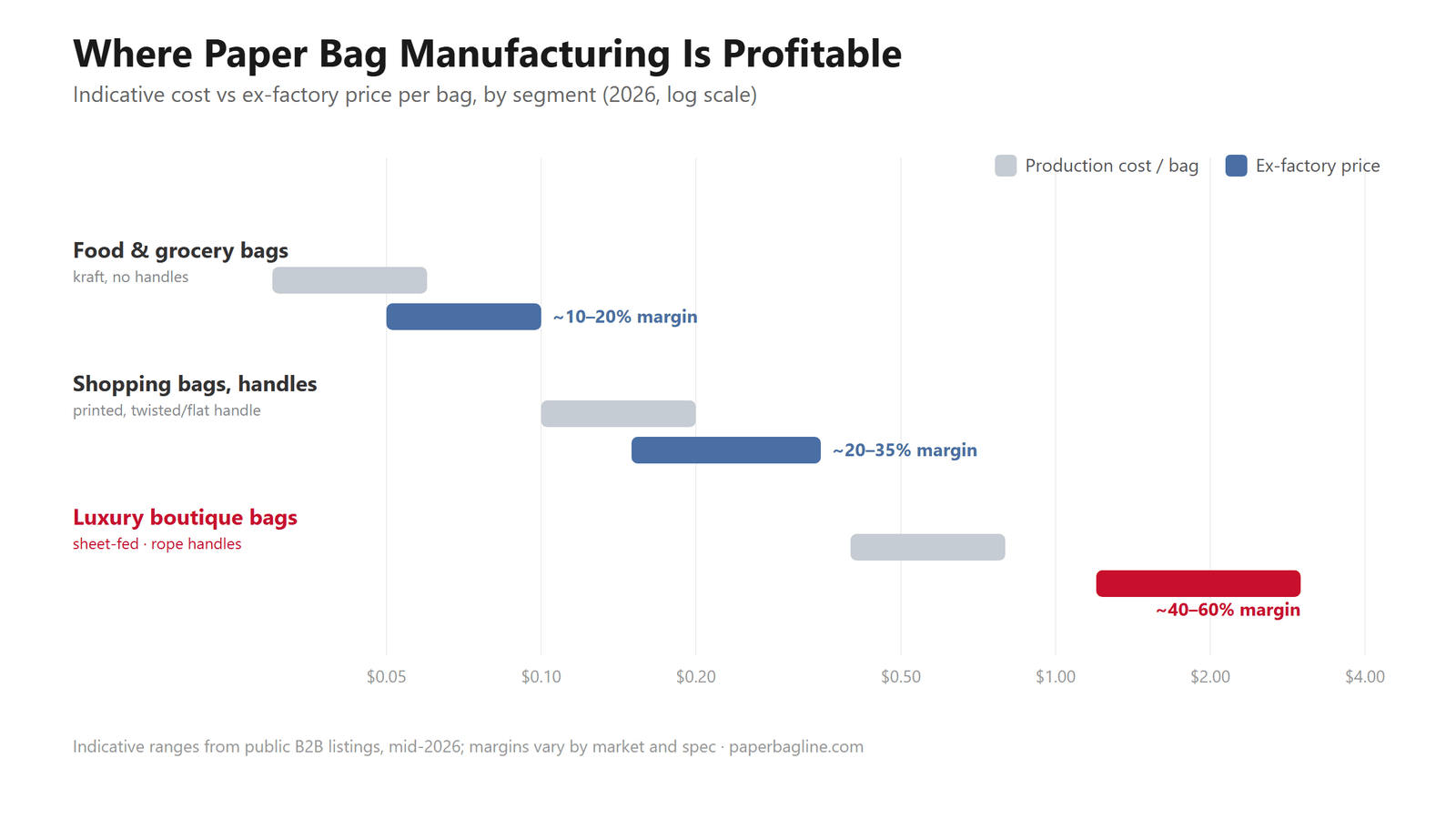
Paper bag manufacturing cost and selling price both move significantly by segment, so there is no single margin that applies to every factory.
Indicative market figures, not ZHENGWEI figures. They move with paper price, order size and country. Rebuild the table with your own local numbers before you rely on it.
Multiply those per-bag figures by 1,000 and the production cost works out to roughly $30–$60 for food and grocery bags, $100–$200 for shopping bags with handles, and $400–$800 for luxury boutique bags, using the same fact-sheet ranges scaled up.
These figures show why product mix matters. Food and grocery bags sit at the commodity end, while printed shopping bags with handles and luxury boutique bags offer higher indicative margins. The equipment requirement changes with the product as well, so the selling price cannot be considered separately from the capital required to produce.
Paper is one of the main cost drivers. It represents 50–65% of bag cost in the supplied market figures. A change in paper cost can have a direct effect on margin. Order size and local market conditions matter too.
The premium end can also require much more capital. Publicly listed sheet-fed luxury lines start at about $170,000, while automatic roll-fed commodity machines are publicly listed at $25,000-$80,000. These are marketplace listing ranges and vary by configuration; our 2026 price guide breaks them down.
A higher selling price therefore does not automatically make a better investment. The equipment cost, expected order volume and achievable margin have to work together.
What does a realistic payback calculation look like?
A realistic payback calculation starts with the machine investment, the capacity that can actually be sold and the time needed to bring the line into production. Publicly listed automatic roll-fed machines are priced at $25,000–$80,000. For this worked example, assume a machine price of $45,000.
Now assume 150 bags/min, 90% uptime and an 8-hour shift. Under those assumptions, the line would produce roughly 65,000 bags/day. That figure shows what the production model looks like under the stated conditions. It does not mean a factory will sell 65,000 bags every day.
A useful market benchmark for an automatic commodity line is a 12–24 month payback on a $40,000–$80,000 machine when local orders are consistent. That is a benchmark, not a guaranteed result. If utilisation is lower than the level needed to support the business case, the payback period will extend. The paper bag business break even question, in practice, is not whether the machine can run. It is whether enough orders exist to keep it running.
Tip: Start your payback clock on the day the deposit leaves your account, not the day the machine runs. Lead time is 60 days after deposit, payment is 30% up front and 70% before shipment, and shipping and installation come after that. A payback model that ignores those months will be wrong by a quarter or more.
Cash timing matters as well. ZHENGWEI’s terms require a 30% deposit and 70% before shipment, with a lead time of 60 days after receipt of the deposit. On a $45,000 assumption, the deposit is $13,500 and the remaining $31,500 is due before shipment.
The investment should therefore be tested against the contribution the line can generate at a defensible utilisation level. A payback period that only works when the machine is kept close to full capacity is not a conservative business case.
What determines whether a paper bag factory makes money?
So is paper bag manufacturing profitable for your factory specifically? Paper bag business profit margin comes down to selling price, production cost and machine utilisation, and whether those three leave enough margin after operating costs. Five variables deserve particular attention: paper price, utilisation, product segment, labour, and downtime.
Paper price. Start here: it represents 50–65% of bag cost in the supplied market figure, so a factory that gets the machine price right but misjudges its paper cost can still bake the wrong margin into its business plan from day one.
Utilisation. Break-even utilisation on a commodity line sits at 40–60%. That figure is not a prediction of what a factory will achieve in its first year.
Product segment changes the equation as well. A commodity grocery bag, a printed handled shopping bag and a luxury retail bag have different price and margin characteristics, and the equipment required for each is not the same.
Labour is another part of the calculation. Fully automatic roll-fed or sheet-fed lines generally require 2–3 operators, while semi-automatic equipment can require 3–6 operators per station, depending on bag complexity. Downtime is easy to underestimate. The cost is not only the replacement part. Spare-parts availability and lead time can determine how long the machine remains stopped, so service support belongs in the purchase decision.
Tip: Before you model revenue at full capacity, write down the utilisation you can defend with orders you already have. Break-even on a commodity line typically needs 40–60%. An oversized machine running at 25% loses money even when the order book looks healthy.
What should you calculate before buying a machine?
Before buying a paper bag machine, compare the equipment with the work you actually need it to handle. The objective is to see whether the machine fits the product, the required capacity and the economics of the orders.
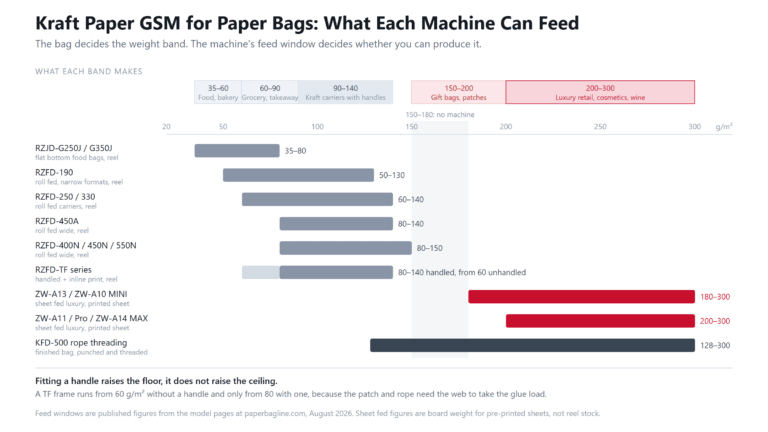
Start with the product and material. Check the bag format, paper grade and the machine’s sheet or reel limits. Sheet size matters as well. A bag may fit the stated dimensions while the printed sheet required for the job does not fit the machine’s feed range.
Compare the machine’s capacity with the work you expect to put through it. A higher output is useful when it replaces current production and supports additional orders. It is less useful when the extra capacity cannot be sold. Use your own local costs in the model, including paper, labour and electricity. Selling price should be tested against the actual customer mix and order size rather than treated as a fixed market number.
The purchase decision also needs to include cash timing. Consider the payment schedule, the period before the machine starts producing and the working capital required while customers are waiting to pay. Allow for spare parts and downtime as part of the assessment.
The final comparison should show whether the machine solves the production requirement you actually have. A high rated output is not, on its own, a reason to buy. Our selection guide covers the full checklist.
When is a paper bag machine a bad investment?
A paper bag machine is a bad investment when its capacity, material range or economics do not match the production requirement, even if the machine itself looks attractive. The wrong machine can tie up capital without improving the factory’s position.
A price-only strategy is one warning sign. If the business can win customers only by offering the lowest price, the buyer may be entering the most competitive part of the market without a clear advantage.
Automation should also be matched to volume. For a smaller operation with limited order volume, a semi-automatic machine may be a better buy when its lower initial investment is easier to justify. The automatic paper bag machine cost maths show where the crossover sits. The trade-off is higher labour input, so the decision should be based on the full operating cost.
Factory readiness is another practical risk. Commissioning is free for the first 7 days. After that, the engineer is charged at US$100 per day. A factory that is not ready when the engineer arrives can turn a planned installation into an additional cost. Cash flow can create a similar problem. The buyer pays before the machine is producing, while packaging customers can take 30–90 days to pay. A business case that ignores that gap can look stronger on paper than it is in practice.
Tip: Paper is 50–65% of what a bag costs to make, so a swing in pulp prices moves your margin more than almost anything you can negotiate on the machine. Model that swing before you commit, not after.
FAQ: is paper bag manufacturing profitable?
How much profit is in one paper bag?
There is no single profit figure because paper bag margins vary by segment. The supplied market figures show indicative gross margins of about 10–20% for food and grocery bags, 20–35% for printed shopping bags with handles, and 40–60% for luxury boutique bags. These are market figures, not a guarantee for any factory, and they should be rebuilt using local costs and selling prices.
How long until a paper bag business breaks even?
The payback period depends mainly on the machine class, utilisation and consistency of orders: 8–12 months for a semi-automatic start under $15,000 all-in with consistent local orders, and 12–24 months for an automatic commodity line costing $40,000–$80,000. Luxury sheet-fed equipment is driven by contracts rather than a fixed number of months.
Is paper bag making still profitable in 2026?
Paper bag manufacturing can still be profitable in 2026 when the product, selling price, equipment and utilisation support the investment. The supplied market figures show higher indicative margins in the printed and luxury segments, but those segments also require different equipment and, in the luxury case, substantially more capital. The practical test is whether your own orders can support the required utilisation and costs.
Which paper bags are most profitable to manufacture?
Luxury boutique bags have the highest indicative gross margin in the supplied figures, at about 40–60%. Printed shopping bags with handles are lower at about 20–35%. Food and grocery bags sit lower, at about 10–20%. The highest margin is not automatically the best opportunity, though luxury sheet-fed lines start at about $170,000 and depend heavily on suitable customer contracts.
How much does it cost to start a paper bag manufacturing business?
There is no single startup cost because the required machine class depends on the product. Publicly listed ranges are about $2,000–$15,000 for semi-automatic equipment, $25,000–$80,000 for automatic commodity roll-fed equipment, and from about $170,000 for sheet-fed luxury lines. These are marketplace listing ranges, not quotations, and working capital, installation and other operating requirements also need to be considered.
Where ZHENGWEI machines fit
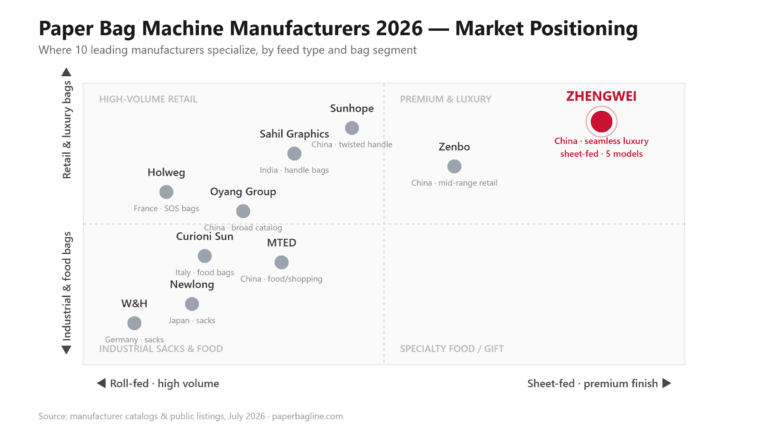
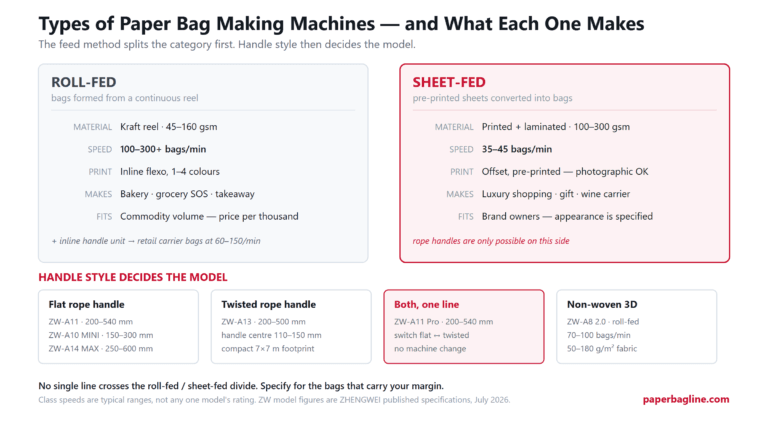
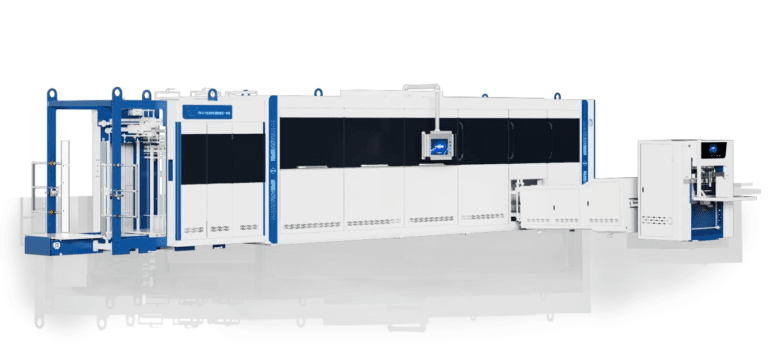
ZHENGWEI builds sheet-fed, crease-free paper bag machines for printed retail and luxury bags. The range runs from the ZW-A10 MINI for small formats to the ZW-A14 MAX for large ones, with the ZW-A11 for flat rope handles, the ZW-A13 for round rope handles, and the ZW-A11 PRO for both on one machine.
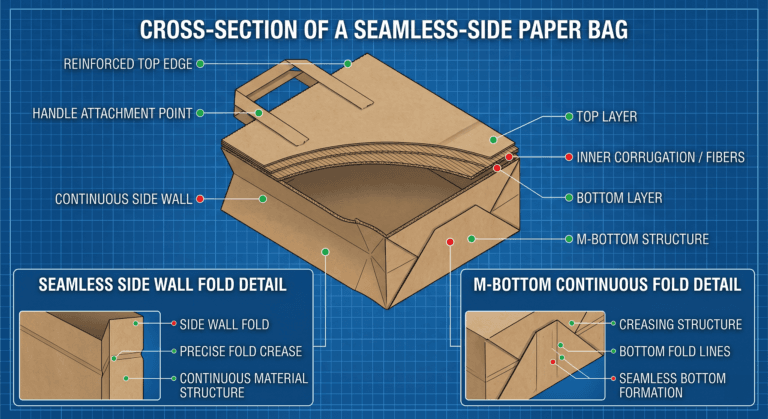
They take 200–300 g cardboard sheets, or 180–300 g on the ZW-A10 MINI and ZW-A13, and run at 40–45 bags per minute, or 35–38 on the ZW-A14 MAX. The bags they produce have a one-piece bottom, meaning the base is formed without a bottom seam.
They are not the right machine for everyone. They are sheet-fed, so they do not run paper from a reel, and they do not run stock below 180 g. A producer whose product is a plain kraft grocery bag needs a roll-fed machine, and we would tell them so.
Lead time is 60 days after deposit. Payment is 30% deposit and 70% before shipment. One engineer travels for installation, with the first 7 days of commissioning included.
Not sure which class of machine fits? Tell us your bag type, your board weight and your daily target, and we will tell you which class of machine fits the job, including when the answer is not ours. Explore the machines or talk to us.