Paper Bag Machine for Die-Cut Sheets: 7 Essential Checks
A paper bag machine for die-cut sheets turns prepared flat blanks into finished bags through the operations specified for that machine. Its starting material is important: the paper has already been cut to an approved shape before it reaches the bag-forming stage.
If you are looking for a machine to process a sheet after die cutting, first identify what your die-cutter delivers. Is it a press sheet with several blanks still attached, or an individual blank with waste removed? Those are different inputs. A feeder designed for one cannot automatically be assumed to handle the other.
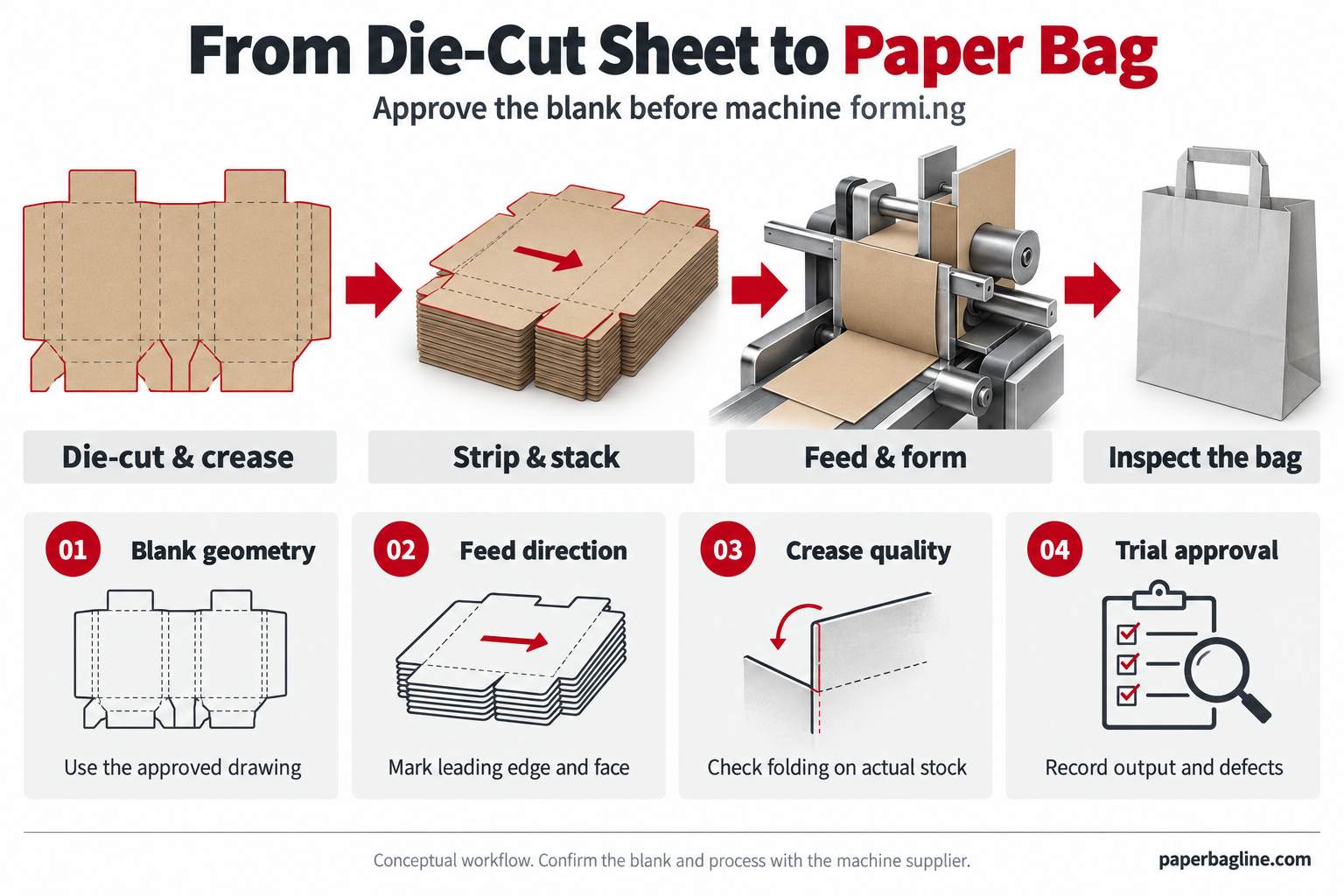
This guide explains seven checks for connecting sheet fed die cutting to paper bag production: the blank drawing, material condition, stripping, feeding, forming, inspection and acceptance trial. They help a buyer, printer and machine supplier approve the same job.
What Happens After Sheet Fed Die Cutting?
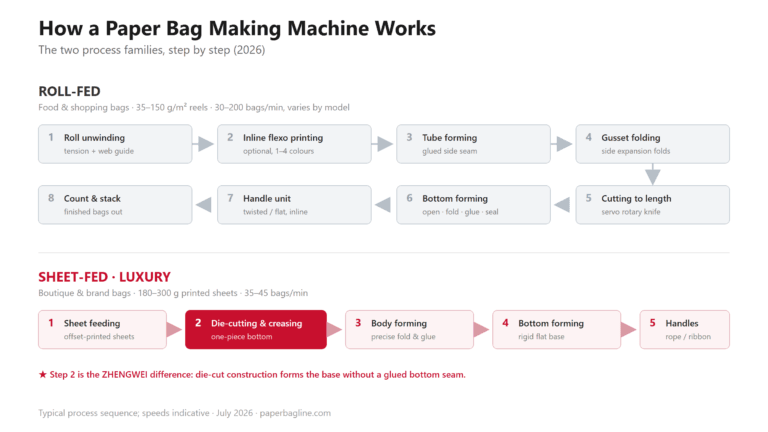
Sheet fed die cutting is a converting stage that works on individual sheets. Cutting defines the outline; creasing prepares designated fold lines. Waste removal and blank separation may be completed in the same system or handled separately, depending on the equipment.
A paper bag machine for die-cut sheets receives the prepared input and forms the bag. Whether reinforcement, handle attachment, bonding or other steps are included must be confirmed against the actual proposal.
| Stage | Required output | Question to resolve |
|---|---|---|
| Printing and finishing | Sheets ready for conversion | Are the ink, film and coating suitable for folding and bonding? |
| Die cutting and creasing | Approved outline and fold pattern | Does the tooling match the machine-approved blank revision? |
| Stripping and separation | Waste removed and blanks presented correctly | Which steps are automated or separate? |
| Bag forming | A formed bag with the specified features | Are the required handle and reinforcement operations included? |
| Inspection and packing | Approved, identified bags | Which criteria release the finished job? |
Do not treat all sheet-fed machines as the same process. Some configurations incorporate cutting or creasing, while others require blanks prepared upstream. Specify the input at each machine boundary rather than relying on the word “automatic.”
1. Approve the Blank Drawing Before Ordering Tooling
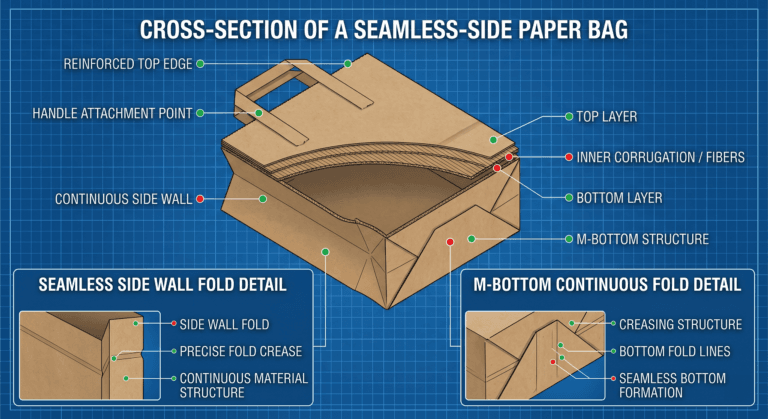
Choosing a paper bag machine for die-cut sheets begins with a drawing of the unfolded bag. Finished width, height and gusset dimensions do not fully define that drawing. The fold arrangement, bonding zones, top turnover, handles and reinforcement can all affect the blank.
Ask the supplier to identify the cut contour, crease lines, leading edge, reference edge and printed face. Keep structural marks separate from artwork so graphics can be positioned without changing the geometry needed for forming.
Approve one revision before making the production die. When a bag dimension changes, recheck both the blank and print layout. Even a small change can affect how many blanks fit the press sheet and how the stack presents to the feeder.
For a paper bag machine for die-cut sheets, the drawing is a handover document: the buyer, printer, die-maker and bag converter should use the same revision. Retain a signed flat blank beside the approved finished bag, and identify any changes made during trial production.
Our guide to paper bag blank size and sheet layout explains the upstream planning questions. Confirm the final layout before committing to printed stock or production tooling.
2. Check the Actual Material and Crease Quality
Grammage alone does not establish whether a blank will run well. Record the paper or board grade, thickness, stiffness, grain direction and surface finish. Include any film, varnish or other treatment present on the production material.
Evaluate the sheet after its intended printing and finishing sequence. A demonstration using unprinted paper leaves questions about marking, fold cracking, surface friction and the suitability of the areas that will be bonded.
Fold representative samples along the specified creases. Look for cracking, unwanted tears, inconsistent folding or a crease that does not guide the stock as intended. Agree the acceptance criteria with the converter and tooling supplier.
A paper bag machine for die-cut sheets should be tested with the materials intended for production. If substitute stock is used initially, record the difference and identify which checks must be repeated on the actual material.
Avoid borrowing pressure, crease-channel or conditioning values from an unrelated job. The setup depends on the stock, tooling and equipment. Supplier instructions and a representative trial should establish the production conditions.
3. Define Waste Removal and Stack Presentation
Clarify what “sheet after die cutting” means in your factory. A sheet may still contain outer waste, internal cut-outs or several blanks connected by holding points. The bag feeder needs the input specified by its manufacturer.
Agree who removes waste, separates blanks, inspects cut edges and prepares the stack. Confirm whether these steps require additional equipment, labor or floor space. They can otherwise disappear from a quotation focused only on the forming machine.
Inspect for loose waste, incomplete separation and damaged edges before feeding. Keep drawing revisions and material batches identified. A neat stack is useful only when it contains the correct blanks in the correct orientation.
When evaluating a paper bag machine for die-cut sheets, include normal stack preparation in the trial. A small hand-selected pile may not represent the handling needed during a production shift.
4. Confirm Feeding on a Paper Bag Machine for Die-Cut Sheets
Show the supplier a physical blank as well as its drawing. Irregular outlines, projecting tabs, openings and surface treatments should be reviewed against the proposed feeder and transport arrangement.
Mark the leading edge and printed face on the reference sample. Ask how the stack is loaded, which edge controls alignment and how incorrect or doubled feeds are handled. Request a demonstration of the quoted functions.
| Input check | What to agree | Evidence to retain |
|---|---|---|
| Geometry | Accepted outline and reference edges | Drawing revision and measured samples |
| Orientation | Leading edge, printed face and stack direction | Marked blank and loading instruction |
| Material condition | Stock, finish and storage requirements | Material identification and feeding observations |
| Waste removal | Condition of tabs, cut-outs and edges | Prepared input samples |
| Continuity | Stack replenishment and collection method | Stops, rejected feeds and operator actions |
Assess feed behavior on the paper bag machine for die-cut sheets over the agreed trial, including replenishment where relevant. Record interruptions and rejected blanks so the result describes usable production rather than a brief display of motion.
5. Specify What the Paper Bag Machine for Die-Cut Sheets Includes
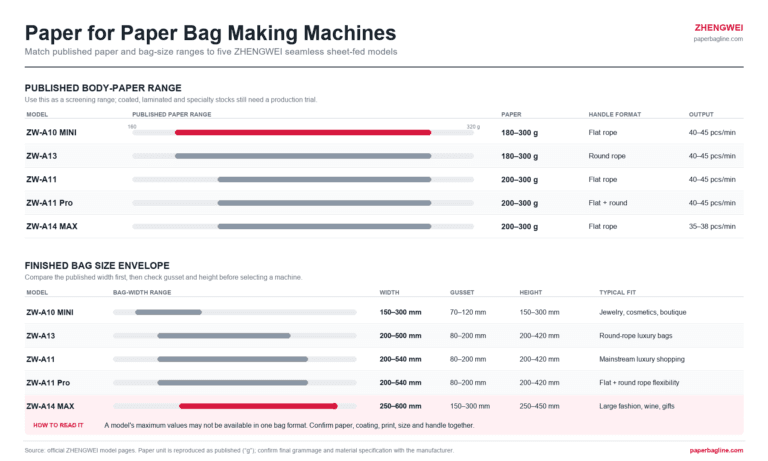
List the operations required by the finished bag and assign each to a machine or separate workstation. Relevant items may include reinforcement placement, handle preparation, handle attachment, folding, bonding, bottom forming and collection.
For each operation, state whether it is in the base configuration, an option or an external process. Making a handle and attaching it are separate functions; feeding reinforcement also differs from supplying the reinforcement material itself.
The Paperbagline technology overview describes a process starting with pre-die-cut sheets. Use that starting point to discuss the required construction, then verify the detailed folding and joining route on a sample and the proposed configuration.
A paper bag machine for die-cut sheets is not automatically compatible with an existing bag die. The blank may have been designed for a different forming sequence. Ask for approval or a revised drawing before promising tooling reuse.
Compare each paper bag machine for die-cut sheets against one finished-bag specification. Similar descriptions can hide different handle operations, reinforcement steps or upstream preparation requirements.
6. Inspect the Formed Bag, Not Only the Blank
A correct flat blank is a starting condition. Inspect the bag after feeding and forming: check dimensions, panel alignment, folds, surface condition, handle position and the relevant bonded areas.
Record defects by location and appearance. An edge damaged before feeding suggests a different investigation from a mark appearing after transport through the forming section. Retain labeled samples from both stages when diagnosing a problem.
Agree carrying-load, handle and bond checks before acceptance. The test medium, handling method, conditioning interval and pass criteria should match the application. A short machine demonstration does not establish a universal carrying capacity.
For the paper bag machine for die-cut sheets under evaluation, retain both the approved blank and finished bag. Together they provide a reference for repeat orders and future material changes.
7. Run a Representative Acceptance Trial
Prepare the acceptance plan before materials arrive. Identify the drawing revision, stock and finish, input preparation, bag features and inspection method. Name the person responsible for reviewing the result.
Evaluate a paper bag machine for die-cut sheets on accepted output. Record trial duration, input quantity, approved bags, rejected pieces and interruptions. Separate setup time from the production observation period so both remain visible.
| Trial record | Information to retain |
|---|---|
| Job and materials | Blank revision, stock batch, print and finish references |
| Configuration | Included operations, options and separate workstations |
| Preparation | Stripping, separation, orientation and stack condition |
| Production | Run interval, quantities, stops and operator interventions |
| Quality | Accepted bags, defect categories and functional results |
| Handover | Approved samples, settings record and unresolved actions |
Use the trial to identify where the complete workflow needs attention. Extra forming capacity has limited value if upstream preparation cannot supply blanks consistently. Include replenishment, collection and packing in that discussion.
What to Send with an Equipment Inquiry
To discuss a paper bag machine for die-cut sheets, send the finished dimensions, handle style, flat drawing, representative blanks, paper specification and print or lamination details. Add the expected order sizes and the processes already available in your factory.
If a drawing is not ready, provide a finished sample and explain which dimensions and appearance features are fixed. Request a proposed blank and process route before arranging production tooling.
Review the paper bag machine range and finished bag samples, then contact our team about a trial using your materials.
Before Ordering a Paper Bag Machine for Die-Cut Sheets
The acceptance trial for a paper bag machine for die-cut sheets should end with a written handover, not just an approved sample. Ask who releases changes to the blank, which training is included and how a repeat job is identified.
Keep the drawing revision, material reference, loading instruction and finished-bag sample together. If a later job changes the film, handle, paper grade or bag dimensions, review which parts of the approval remain applicable. A previous successful run is useful evidence, but it does not approve every new combination.
Assign responsibility for upstream blanks as well as machine setup. The printer should know who to contact when a die or layout changes; the forming operator needs a clear way to identify the approved stack. This shared record makes the production handover easier to repeat across shifts.
Frequently Asked Questions
Can a paper bag machine use sheets after die cutting?
Yes, when its specification calls for prepared die-cut blanks and the supplied blanks meet it. Confirm shape, stock, orientation and waste-removal requirements before production.
Is sheet fed die cutting included in the bag machine?
It depends on the configuration. Cutting may be upstream, while some systems include selected cutting or creasing functions. The quotation should identify the input and output of every operation.
Can existing dies be reused?
Only after the supplier confirms that the existing blank matches the proposed process. Similar finished dimensions do not guarantee compatible cut outlines and crease layouts.
Does heavier paper always need a different process?
Grammage alone cannot answer that. Review thickness, stiffness, grain and finish alongside the blank geometry, tooling and machine requirements.
What should I request before buying a paper bag machine for die-cut sheets?
Request an approved blank drawing, a clear list of included operations and a representative trial with documented output and quality criteria. Retain samples from the accepted run.
Process Reference
Published equipment descriptions illustrate why configurations need to be checked individually. For example, NESSCO’s sheet-feed machine description lists its own sequence of feeding, creasing and bag-forming operations. That example is not a specification for the equipment discussed here; use the supplier-approved drawing and proposal for your project.
Talk to us about your line
You’ll hear back within 24 hours, in English or Chinese, with a response tailored to your factory’s specific situation — not a generic brochure.
Request a Quote →Zhengwei Machinery specializes in seamless paper bag machines for luxury production. Our machines are CE-certified and serve customers across Europe, Latin America, the Middle East, and Asia.