How to Calculate Paper for Paper Bags: Blank Size, Sheet Layout and Waste
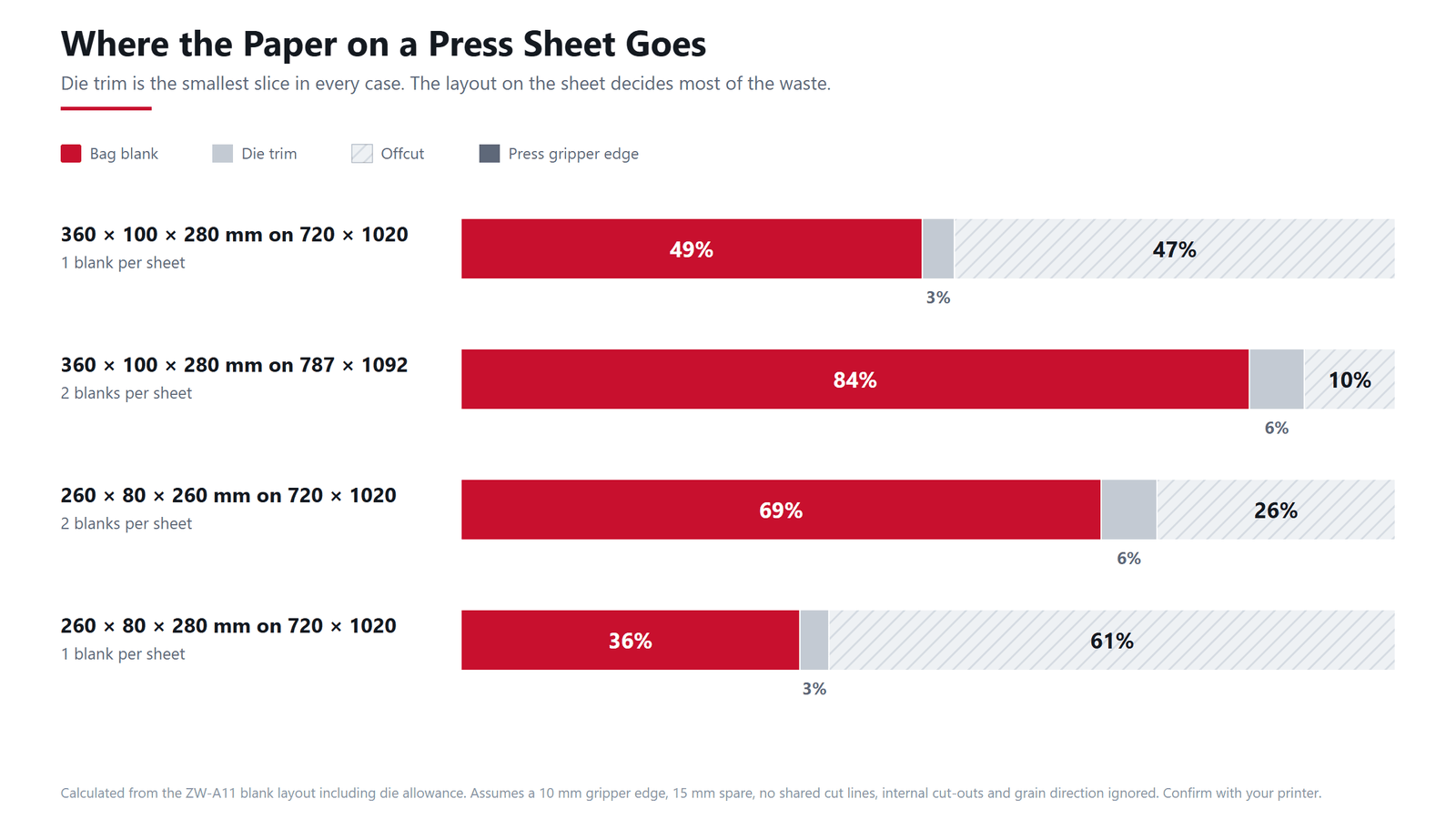
Quick answer To calculate paper for paper bags, work out the flat die-cut blank from the bag’s width, gusset and height, then count how many blanks fit your printer’s press sheet. On a sheet-fed line, most paper waste does not come from the die itself. Die trim took 3–6% of the press sheet in our worked examples, while offcut left over from a poor sheet layout ranged from 10% to 61%. Check how many blanks fit your printer’s sheet before you sign off a bag size.
Buyers usually size a paper bag around the product and the brand guidelines, then send the drawing to a printer. The paper bill only appears later, when the printer quotes sheets. By then a 20 mm change in bag height can mean paying for twice as much printed board per bag.
This guide shows where the paper goes between the paper merchant and the finished bag. The figures come from laying out real blank shapes for a sheet-fed machine on common press sheet formats. Most online calculators stop at blank size and weight, so this guide carries on to the press sheet, where most of the paper is lost.
What sets a paper bag blank size?
A paper bag blank size is set by three things: the finished bag dimensions, the way the machine folds the bag, and the allowance the die needs around the shape. Here a blank means the flat die-cut shape, not an unprinted bag. The bag dimensions are yours to choose, but the other two come from the machine, so ask the supplier for them before you finalise any artwork.
Construction changes the shape far more than buyers expect. A conventional square-bottom bag starts as a wide, short blank that wraps around the width of the bag and is closed with a glued overlap. A one-piece-bottom bag starts as a long, narrow blank that runs down one face, across the base and up the other face. Its long side is roughly twice the bag height plus the base.
Neither construction automatically uses less paper per bag. The glue flaps simply sit in different places. What differs is the shape of the blank, and shape decides how blanks fit on a printed sheet.
Where paper waste comes from in paper bag production
Paper waste in paper bag production comes from five places, and only one of them is decided by the die. The table puts the largest measured source first and the two we could not measure next.
| Source of waste | What decides it | Who controls it | Size in our examples |
|---|---|---|---|
| Offcut from sheet layout | How many blanks fit the press sheet | Buyer and printer | 10–61% of the sheet |
| Makeready sheets | Setup on the press and the die-cutter | Printer and converter | Varies by job, ask your printer |
| Rejected bags | Registration, board quality, machine setup | Converter | Track it per run |
| Die trim | Allowance the die needs around each blank | Machine and die design | 3–6% of the sheet |
| Internal cut-outs | Notches and handle slots inside the blank | Die design | Small, not counted here |
Examples: four bag and sheet combinations calculated from the ZW-A11 blank layout, with a 10 mm press gripper edge and 15 mm spare on the sheet. No real press run was measured.
Makeready and rejects are real, but we have no measured figures to put in that column. Your printer does, because a print quote usually includes a spoilage allowance. Ask for that number separately rather than accepting it buried in the sheet count.
Ask your printer to quote sheets and blanks per sheet as two separate lines. If the quote only shows a total sheet count, you cannot see whether a small change to the bag would halve the paper.
Die trim: why a fixed allowance favours larger bags
Die trim is the narrow border the cutting die needs around each blank, and on the ZW-A11 it is a fixed allowance of roughly 2 cm in each direction. Because the border does not grow with the bag, it takes a smaller share of the paper as bags get bigger.
| Bag size, width × gusset × height (mm) | Die trim as a share of the die-cut sheet |
|---|---|
| 200 × 80 × 200 | 9.5% |
| 260 × 100 × 320 | 7.4% |
| 320 × 120 × 400 | 6.2% |
| 400 × 150 × 350 | 5.4% |
| 450 × 160 × 380 | 5.0% |
Die-cut sheet here means one blank plus its die allowance. Notches and handle slots inside the blank are excluded, so real trim is slightly higher.
These percentages are the part of paper waste that machine design actually controls. They are also the smallest part. A supplier who talks only about die efficiency is describing one of the thinnest slices of your paper bill.
Sheet layout decides most of the paper waste
The number of blanks that fit on one press sheet decides most of the paper waste on a sheet-fed bag. A blank that fits once where it could fit twice doubles the printed board you buy per bag, and no die setting can recover that. Any attempt to calculate paper for paper bags that stops at the blank misses this step.
Press sheets come in a handful of standard paper sizes. European print shops commonly run 700 × 1000 mm and 720 × 1020 mm, the second being the maximum sheet on many B1 presses. Printers working from Chinese mills often stock 787 × 1092 mm and 889 × 1194 mm.
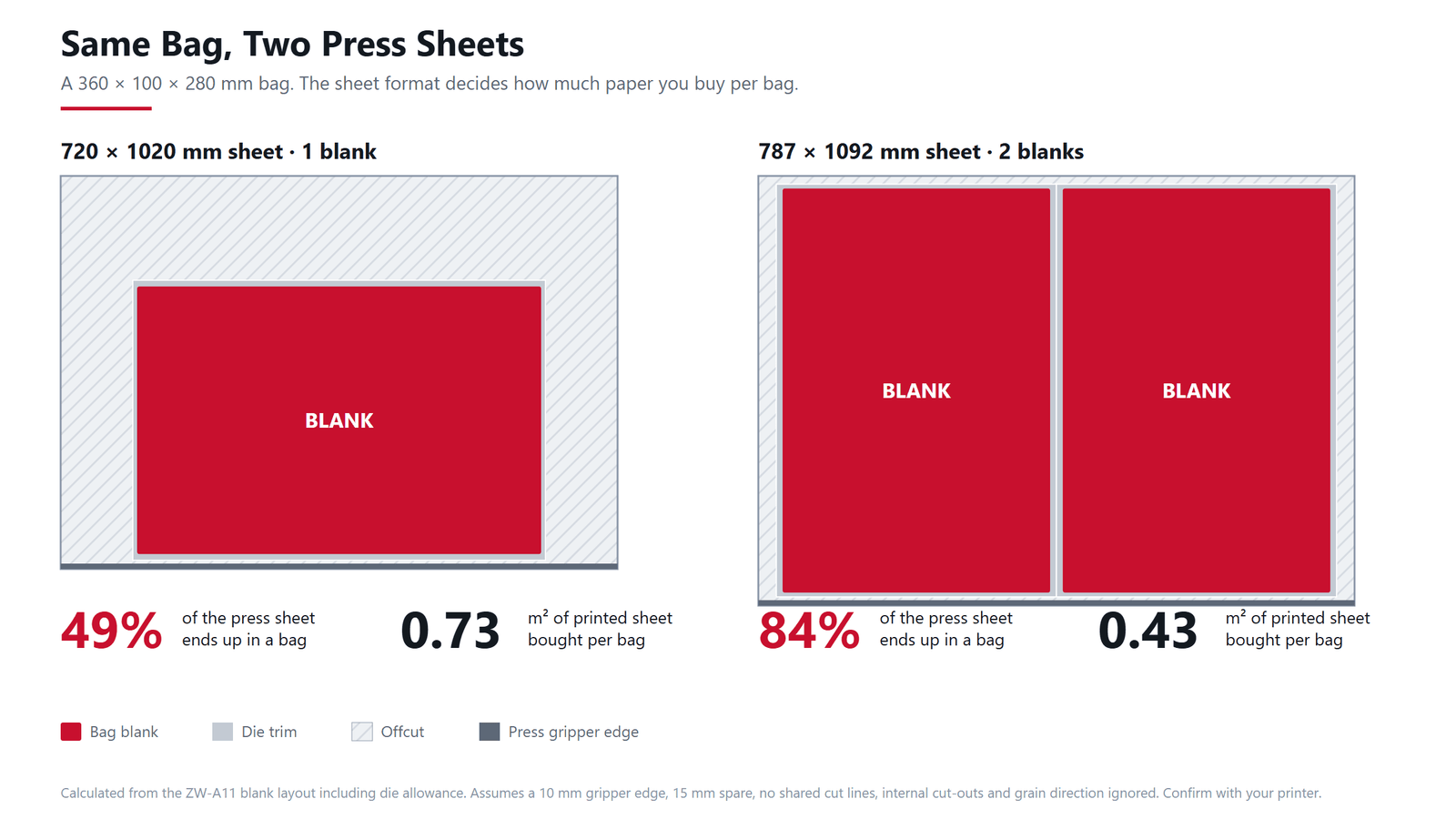
Take a 360 × 100 × 280 mm bag. On a 720 × 1020 mm sheet only one blank fits, and 49% of the sheet ends up in the bag. On a 787 × 1092 mm sheet two blanks fit side by side, and the share rises to 84%. Printed sheet per bag falls from 0.73 m² to 0.43 m², about 41% less board for an identical bag.
Before you accept a layout that turns the blank 90 degrees to fit one more, ask which way the grain runs on the board. Heavy board creased across the grain is more likely to crack at the fold, so the extra blank may cost you in rejects.
Small size changes that double the paper per bag
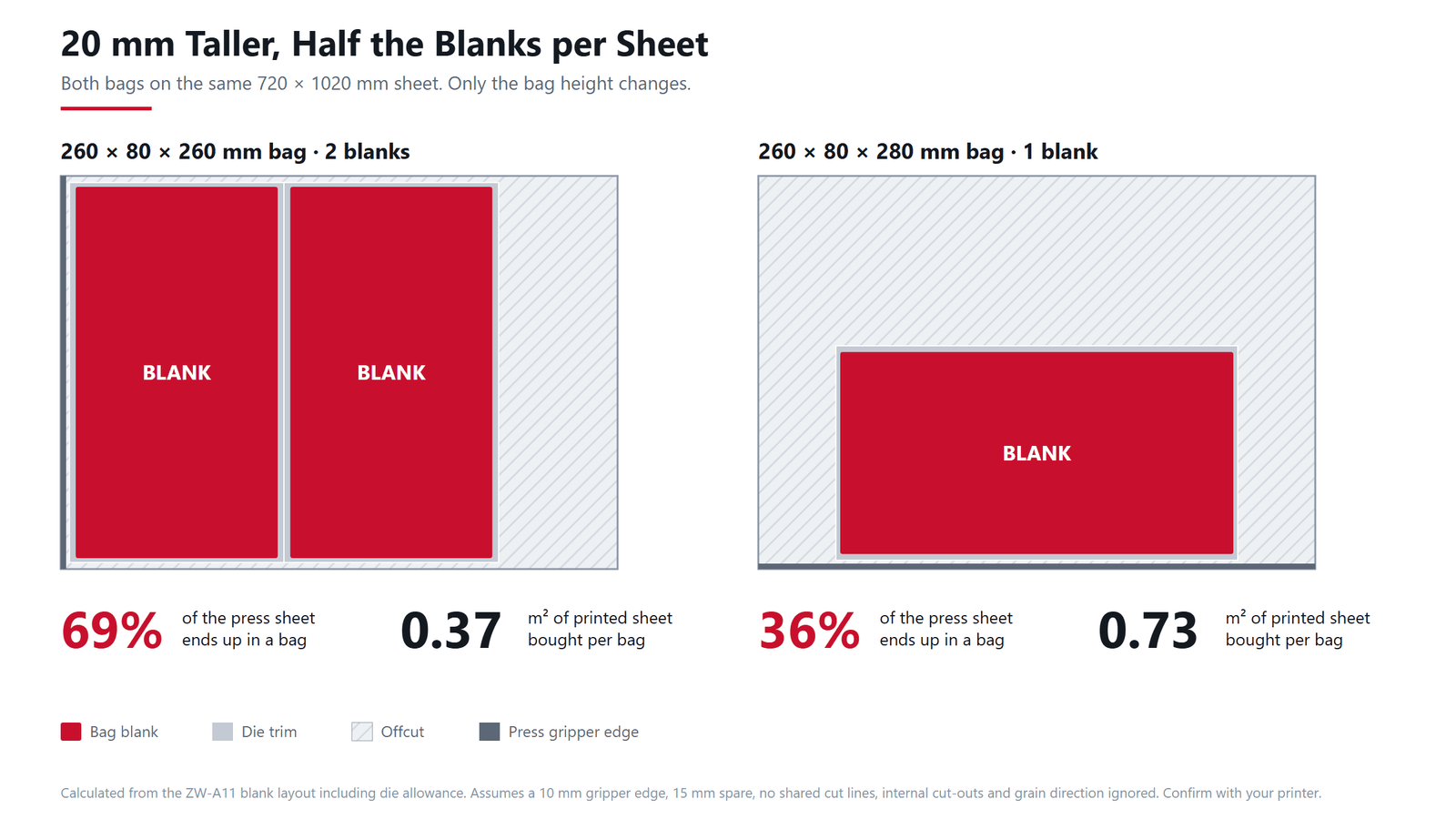
A change of 20 mm in one bag dimension can halve the number of blanks per sheet. It happens when the blank crosses the edge of the usable sheet, and nothing on the bag drawing warns you.
On a 720 × 1020 mm sheet, a 260 × 80 × 260 mm bag fits two blanks and uses 69% of the sheet. Make the same bag 280 mm tall and only one blank fits. The share drops to 36%, and printed sheet per bag doubles from 0.37 m² to 0.73 m².
Very tall bags hit a harder limit. A 320 × 120 × 400 mm bag has a blank about a metre long on a one-piece-bottom machine. It does not fit a 720 × 1020 mm sheet with a normal gripper edge, so the job moves to a 787 × 1092 mm sheet with 55% of it in the bag.
A five-step way to calculate paper for paper bags before you approve artwork
You can calculate paper for paper bags with two documents: the machine’s blank drawing and your printer’s sheet format. Run it on two or three candidate sizes, not just the one on the brand brief.
- Get the blank drawing from the machine supplier. It gives the paper bag blank size for your bag, including glue flaps and top turnovers.
- Add the die allowance. The supplier should state it. Without it your layout will look better on paper than it runs.
- Get the press sheet and gripper edge from your printer. Use the sheet they actually stock, not the largest their press can take.
- Try both orientations, then check the grain. Keep a rotated layout only if the grain still suits the creases.
- Divide sheet area by blanks per sheet. Compare printed m² per bag across your candidate sizes.
When we send a buyer the blank drawing for the ZW-A11, it separates the dimensions that stay fixed for every bag from those that follow the bag size. It also marks the crease lines that must run as one unbroken rule. Ask any supplier for a drawing at that level before you size a bag, because a rough outline will not survive this check.
Ask your brand team which bag dimension is truly fixed. Gusset is often the flexible one. Taking 10–20 mm off it can be enough to fit a second blank without changing how the bag looks from the front.
Where the ZW-A11 fits in this
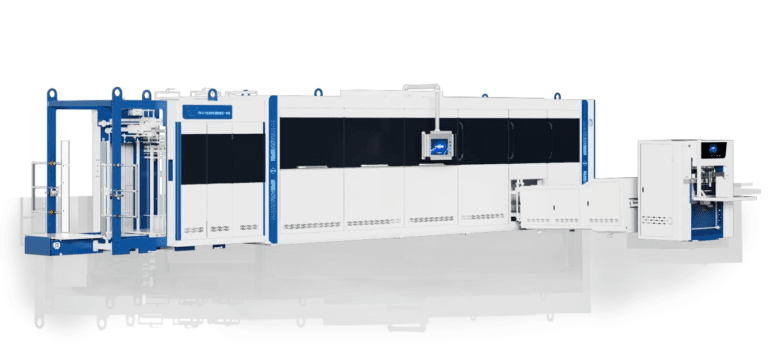
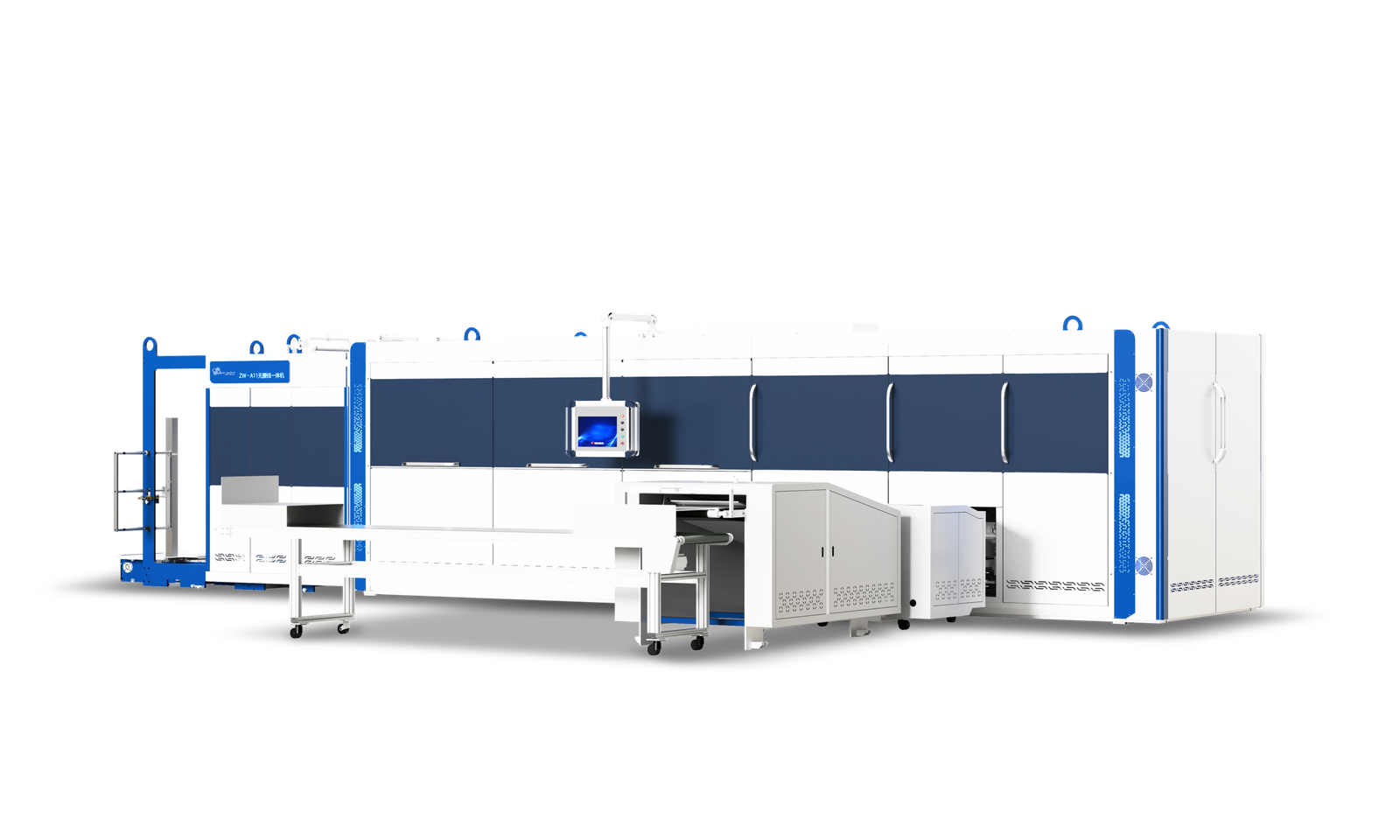
The ZW-A11 flat handle paper bag machine is fed pre-die-cut blanks, so the sheet layout is settled at the printer and die-cutter before paper reaches the machine. Its paper bag blank size window runs from 310 to 680 mm wide and 560 to 1040 mm long. It takes board from 200 to 300 g and runs at 40–45 bags per minute.
What the machine controls is the die allowance, which stays at roughly 2 cm in each direction regardless of bag size. What it does not control is the sheet format, the grain, or makeready at the printer. Those decide most of your paper bill, and they are why we check the layout with buyers rather than quoting die efficiency on its own.
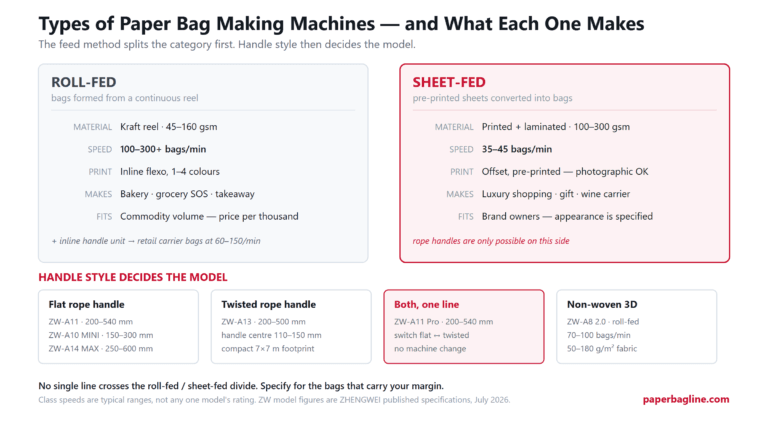
If you are still matching board weight to machine, see what gsm kraft paper suits each machine. For how sheet-fed and roll-fed lines differ upstream, see sheet-fed vs roll-fed paper bag machines.
Frequently asked questions
What is the formula for calculating paper size?
For a paper bag, the formula starts with the flat blank. On a conventional square-bottom bag, blank width is twice the bag width plus twice the gusset plus a glue overlap, and blank length is the bag height plus the bottom folds and top turnover. A one-piece-bottom blank runs the other way, so ask your machine supplier for its drawing. Add the die allowance, then fit the result onto your press sheet.
How do you calculate paper weight per bag?
Multiply the printed sheet area each bag uses by the board grammage. A 360 × 100 × 280 mm bag laid out two-up on a 787 × 1092 mm sheet uses 0.43 m², so on 250 g board it needs about 108 g of paper including trim and offcut. Laid out one-up on 720 × 1020 mm, the same bag needs about 184 g. Multiply by your order quantity to calculate paper for paper bags in tonnes.
How much paper is wasted when making a paper bag?
It depends mostly on the sheet layout. In our worked examples on a sheet-fed machine, die trim took 3–6% of the press sheet, while offcut ranged from 10% to 61% depending on bag size and sheet format. Makeready sheets and rejected bags add to that and vary by job.
What is die trim on a paper bag blank?
Die trim is the border of paper the cutting die needs around each blank so that it cuts a clean edge. It becomes scrap. On the ZW-A11 the allowance is roughly 2 cm in each direction, which works out at about 5–10% of each die-cut sheet for common bag sizes.
Does grain direction matter for a paper bag blank?
Yes, especially on heavy board. Creasing across the grain makes a fold more likely to crack, and grain also affects how stiff the bag stands. Check the grain before accepting a layout that rotates the blank to fit an extra one on the sheet.
Does a one-piece-bottom paper bag use less paper?
Not automatically. A one-piece-bottom blank is long and narrow, while a conventional blank is wide and short. Total area depends on the glue flaps and turnovers each design needs. The larger difference usually comes from how each shape fits your press sheet, so lay both out before assuming either saves board.
Check your bag size against your sheet
Send us your bag dimensions and the press sheet your printer stocks. We will lay out the blank and tell you how many fit before you commit to artwork.
Get in Touch