Automatic vs Semi-Automatic Paper Bag Making Machine (2026)
Many buyers hesitate between an automatic paper bag making machine and a semi-automatic one. What settles it is not the brochure: it is your daily volume, your bag type and your material weight. If you are a factory owner or a procurement manager, the machine has to be affordable and it has to move product, and those two pull against each other.
In short: an automatic paper bag making machine suits factories with bulk orders that need speed. A semi-automatic machine suits owners who need a low entry cost and have an order book that moves around.
This article covers three questions:
- What do automatic and semi-automatic paper bag machines cost to run?
- Which bag types and material weights can each one handle, and which can it not?
- What should you ask a supplier before you decide?
Automatic vs semi-automatic: which suits your factory?
A semi-automatic machine needs people. Workers form, feed and finish by hand, and output depends heavily on how experienced those operators are. It looks flexible, and it is, but the flexibility is bought with labour.
An automatic machine is built for repetition. Labour is needed for loading material, quality checks and packing, and not much else.
The two answer different situations. If your orders are modest and steady and your opening budget is tight, a semi-automatic machine is the lower-risk buy. If you have a settled client base and volume you can count on, an automatic line does more work per shift and takes the output ceiling off your operators.
| Semi-automatic | Roll-fed | Automatic sheet-fed (ZHENGWEI) | |
|---|---|---|---|
| Output | 80–1,000 bags/hour | 30–200 bags/min; 50–580 on flat-bottom food-bag frames | 40–45 bags/min (ZW-A14 MAX: 35–38) |
| Operators | 3–6 per station | 2–3 per line | 2–3 per line |
| Material | varies by model | 35–150 g/m² kraft from reel, no single model spans it all | 180–300 g cardboard sheets |
| Bag type it suits | simple flat and satchel bags, handles attached by hand | kraft retail carrier bags, bakery and takeaway bags | printed retail and luxury bags with rope handles |
| Publicly listed price range | $2,000 – $15,000 | $25,000 – $80,000 | from about $170,000, quoted per configuration |
Semi-automatic machines: what the work actually looks like
A semi-automatic line runs on people. Each of these stages is a person:
- Feed station. Workers load paper sheets by hand.
- Bottom station. Workers lift the gusset panels open.
- Handle station. Workers feed and press rope handles on, one bag at a time.
- Delivery. Workers count and stack the finished bags.
Every bag repeats every step, for the whole shift.
Staffing. Three to six operators per station. Flat bags need fewer; gusseted bags with hand-attached rope handles need more.
Output. Eighty to 1,000 bags per hour. The ceiling is set by the operators, not by the machine, so team size, experience and bag type decide where you land inside that range. An experienced team will beat an inexperienced one on the same equipment.
Automatic machines: what changes
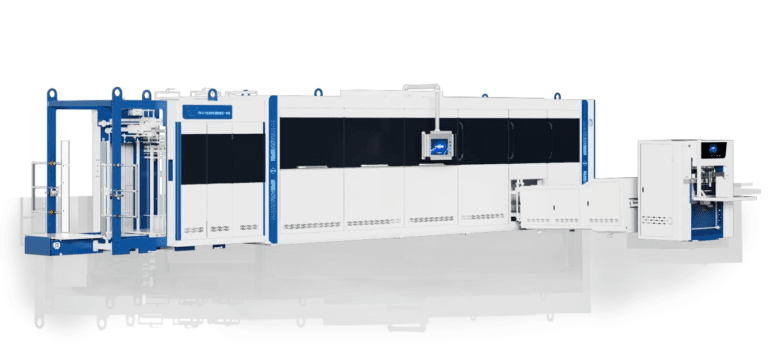
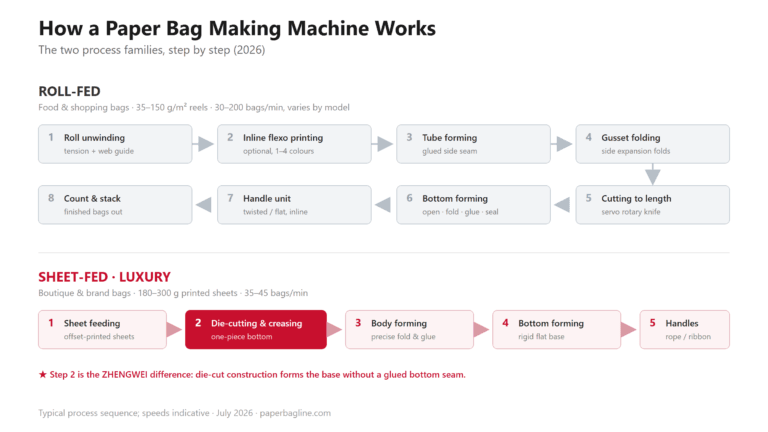
A fully automatic paper bag making machine takes forming, folding, gluing and handle fitting off the operators; our step-by-step process guide walks through each station. Two to three people load material, check quality and pack.
The point worth holding onto is that the headcount does not move. It is the same two or three people whether the line runs a partial batch or a full shift at capacity. Volume scales with machine speed, not with team size.
Speed and material by machine class
Thin kraft carrier bags. Roll-fed frames run from 30 up to 200 bags per minute, but no single machine covers that whole span. The fastest, narrowest frames reach 200 bags per minute on lighter 50–130 g/m² paper. Heavier-duty frames run 30–110 to 30–130 bags per minute on stock up to 150 g/m².
Flat-bottom food bags. Flat-bottom food-bag frames run 35–80 g/m² stock at 50–500 bags per minute on narrower models and up to 50–580 on wider ones.
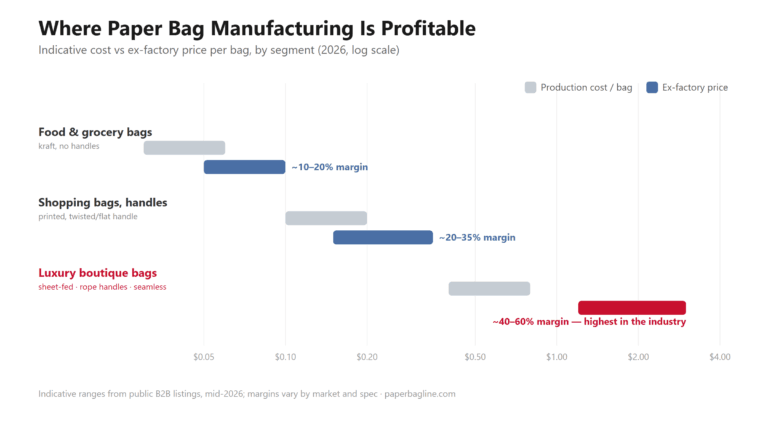
Printed retail and luxury bags. This is automatic sheet-fed territory. The ZHENGWEI crease-free range runs at 40–45 bags per minute on 200–300 g cardboard sheets, or 180–300 g on the ZW-A10 MINI and ZW-A13. The ZW-A14 MAX, built for larger formats, runs 35–38.
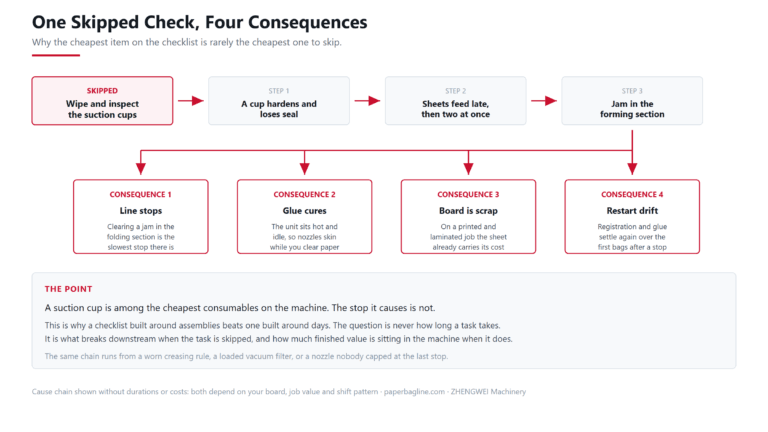
Tip: When you visit a supplier, ask them to run a changeover in front of you, using your bag size and your board, not their demo setup. Time it yourself. A changeover figure quoted in a brochure was measured under conditions nobody will tell you about.
Cost per 1,000 bags: where the two actually separate
Labour is the line that moves. It is a per-shift gap, so it widens every day the line runs.
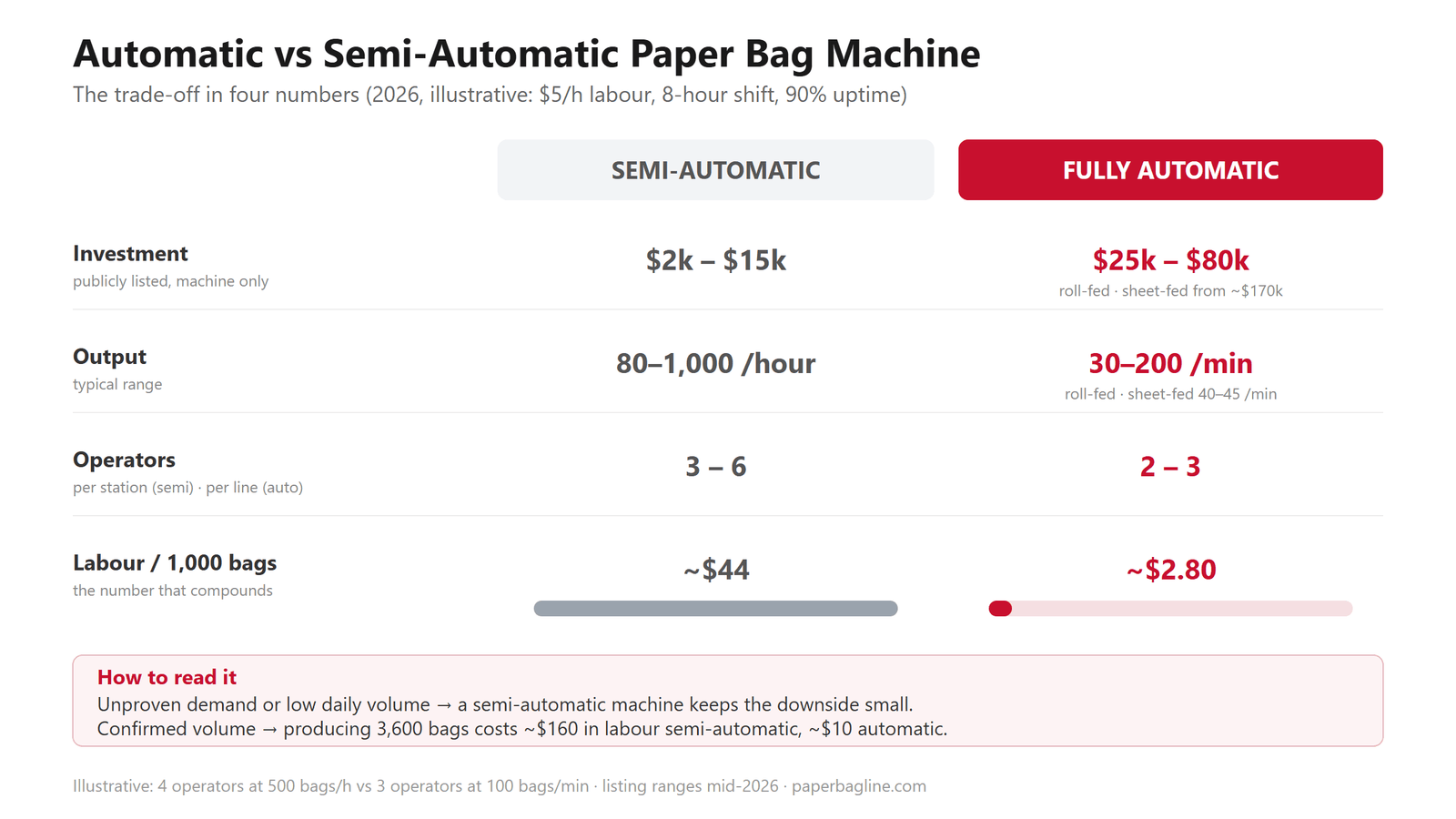
The worked example below assumes an operator cost of $5 per hour all-in, an 8-hour shift and 90% uptime. These are assumptions. Substitute your own.
Semi-automatic line. Four operators at 500 bags per hour produce roughly 3,600 bags per shift. Labour is 4 × $5 × 8 = $160 per day, which works out at about $44 per 1,000 bags.
Automatic line. A roll-fed automatic paper bag making machine at 100 bags per minute with three operators produces roughly 43,200 bags in the same shift. Labour is 3 × $5 × 8 = $120 per day, or about $2.80 per 1,000 bags.
Compare them at the same output rather than over the same day. Producing 3,600 bags costs $160 in labour on the semi-automatic line and about $10 on the automatic one, a difference of roughly $150 for that quantity at these assumed rates. Against that, semi-automatic machines are publicly listed at $2,000 to $15,000 and automatic roll-fed lines at $25,000 to $80,000. Our 2026 price guide breaks those ranges down.
Tip: When you compare labour cost per 1,000 bags, substitute your own wage rate and the utilisation you can defend with orders you already have. A calculation run at 90% uptime and a $5/hour wage is an illustration, not a forecast, and a new line rarely starts at the number in the illustration.
When is a semi-automatic machine the better buy?
Three situations.
Unproven demand. If you do not yet know whether customers will buy enough bags to justify automation, a semi-automatic machine keeps the downside small. Test the market, then buy to your actual volume.
Low daily volume. If a small skilled team can absorb your order flow, a semi-automatic machine fits it. An automatic paper bag making machine running well below capacity takes too long to pay for itself.
Bag type and material weight. ZHENGWEI’s crease-free sheet-fed machines have a 180 g minimum and run pre-printed cardboard sheets, not paper from a reel. If your product is a plain kraft grocery bag in the 45–160 g/m² range, these machines cannot make it. That is a roll-fed job.
Why changeover matters more than the speed figure
Changeover times in brochures are usually unreliable, because suppliers rarely say how they were measured.
On a semi-automatic machine, a size change is manual: resetting guides, repositioning the seal bar, re-registering the sheet feed by hand. Every parameter goes back to zero on every switch, and every step lands on the operator.
On a fully automatic line, most of the set-up can be stored in the control system (the PLC) as a recipe, so switching sizes means loading stored settings instead of rebuilding them. Automatic tool repositioning does exist elsewhere in ZHENGWEI’s range: the ZW-A8 non-woven machine repositions its moulds automatically on a tooling change. That is a different machine from the paper bag range, so treat it as a sign of what automation can do, not as a feature of the ZW-A11 or ZW-A13.
The only time figure worth trusting is the one you measure yourself, at the supplier’s factory, on your own bag specification.
Tip: Ask what happens after the engineer arrives. ZHENGWEI includes 7 days of installation and commissioning; from day 8 the engineer is charged at US$100 per day plus travel and accommodation. That clock starts whether or not your building has power to the control panel, so have the site, the labour and the tools ready before the machine ships.
How should you choose?
Three questions, in this order:
- What is the bag type, and what does it weigh?
- What is your confirmed daily volume, counted from orders you already hold rather than from projections?
- At your wage rate, does the cost per 1,000 bags favour automation?
For the full checklist, see our machine selection guide.
Where ZHENGWEI machines fit
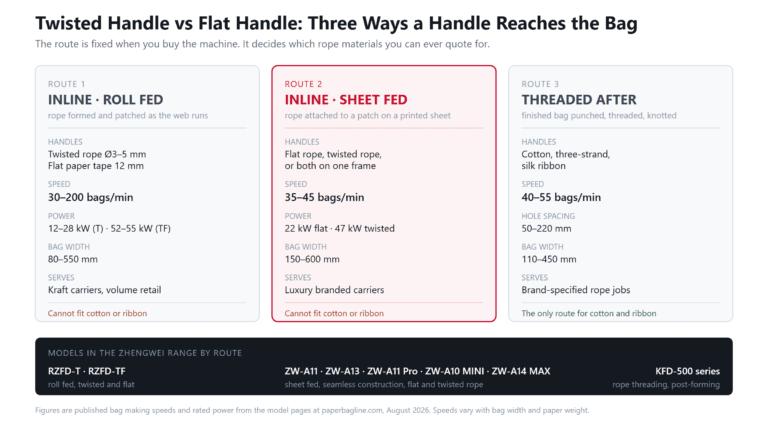
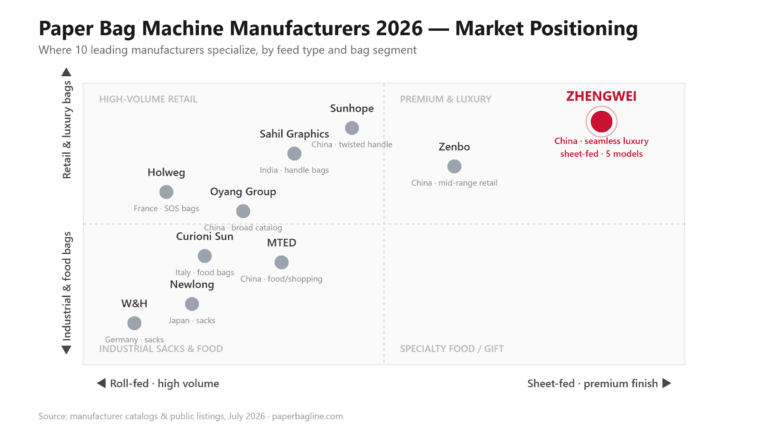
ZHENGWEI builds sheet-fed, crease-free paper bag machines for printed retail and luxury bags. The range runs from the ZW-A10 MINI for small formats to the ZW-A14 MAX for large ones, with the ZW-A11 for flat rope handles, the ZW-A13 for round rope handles, and the ZW-A11 PRO for both on one machine.
They take 200–300 g cardboard sheets, or 180–300 g on the ZW-A10 MINI and ZW-A13, and run at 40–45 bags per minute, or 35–38 on the ZW-A14 MAX. The bags they produce have a one-piece bottom, meaning the base is formed without a bottom seam.
They are not the right machine for everyone. They are sheet-fed, so they do not run paper from a reel, and they do not run stock below 180 g. A producer whose product is a plain kraft grocery bag needs a roll-fed machine, and we would tell them so.
Lead time is 60 days after deposit. Payment is 30% deposit and 70% before shipment. One engineer travels for installation, with the first 7 days of commissioning included.
Not sure which class of machine fits? Tell us your bag type, your board weight and your daily target, and we will tell you which class of machine fits the job, including when the answer is not ours. See the machines or talk to our engineers.
Frequently asked questions
How much does a semi-automatic paper bag machine cost?
Publicly listed semi-automatic paper bag machine prices run from $2,000 to $15,000 in 2026. That is a marketplace listing range, not a ZHENGWEI quotation: ZHENGWEI does not build semi-automatic machines.
How many workers does each type need?
A semi-automatic line needs 3–6 operators per station, depending on bag complexity. A fully automatic line needs 2–3 operators for material loading, quality checks and packing.
At what volume does an automatic machine pay off?
There is no single volume, because the crossover moves with your wage rate and your uptime. Using the assumptions in this article, $5 per hour all-in, 8-hour shifts and 90% uptime, a semi-automatic line at 500 bags per hour with four operators carries about $44 of labour per 1,000 bags, against about $2.80 on an automatic line.
Can a semi-automatic machine make bags with handles?
Yes, but the handles are attached by hand or on a separate machine rather than inline, which is slower and harder to keep consistent. Fully automatic roll-fed machines attach twisted or flat rope handles inline.
Is there an automatic machine for luxury paper bags?
Yes. Automatic sheet-fed machines make luxury bags from pre-printed cardboard sheets. ZHENGWEI’s crease-free models run at 40–45 bags per minute, and the ZW-A14 MAX at 35–38.