Twisted Handle vs Flat Handle Paper Bags: Machines Compared (2026)
On the bag, the difference between a twisted and a flat handle is look and carrying comfort. On the machine, it is a different question: it decides how many stations your line carries, how much power it draws, which rope materials you can ever quote for, and whether one frame can do both. A twisted handle paper bag machine is not a flat handle machine with a different attachment. It is a different build.
This guide compares the two from the buyer’s side of the specification sheet. It covers the three routes a handle can take onto a bag, the published figures for each, and the three questions that settle the choice for most converters.
Twisted and flat handles, defined on the machine side
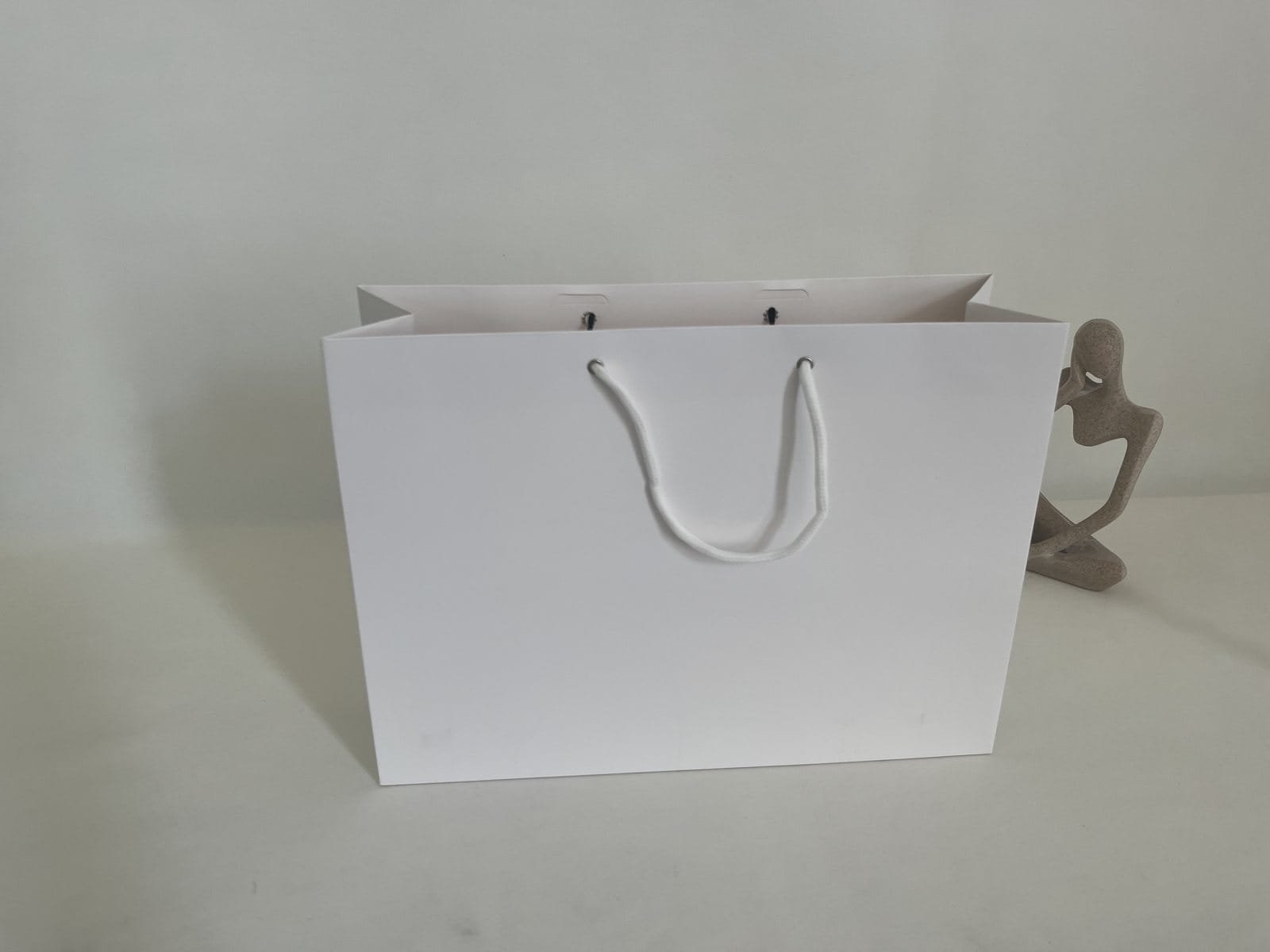
A twisted handle is a paper rope, twisted from a narrow paper ribbon and glued to a reinforcing patch inside the bag mouth. On roll fed frames the rope typically runs Ø3 to 5 mm. A flat handle is flat tape, either a 12 mm paper tape on a roll fed line or a flat woven rope on a sheet fed luxury bag, glued down the same way.
Both need a patch, and both need hot-melt adhesive with enough open time to bond before the blank moves on. The difference is what happens before the patch: twisted rope has to be formed and cut to length first, which is a station a flat handle line does not carry.
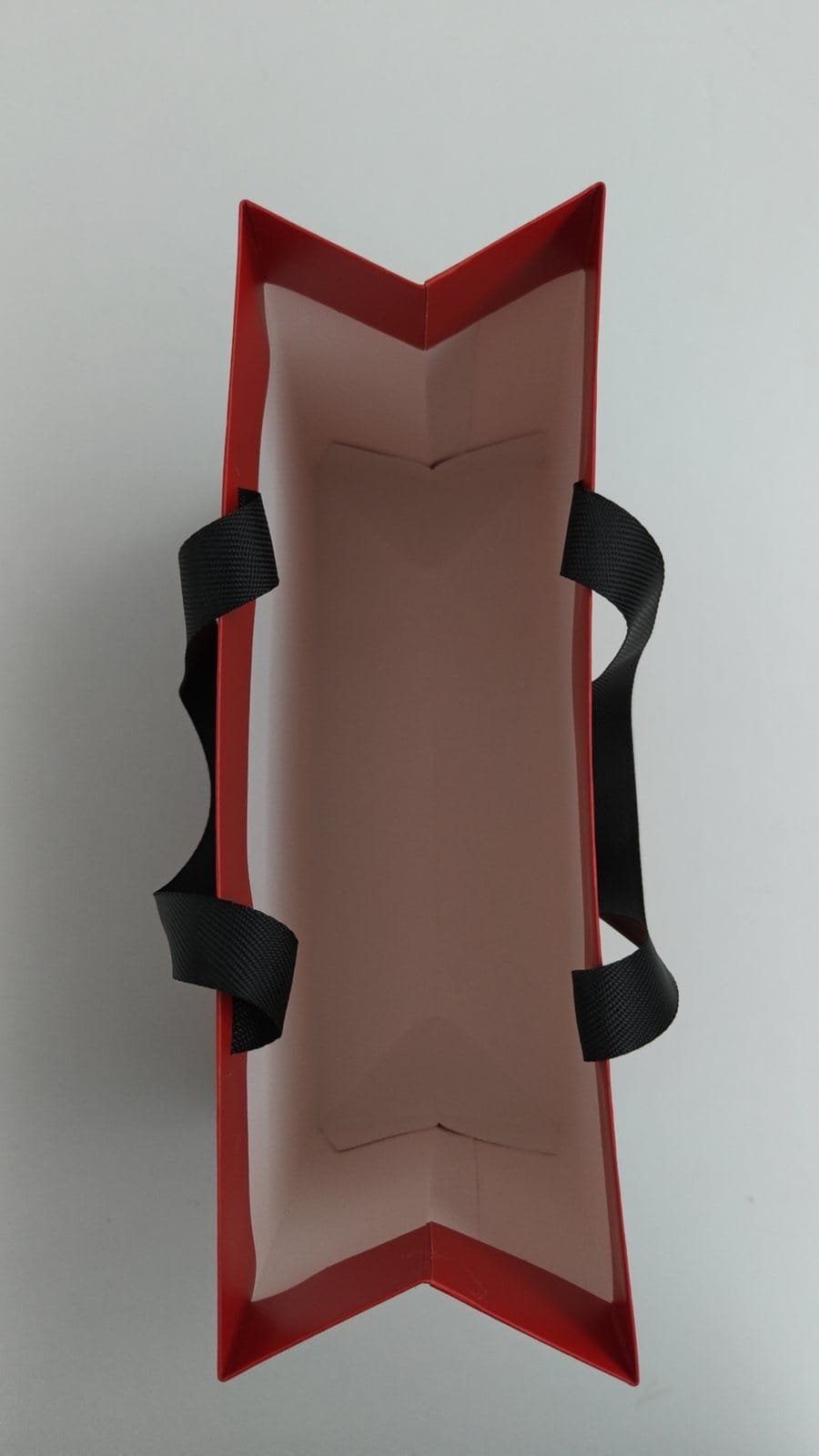
The three routes a handle takes onto a bag
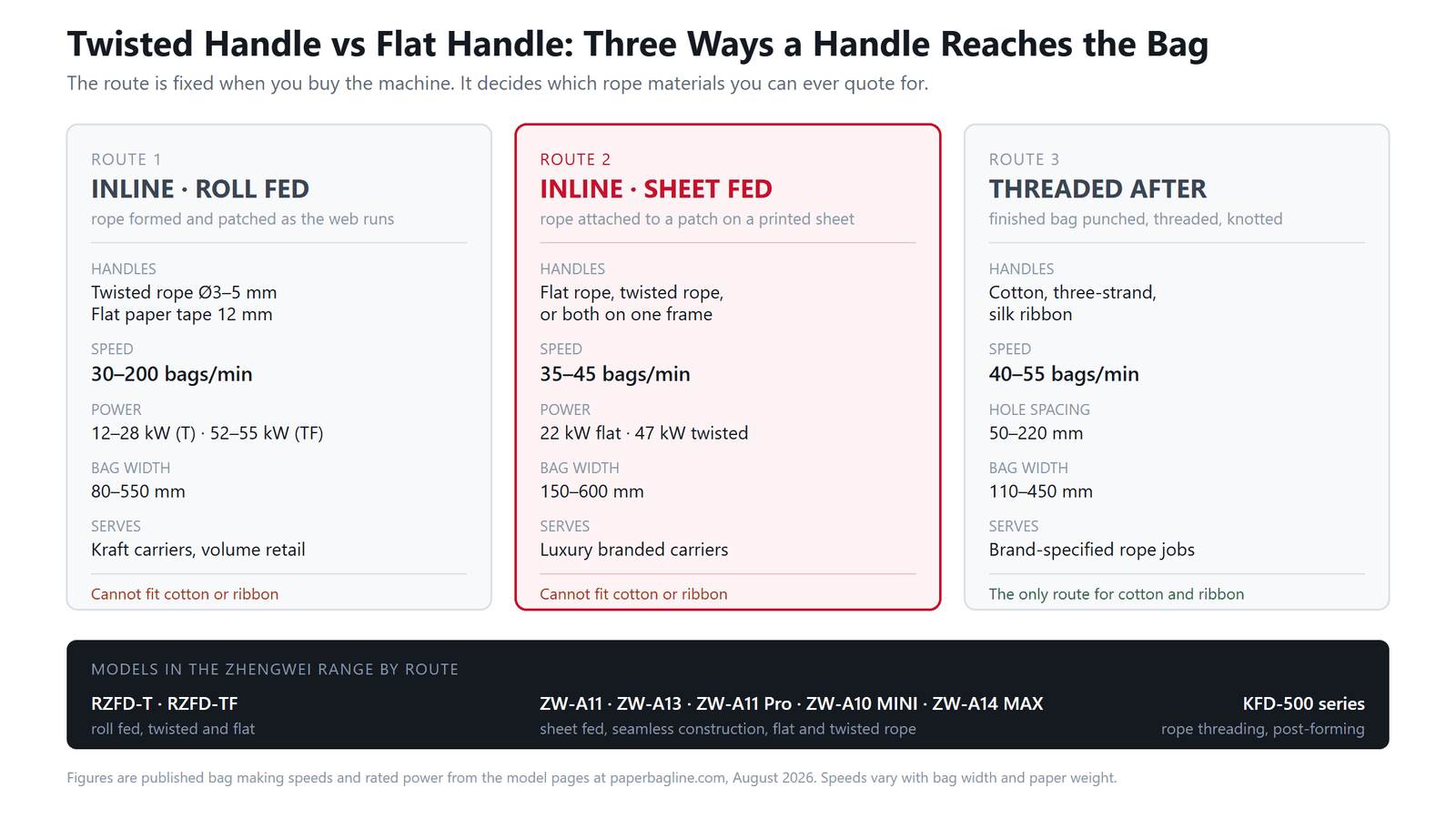
Most comparisons of paper bag handle types stop at the bag. There are three production routes, and they are not interchangeable. Picking the wrong one is the expensive mistake in this category, because the route is fixed at purchase.
| Route | How the handle gets on | Handles possible | Typical speed |
|---|---|---|---|
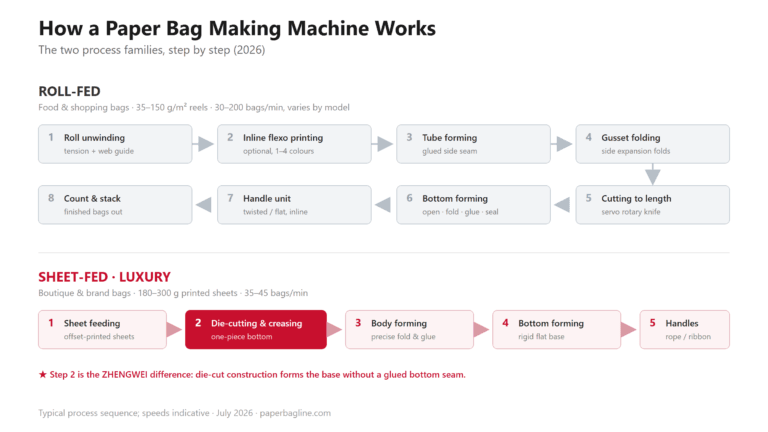
| Inline, roll fed | Rope formed and patched as the web runs | Twisted rope, flat paper tape | 30–200 bags/min |
| Inline, sheet fed | Rope attached to a mouth patch on a printed sheet | Flat rope, twisted rope, or both | 35–45 bags/min |
| Threaded after forming | Finished bag punched, threaded and knotted | Cotton, three-strand, silk ribbon | 40–55 bags/min |
The third route exists for a physical reason. Cotton rope and silk ribbon cannot be glued down inline, so a bag carrying either was punched and threaded after it was formed. If a brand ever specifies a cotton handle, no inline machine of any kind will produce it.
Tip: Before you compare handle machines, count how many of last year’s orders specified cotton or ribbon. If it is more than about one order in ten, budget for a rope threading machine alongside the forming line rather than expecting one frame to cover both. Threading runs 40 to 55 bags per minute on bags 180 to 450 mm wide, so it is a real second line, not an accessory.
What a twisted handle paper bag machine adds to the build
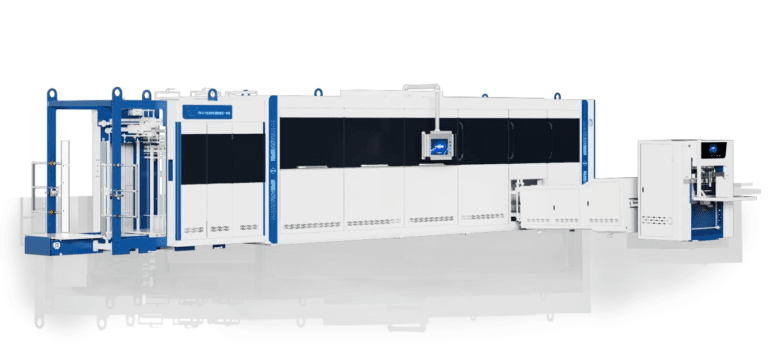
A twisted handle paper bag machine carries a rope unit the flat handle version does not have: an unwind for the paper ribbon, a twisting head, a cut-off, and the transfer that lays the cord onto the patch. Those stations show up in the published figures.
The clearest example in our range is the sheet fed pair. The ZW-A13 twisted handle paper bag machine is built for round twisted rope and is rated 47 kW, published as 35 plus 12. The second number is the rope side. The ZW-A11 flat handle paper bag machine is rated 25 kW on the same 40 to 45 bags per minute.
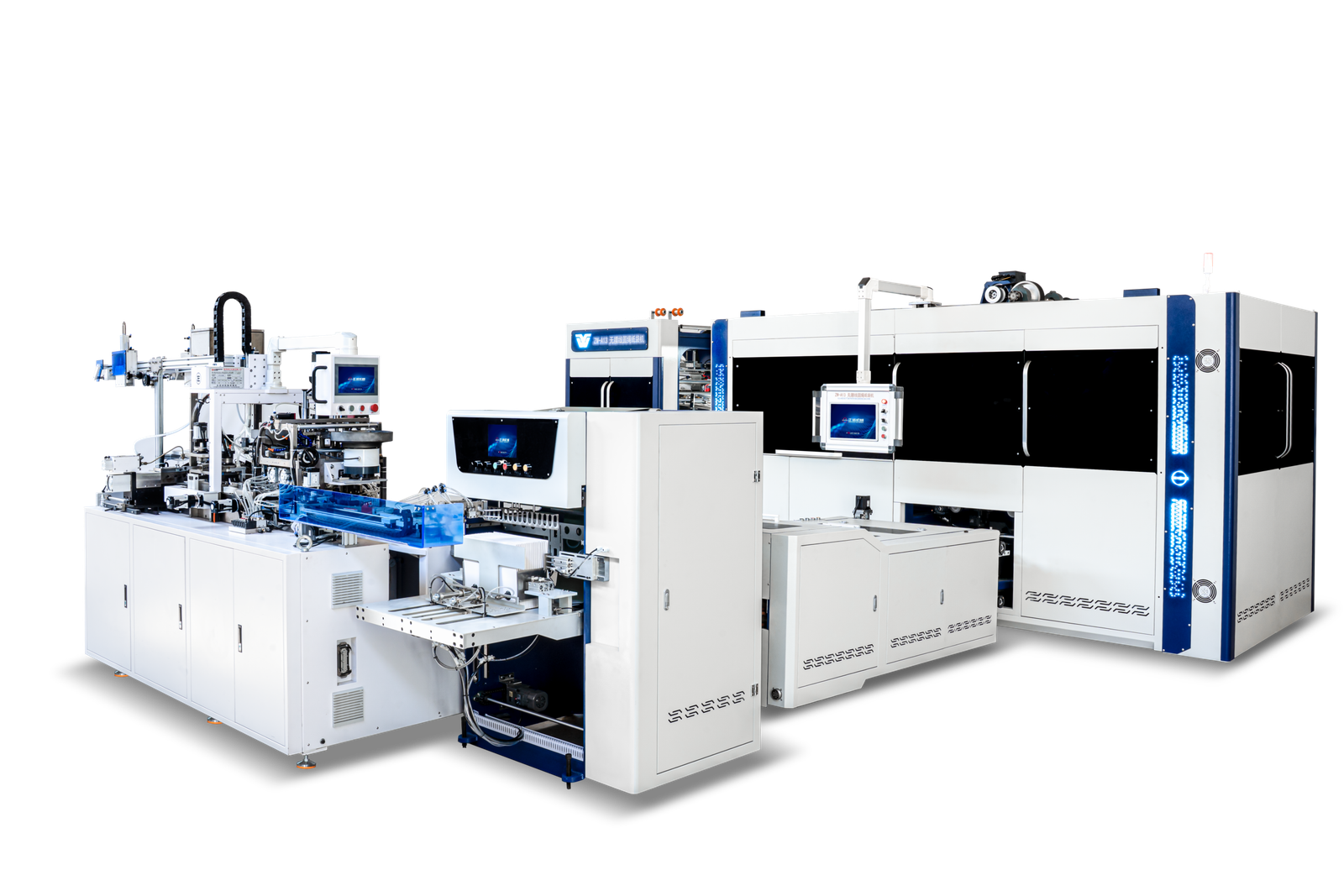
Two figures on the ZW-A13 have no equivalent on a flat handle machine. Rope length is adjustable 340 to 460 mm, and handle centre distance is adjustable 110 to 150 mm. Centre distance is the one buyers forget to ask about. It is what lets you match a brand’s existing bag rather than telling the brand its handle spacing has to change.
On the roll fed side the same logic applies at a larger scale. Roll fed machines split into twisted-rope-only frames at roughly 12 to 28 kW, and dual-handle frames that make twisted rope and 12 mm flat tape and carry an inline printing unit, at 52 to 55 kW.
What a flat handle machine gives up, and what it gains
A flat handle paper bag machine is the simpler build, and the simplicity buys format range rather than speed. The ZW-A11 covers 200 to 540 mm bag width against the ZW-A13’s 200 to 500 mm, on the same speed and the same 180 to 300 g mouth patch.
Flat handles also stack better. A flat rope sits close to the bag face, so finished bags nest more densely in the carton, which matters when you are quoting delivered price to a customer three countries away. Twisted rope adds bulk in the same carton.
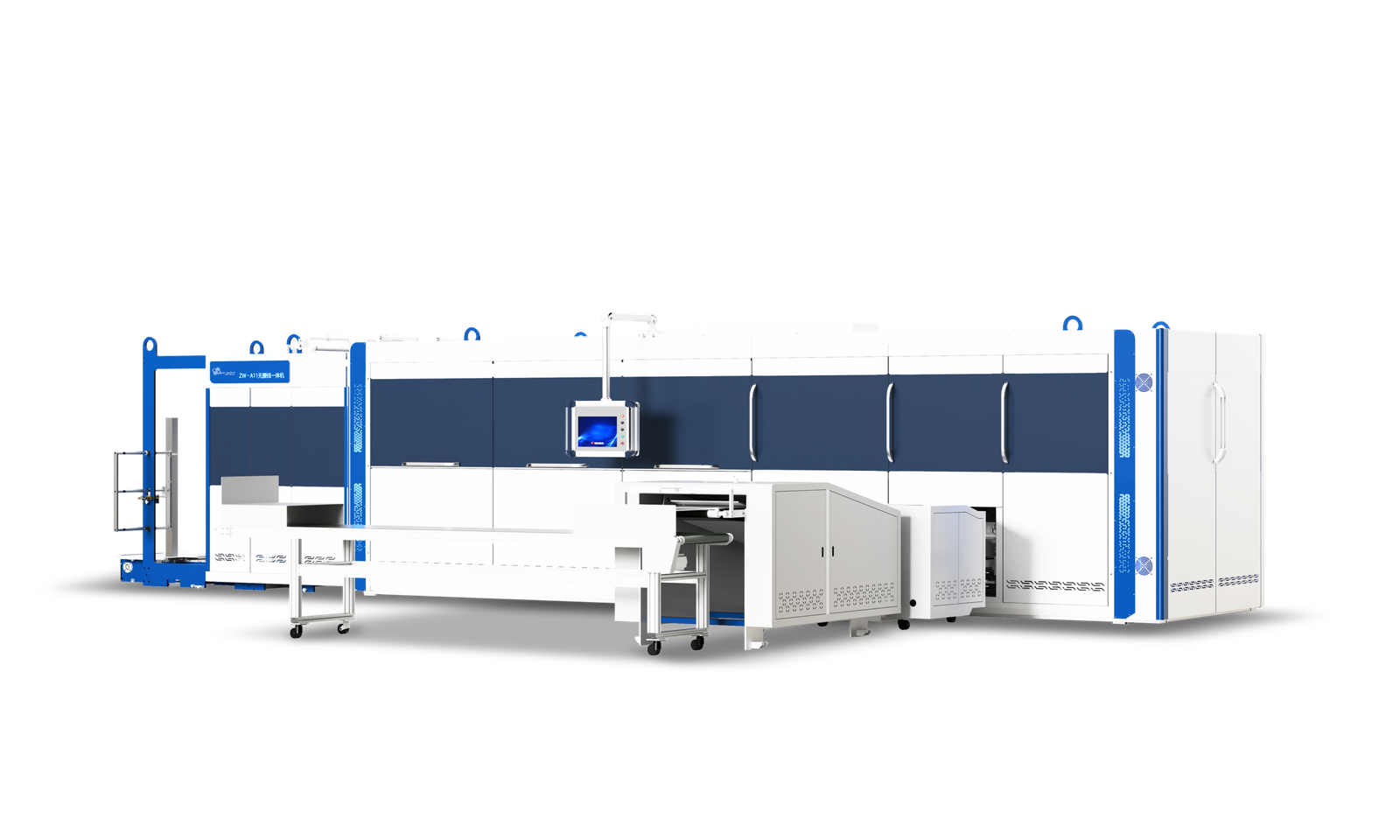
Two more flat rope models sit either side of it. The ZW-A10 MINI runs 150 to 300 mm bags for jewellery and cosmetics work, and the ZW-A14 MAX extends to 600 mm wide with 300 mm gussets at 35 to 38 bags per minute. Both are flat rope only.
Twisted handle paper bag machine versus flat: the numbers that cost money
Published specifications for the models in our range, taken from the product pages rather than from class averages. Speeds are bag making speeds, not mechanical maxima.
| Model | Handle | Bag width | Speed | Power | Footprint |
|---|---|---|---|---|---|
| ZW-A11 | Flat rope | 200–540 mm | 40–45/min | 25 kW | 10.5 × 7 m |
| ZW-A13 | Twisted rope | 200–500 mm | 40–45/min | 47 kW (35 + 12) | 7 × 7 m |
| ZW-A11 Pro | Flat and twisted | 200–540 mm | 40–45/min | 25 kW | 10.5 × 7 m |
| ZW-A10 MINI | Flat rope | 150–300 mm | 40–45/min | 22 kW | 8.8 × 7 m |
| ZW-A14 MAX | Flat rope | 250–600 mm | 35–38/min | 22 kW | 11 × 7 m |
Read the power column next to the speed column. The ZW-A13 draws almost twice the ZW-A11 for the same output, and that gap is the rope unit running continuously. Over a two-shift year it is a real line item, though usually a smaller one than the labour difference between an automatic and a semi-automatic line, which we work through in fully automatic vs semi-automatic paper bag machines.
Tip: Ask any supplier for the handled format range and the unhandled format range as two separate numbers. On a 330 mm dual-handle reel frame the bag runs 120 to 330 mm without a handle but only 200 to 330 mm with one, because the handle patch consumes web width. Buying against the unhandled figure and then discovering your 150 mm gift bag will not take a rope is a costly way to learn this.
When one machine should make both handle types
Two frames in the range run both. The ZW-A11 Pro switches between flat and round rope on one sheet fed line at 200 to 540 mm, and dual-handle reel frames do the same on the roll fed side while also printing inline.
Dual capability is worth paying for when your order book has not settled. A converter serving five brands, two of which specify twisted rope and three flat, spends more on changeovers between dedicated machines than the dual frame ever costs. A converter with one large account specifying one handle style is better served by a dedicated twisted handle paper bag machine at lower power and lower cost.
There is a limit worth stating plainly. Neither the ZW-A11 nor the ZW-A13 can be converted to the other handle type after purchase. Each is purpose-built, and the honest answer when a customer asks about upgrading later is to buy the ZW-A11 Pro at the start instead.
What each route costs
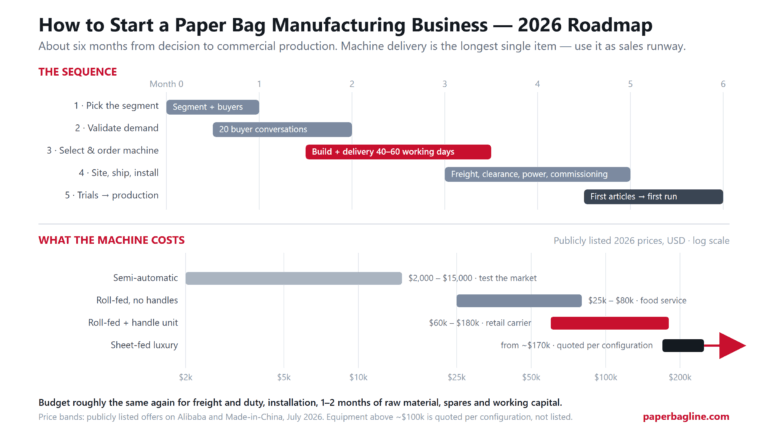
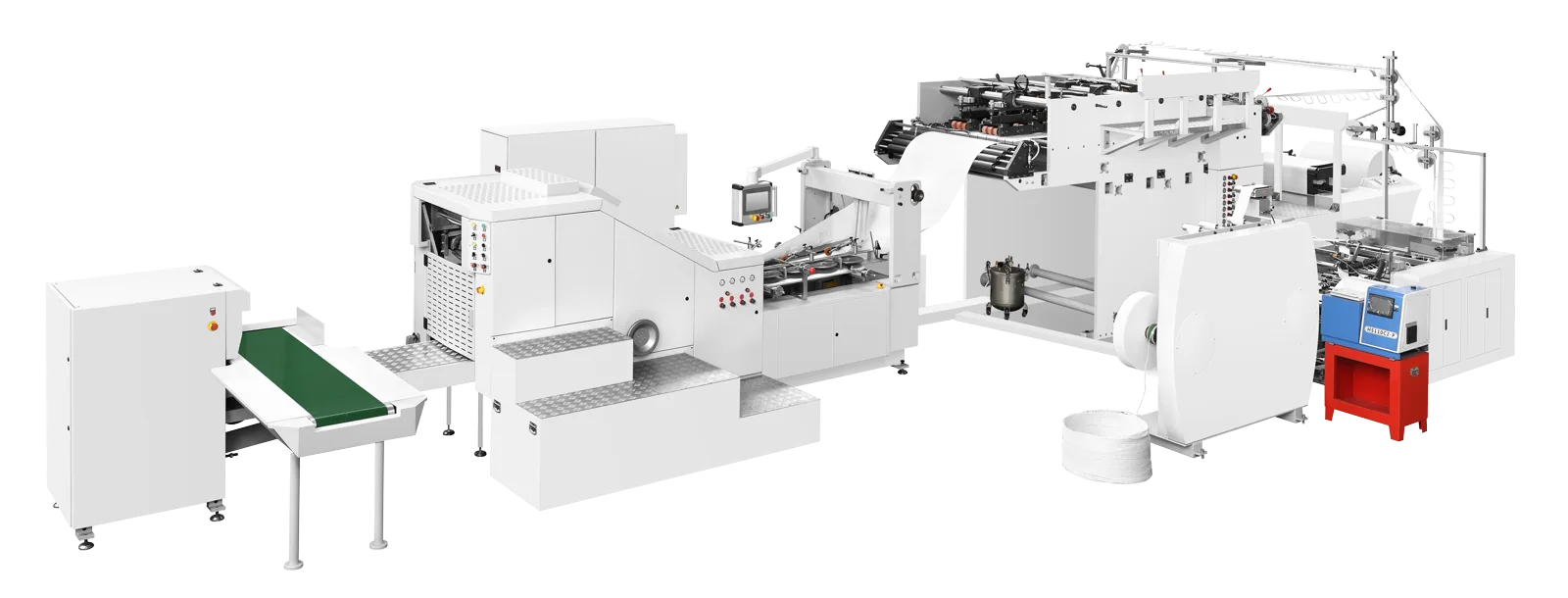
Our own prices are quoted per configuration rather than published, but the public market bands are useful for budgeting, and they line up with the routes above. Roll fed lines without a handle unit trade in roughly the $25,000 to $80,000 band. Adding an inline handle unit moves that to roughly $60,000 to $180,000, and the unit itself accounts for something like $30,000 to $100,000 of the difference depending on handle type and speed.
Sheet fed luxury lines start higher, from roughly $170,000, because the machine is doing finer work on heavier board at a fifth of the speed. Our paper bag machine price guide sets out where those bands come from and what moves a quote inside them.
Tip: When you compare two quotes for a twisted handle paper bag machine, normalise on handled width and delivered speed at your own paper weight, not on the headline figures. Ask for the speed at the widest bag you actually sell. A frame quoted at 200 bags per minute on an 80 mm bag may be a 110 bag per minute machine at 550 mm.
Which handle should your machine make?
Feature-by-feature comparison rarely settles this, because both handle types work. Three questions about your own order book do.
- Who specifies the bag, you or your customer? If the brand hands you a spec, handle style is not your decision, and the machine has to match what your accounts already buy. If you are selling stock bags, choose on cost and pick flat.
- How heavy is the loaded bag? Twisted rope carries more and stays comfortable under load, which is why it dominates gift, wine and premium retail. Flat is sufficient below a few kilograms and cheaper per bag.
- Will you ever be asked for cotton or ribbon? If yes, an inline machine of either type will not cover it, and the threading route belongs in the plan from the start.
If you want the wider selection framework beyond handles, see how to choose a paper bag making machine, and types of paper bag making machines for how handle choice sits inside the wider category.
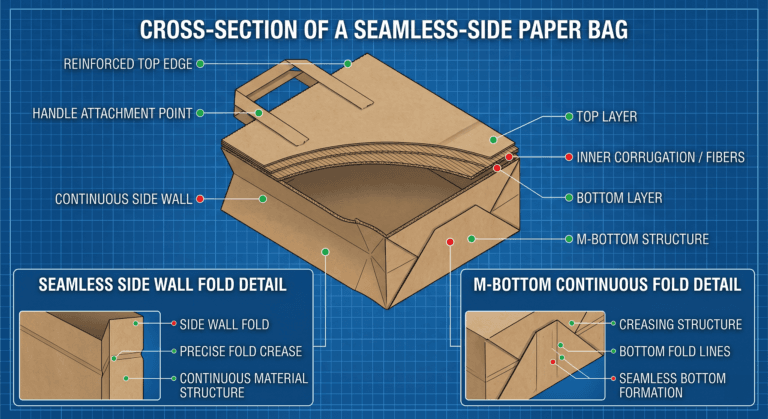
One construction note that cuts across both handle types on our sheet fed models. All five use ZHENGWEI’s patented seamless construction, which forms the side wall from a single fold instead of gluing an overlap, and it applies whether the handle on top is flat or twisted. The bag body and the handle are separate decisions. You can see both handle styles on finished work in our bag samples, and the paper handbag making machine page maps handle styles to models in more detail.
Frequently asked questions
What is the difference between a twisted handle and a flat handle paper bag?
A twisted handle is a paper cord, twisted from a ribbon of paper and glued to a reinforcing patch inside the bag mouth. A flat handle is flat tape or flat woven rope attached the same way. Twisted rope carries more weight comfortably and reads as premium, so it dominates gift and wine packaging. Flat handles cost less per bag and stack more densely in the carton, which is why food service and volume retail use them.
Which machine makes twisted handle paper bags?
On sheet fed luxury work, a purpose-built twisted handle paper bag machine such as the ZW-A13 produces 200 to 500 mm bags at 40 to 45 per minute with adjustable rope length of 340 to 460 mm. On roll fed work, twisted-rope frames make handles at Ø3 to 5 mm from 30 to 200 bags per minute. The two serve different markets: printed board carriers versus high-volume kraft bags.
Can one machine make both twisted and flat handles?
Yes, on frames built for it. The ZW-A11 Pro switches between flat and round rope on one sheet fed line, and roll fed dual-handle frames run both a Ø3 to 5 mm twisted rope and a 12 mm flat handle on the same frame. Dedicated machines cannot be converted after purchase, so if you expect both handle types, specify a dual frame at the start rather than planning an upgrade.
How much does a twisted handle paper bag machine cost?
Public market bands put roll fed lines with an inline handle unit at roughly $60,000 to $180,000, against $25,000 to $80,000 for the same class without handles. Sheet fed luxury machines start from roughly $170,000. The handle unit alone typically accounts for $30,000 to $100,000 depending on handle type and line speed. Configured quotes vary with format, speed and tooling, so treat these as budgeting bands.
Flat handle vs twisted handle: which is stronger?
Generally yes, and the reason is the patch as much as the rope. A twisted cord distributes load across a round section and is usually fitted to a heavier reinforcing patch, so it stays comfortable under a loaded bag. Flat handles are adequate for lighter contents. On both, the failure point in practice is the patch bond rather than the handle itself, which is why patch weight and adhesive open time matter more than rope diameter.
Can handles be added to paper bags after they are made?
Yes, and for cotton rope or silk ribbon it is the only method, because those materials cannot be glued down inline. A rope threading machine punches the finished bag, threads the rope and knots it, running 40 to 55 bags per minute on bags 180 to 450 mm wide with hole spacing from 50 mm. Many converters run an inline handle line for volume and keep a threading machine for premium jobs.
Not sure which handle route fits your order book?
Send us the bag you need to produce, including width, board weight, handle style and monthly volume, and we will tell you which route fits, including when the answer is a threading machine rather than a forming line. Configured quotes within 24 hours, and free physical samples produced on the model we recommend.
Related reading: Types of Paper Bag Making Machines · How Does a Paper Bag Making Machine Work? · Our Machines