Types of Paper Bag Making Machines & Their Applications (2026)
Search for a bag machine and you will be shown what looks like a dozen different products: SOS machines, square bottom machines, twisted handle machines, sheet-fed machines, V-bottom machines, roll-fed machines. In reality the types of paper bag making machines sort into three dimensions, and most of those product names are just a point where the three overlap. Once you see the dimensions, the category stops being confusing.
This guide sets out the three axes that actually classify a machine, walks through each type with what it produces and where it fits, and finishes with a map from application to machine so you can find your own use case rather than reading the whole thing.
The three axes that classify the types of paper bag making machines
Before the type names, here is the structure underneath them. All the types of paper bag making machines on the market are described by these three choices, and a vendor’s product name is usually just shorthand for one combination.
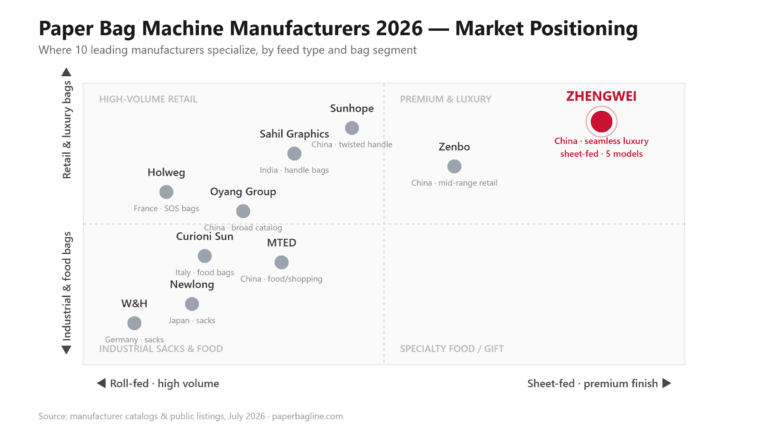
- How the paper arrives — from a reel (roll-fed) or as pre-cut, usually pre-printed sheets (sheet-fed). This is the biggest single divide and it decides almost everything downstream: speed, print quality, paper weight and the market you can serve.
- What the bag looks like — flat/V-bottom, square bottom (SOS), or a handled carrier. This decides the forming section.
- How automated it is — manual, semi-automatic, or fully automatic. This decides labour cost per thousand bags far more than it decides bag quality.
A “square bottom paper bag machine” is axis 2. A “roll-fed twisted handle machine” is axes 1 and 2. A “semi-automatic SOS machine” is axes 2 and 3. They are not competing categories — they are coordinates.
Type 1: Roll-fed machines
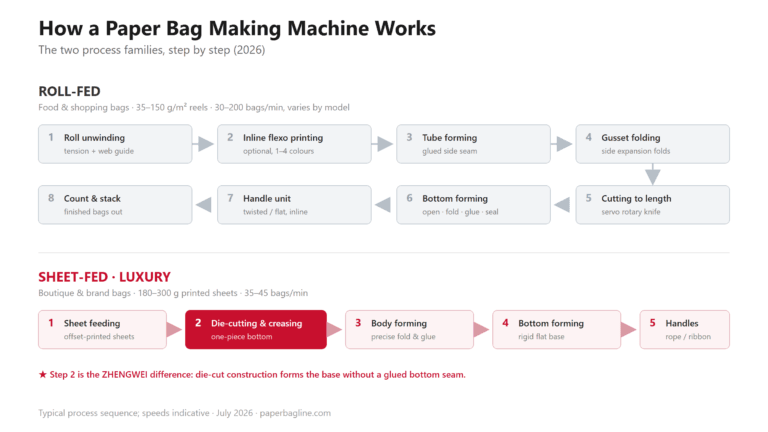
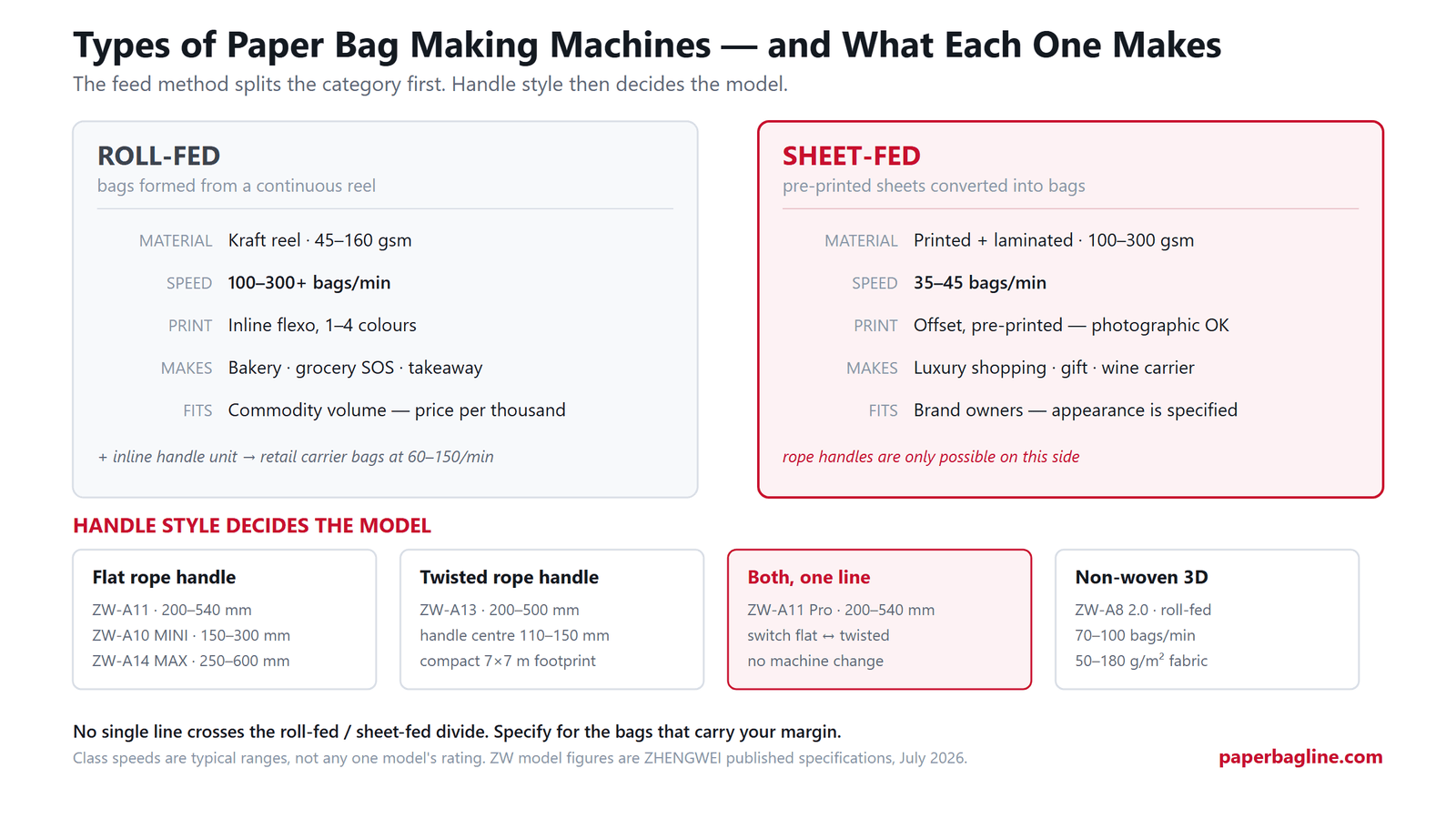
A roll-fed paper bag machine draws paper from a reel, forms the tube, glues the bottom and cuts individual bags in one continuous pass. Because the web never stops, these are the fastest machines in the category — commonly 100 to 300+ bags per minute — and they usually run kraft in the 45–160 gsm range.
Printing, if any, is done inline by a flexo unit of one to four colours. That is adequate for a logo and simple graphics but not for photographic or heavily branded work.
What it makes: bakery bags, grocery SOS bags, takeaway and food service bags, pharmacy bags, seed and hardware bags.
Where it fits: high-volume commodity production where cost per thousand bags is the whole competition.
Where it does not: laminated finishes, rope handles, heavy cardstock, or anything a fashion or cosmetics brand would specify.
Type 2: Sheet-fed machines
A sheet-fed paper bag machine starts from sheets that have already been printed — normally offset, often laminated — and converts them into finished bags. Feeding sheets rather than a web is slower, typically 35 to 45 bags per minute, and the trade is deliberate: you get offset print quality, matt or gloss lamination, heavier board (roughly 100–300 gsm) and rope handles, none of which a roll-fed line can produce.
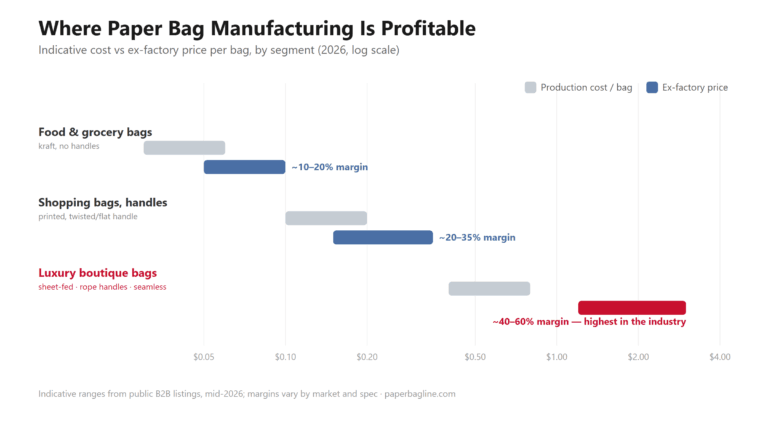
This is the machine type behind the bags handed over the counter in fashion, cosmetics and fragrance retail. Margins here are structurally higher than in food service precisely because the buyer is specifying appearance, not price per thousand.
What it makes: luxury shopping bags, branded retail carriers, gift bags, wine carriers.
Where it fits: converters serving brand owners and premium retail.
Where it does not: commodity food bags — the economics do not work at this speed.
Disclosure: this guide is published by ZHENGWEI, whose range is five sheet-fed luxury machines, one non-woven machine and rope handle threading machines. Where a category sits outside that range, this guide says so rather than steering you toward us.
The middle case: roll-fed with an inline handle unit
Between the two sits a hybrid worth knowing about, because it is where a lot of general retail bag production actually happens. A roll-fed line can be specified with an inline handle unit that attaches twisted or flat handles as the web runs, producing carrier bags at 60–150 bags per minute — slower than a plain roll-fed line, far faster than sheet-fed.
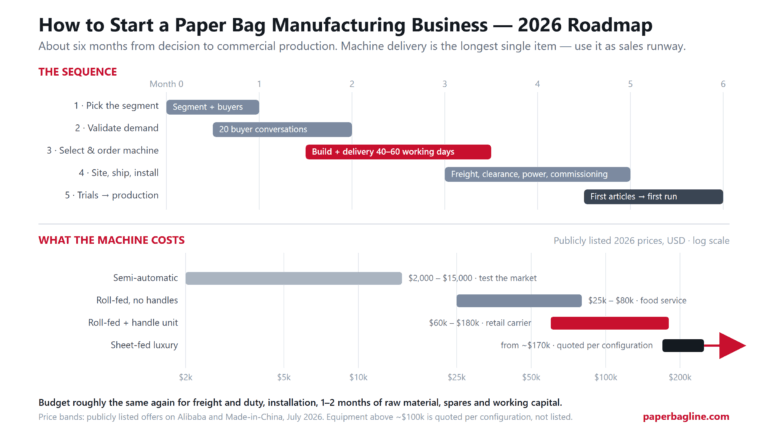
What you get is a handled bag at commodity economics. What you give up is finish: the bag is still inline-flexo printed on kraft, so it serves high-street retail and general trade rather than brand owners. Adding the handle unit to a roll-fed machine costs roughly $30,000–$100,000 depending on handle type and speed, which is why it is a decision to make at purchase rather than later.
Type 3: Machines classified by handle
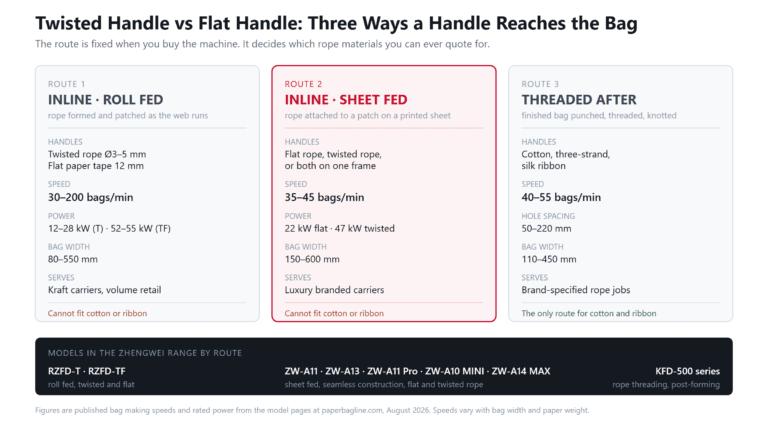
Within sheet-fed work, the handle decides the model more than bag size does, because each handle style needs its own attachment mechanism. The two rope routes differ more than the bag suggests: see twisted handle paper bag machine vs flat handle.
- Flat rope handle — flat woven tape, the most common luxury format. Produced on the ZW-A11 flat handle paper bag machine (200–540 mm, 40–45 bags/min) and, for small formats, the ZW-A10 MINI (150–300 mm).
- Twisted (round) rope handle — twisted paper or cotton cord, the most requested style for premium gift packaging. Produced on the ZW-A13 (200–500 mm, adjustable handle centre distance 110–150 mm, compact 7×7 m footprint).
- Both on one line — the ZW-A11 Pro switches between flat and twisted rope without a machine change, which matters if your order book mixes brands.
- Die-cut and patch handles — punched or glued-on handles, cheaper but visibly lower grade; usually a roll-fed or semi-automatic route.
- No handle — flat and SOS bags, the roll-fed territory described above.
For large formats, the ZW-A14 MAX extends flat-rope production to 600 mm wide, 450 mm tall with 300 mm gussets, at 35–38 bags/min — wine carriers and oversized fashion bags. Our paper handbag making machine page maps handle styles to models in more detail.
Type 4: Machines classified by automation level
The third axis cuts across all the types of paper bag making machines above, and it is the one that quietly decides your cost base.
| Level | What the operator does | Realistic output | Fits |
|---|---|---|---|
| Manual / tabletop | Most forming steps by hand | Very low | Craft and sampling only |
| Semi-automatic | Machine forms the bag, handles attached by hand | Low to moderate | Market testing, very small runs |
| Fully automatic | Loads material, monitors, unloads | High and consistent | Any commercial operation |
The gap is labour, not speed: manual handle attachment runs around $27 per thousand bags against roughly $1.70 on an automatic line. We work the numbers through in our automatic paper bag making machine comparison. All five ZHENGWEI seamless models are fully automatic end to end.
Specialty type: non-woven and 3D box bag machines
Adjacent to paper but worth knowing, because buyers frequently need both: non-woven machines run fabric rather than paper from a roll. The ZW-A8 2.0 produces box-bottom 3D bags from spunbond non-woven, PP film and coated woven fabric at 50–180 g/m², running 70–100 bags per minute on 28 servo axes with automated mould positioning. It is roll-fed, unlike the rest of our range.
Comparing the types of paper bag making machines
| Type | Material in | Typical speed | Main applications | |
|---|---|---|---|---|
| Roll-fed, no handle | Kraft reel, 45–160 gsm | 100–300+ bags/min | Inline flexo, 1–4 colour | Bakery, grocery SOS, takeaway |
| Roll-fed with handle unit | Kraft reel | 60–150 bags/min | Inline flexo | Retail carrier bags, general trade |
| Sheet-fed luxury | Printed sheets, 100–300 gsm | 35–45 bags/min | Offset, pre-printed + laminated | Fashion, cosmetics, fragrance, gift |
| Non-woven 3D | Fabric roll, 50–180 g/m² | 70–100 bags/min | Pre-printed material | Reusable shopping, promotional |
Speeds are class typicals, not any single model’s rating; ZHENGWEI figures are our own published specifications. Note how little the types of paper bag making machines overlap in application: each row serves a market the others cannot reach economically, which is why the specification decision is really a market decision.
Paper bag making machine applications: find your use case
Working backwards from the bag is faster than working forwards through the types of paper bag making machines. Find the row that matches what you sell:
| You produce… | Machine type | ZHENGWEI model |
|---|---|---|
| Jewellery, cosmetics, boutique bags (150–300 mm) | Sheet-fed, flat rope | ZW-A10 MINI |
| Luxury shopping bags, flat handle (200–540 mm) | Sheet-fed, flat rope | ZW-A11 |
| Premium gift bags, twisted handle (200–500 mm) | Sheet-fed, round rope | ZW-A13 |
| Mixed brand work, both handle types | Sheet-fed, dual handle | ZW-A11 Pro |
| Wine carriers, oversized fashion bags (up to 600 mm) | Sheet-fed, large format | ZW-A14 MAX |
| Reusable non-woven shopping bags | Roll-fed, non-woven 3D | ZW-A8 2.0 |
| Bakery, grocery, takeaway kraft bags | Roll-fed kraft | Roll-fed kraft line — not in this range |
One structural note on the sheet-fed rows: all five models use ZHENGWEI’s patented seamless construction, which forms a one-piece bottom rather than gluing a bottom overlap. Beyond appearance it cuts material cost by around 30%, and we compare the two constructions directly in seamless versus traditional.
Choosing between the types
Comparing the types of paper bag making machines feature by feature rarely settles anything, because the specifications overlap. Three questions about your own business resolve most cases:
- Who is your customer — a brand, or a shop? Brands specify appearance and pay for it, which means sheet-fed. Shops buy on price per thousand, which means roll-fed. Trying to serve both on one machine is the most common specification error in this category.
- Do your bags carry printed artwork? Full-colour, photographic or laminated artwork rules out inline flexo, and therefore rules out roll-fed.
- What is your widest and heaviest bag? Format ceiling and board weight eliminate candidates faster than speed does.
If you want the longer selection framework, see how to choose a paper bag making machine; for what each type costs, our price guide gives the public bands, and how the machine works covers the forming process step by step.
Frequently asked questions
What are the main types of paper bag making machines?
They classify on three axes rather than as a simple list. By feed: roll-fed, which draws paper from a reel at 100–300+ bags per minute, and sheet-fed, which converts pre-printed sheets at 35–45 bags per minute. By bag style: flat/V-bottom, square bottom (SOS), and handled carrier bags. By automation: manual, semi-automatic and fully automatic. Most product names you see advertised — “square bottom machine”, “twisted handle machine” — are simply one combination of these three.
What is the difference between roll-fed and sheet-fed paper bag machines?
Roll-fed machines make bags from a continuous reel, run far faster, and print inline with one to four flexo colours on 45–160 gsm kraft — ideal for food and commodity bags. Sheet-fed machines start from sheets already printed offset and often laminated, run slower at 35–45 bags per minute, and handle 100–300 gsm board with rope handles. The choice is not about quality of machine but about which market you serve: commodity volume versus branded appearance.
Which machine makes square bottom paper bags?
A square bottom paper bag machine — also called an SOS machine, after “self-opening sack” — forms the flat rectangular base that lets a bag stand up on its own. On roll-fed lines this is the standard grocery and bakery format produced at high speed. On sheet-fed luxury lines the same square base is produced with gussets and rope handles for retail carrier bags; ZHENGWEI’s ZW-A14 MAX, for example, produces up to 600 mm wide with 300 mm gussets.
Which type of paper bag machine is most profitable?
Margin follows segment, not machine type. Commodity food-service bags from roll-fed lines typically run 10–20% gross margin, retail carrier bags 20–35%, and luxury branded bags from sheet-fed lines 40–60%. Roll-fed machines produce far more bags per hour, so the trade is volume against margin — and utilisation decides which one wins in practice.
Can one machine produce every type of paper bag?
No, and any supplier claiming otherwise is worth questioning. Roll-fed and sheet-fed are structurally different machines and no single line does both. Within sheet-fed work some flexibility exists — the ZW-A11 Pro produces both flat and twisted rope handles on one line — but crossing the roll-fed/sheet-fed divide means two machines. Specify for the bags that carry your margin, not for the widest theoretical range.
Not sure which type you need?
Send us the bag you want to produce — dimensions, board weight, handle style, monthly volume — and we will tell you which of the types of paper bag making machines fits, including when the answer is a machine class outside our sheet-fed range. Configured quotes within 24 hours, and free physical samples produced on the model we recommend.
Related reading: How to Choose a Paper Bag Making Machine · How Does a Paper Bag Making Machine Work? · Our Machines