Paper Bag Quality Control: Load, Drop, Handle and Glue-Bond Checks
Paper bag quality control should answer two questions: does the bag match the approved specification, and does it perform satisfactorily in its intended use?
Appearance alone cannot answer the second question. A neat bag may have a weak handle attachment, an incomplete side seam or a bottom that opens under the customer's load. Conversely, a bag that carries its contents may still be rejected for dimensions, print alignment or visible glue marks.
A documented paper bag quality control plan connects incoming materials, production checks and finished-bag testing. This guide explains the four functional checks and the records needed to make each result useful.
Define the Paper Bag Quality Control Specification
Begin with the application. A small cosmetics bag, a clothing carrier and a bag intended for a heavy, rigid product do not present the same loading conditions.
The buyer and manufacturer should agree:
- Intended contents, their shape and how the bag will be carried.
- Finished width, height and gusset dimensions, including measurement points and tolerances.
- Paper grade, grammage, printing and surface treatment.
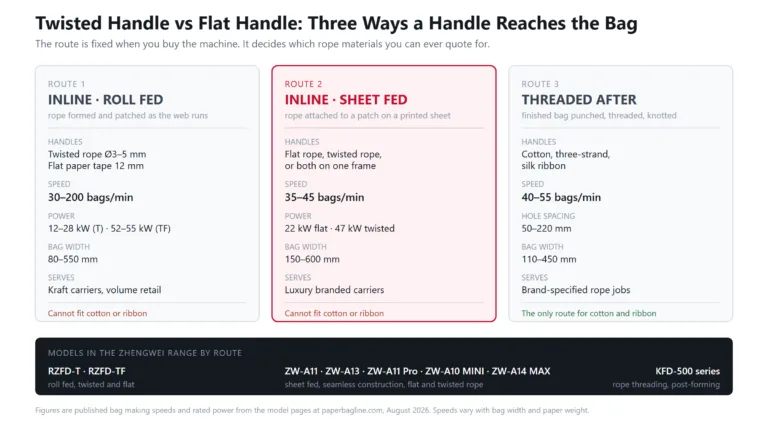
- Handle material, dimensions, position and attachment method.
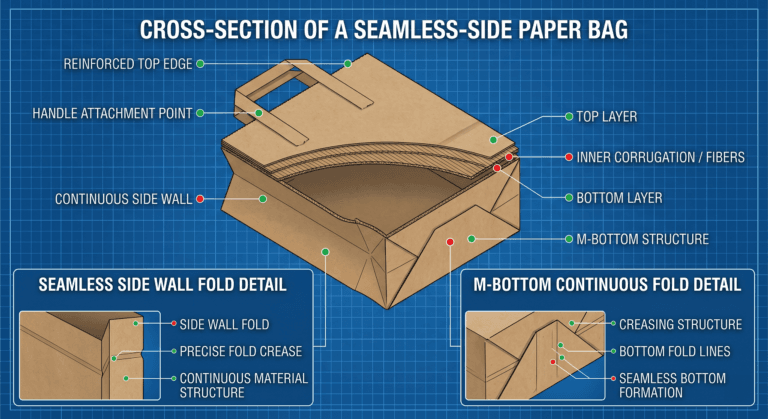
- Top fold, side seam, bottom construction and any reinforcement.
- Approved appearance reference.
- Required test methods, sample selection and acceptance criteria.
Do not derive a load claim from paper grammage alone. The Paper Bag's quality guidance identifies material, construction, glue selection and handle construction as contributors to performance.
A test result belongs to the specified bag and test conditions. It is not evidence that every bag made on the same machine will carry the same load.
Schedule Incoming, In-Process and Final Checks
Schedule paper bag quality control at the material, production and finished-bag stages. Give each inspection stage a defined purpose.
Incoming Materials
Confirm that paper, handle material, adhesive and reinforcement components match the approved specification. Record supplier and batch details so that an unexpected result can be traced.
For preprinted or laminated sheets, include print revision, surface condition and readiness for the next operation. Check that the material supplied for the trial represents what will be used in production.
In-Process Inspection
Approve a first-off bag against the specification before releasing the run. Then use the agreed sampling plan to monitor dimensions, folding, adhesive placement, reinforcement and handle position.
Define which events require another approval. Useful triggers include a material-batch change, a job change, a relevant setting adjustment or a restart after a process problem.
Final Inspection
Assess finished bags after the agreed adhesive-setting or conditioning interval. Include both appearance checks and the functional tests required by the order.
Final inspection should also confirm quantity identification, packing condition and traceability. Mixing approved and unverified batches can undermine an otherwise sound process.
Use a Practical Paper Bag Inspection Checklist
Use this paper bag quality control checklist as a starting point. The order specification should provide the actual limits and methods.
| Inspection area | What to check | Record or acceptance reference |
|---|---|---|
| Paper and surface | Correct grade, visible damage, contamination and finish | Approved material specification and batch |
| Artwork revision, color reference, registration and visible marking | Signed print sample and agreed viewing conditions | |
| Dimensions | Width, height, gusset and relevant openings | Drawing, measurement points and tolerances |
| Folds and creases | Position, symmetry, cracking and repeatability | Approved formed sample |
| Side seam | Adhesive coverage, overlap, closure and visible squeeze-out | Seam specification and bond-check method |
| Bottom | Fold arrangement, closure, adhesive and squareness | Bottom drawing and finished-bag reference |
| Top fold | Height, alignment, closure and appearance | Structural specification |
| Reinforcement | Correct material, size, position and attachment where specified | Top-card or bottom-card requirement |
| Handles | Type, length, spacing, position and attachment | Handle drawing and approved sample |
| Finished performance | Load behavior, handle behavior and other agreed tests | Written test method and pass/fail criteria |
| Packing and traceability | Count identification, deformation and lot separation | Packing instruction and batch record |
Separate cosmetic and functional observations in the inspection record. A single general result such as "bag quality good" provides little help if a customer later reports a failure.
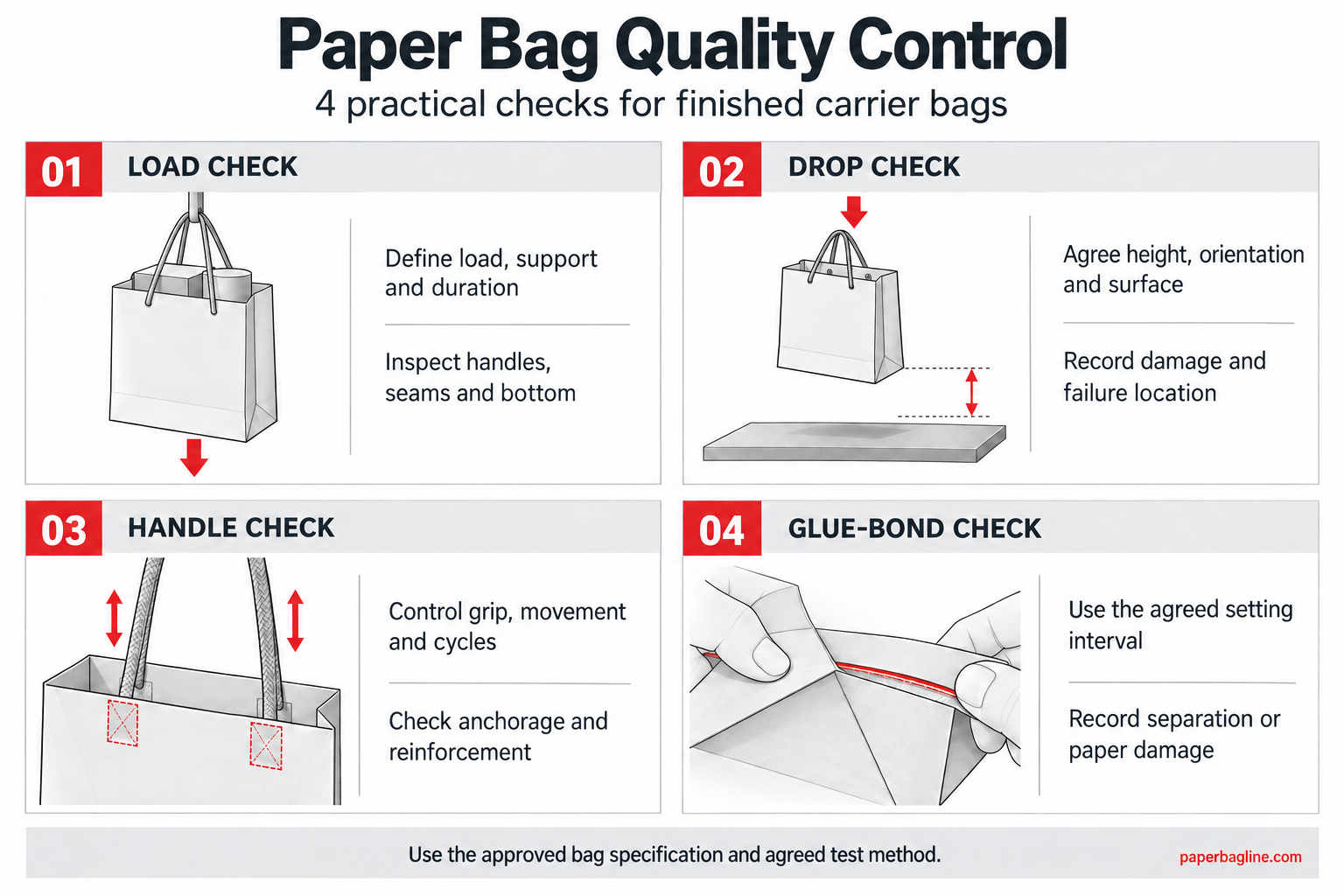
Plan 4 Paper Bag Quality Control Checks
The load, drop, handle-fatigue and glue-bond checks below are a practical planning framework. They do not constitute a universal standard.
Where a customer specifies a formal method, use its stated scope, procedure and acceptance requirements. If no method has been specified, agree one before making a performance claim.
Sample size, test loads, durations, drop conditions and allowable failures should be documented for the bag application. Do not copy values from another customer's bag or an unrelated machine demonstration.
1. Paper Bag Load Check
A paper bag quality control load check assesses the finished bag under the agreed loading and support conditions.
Specify the contents or test medium, load distribution, total load, how the bag is lifted or suspended, and the duration or handling sequence. A concentrated rigid object and an evenly distributed soft load should not be treated as equivalent merely because their mass is the same.
Inspect the handles, attachment areas, top fold, side seam and bottom before and after the check. Record deformation and the first visible sign of failure, not only whether the contents stayed inside.
2. Paper Bag Drop Check
For paper bag quality control, include a drop check where it is relevant to the customer's intended use or required method. Its result applies to the agreed setup and does not automatically establish suitability as a shipping package.
Agree the filled-bag condition, load, orientation, release method, drop height, impact surface and number of drops. Also specify what counts as a failure.
Photograph the bag and defect location after the test. A split bottom, torn paper and detached handle are different outcomes that should not be combined under the description "drop failure."
3. Handle-Fatigue or Repeated-Lifting Check
A controlled handle check adds evidence to paper bag quality control under the agreed carrying action.
Define the load, grip arrangement, movement, number of cycles and inspection points. Record whether failure starts in the handle material, handle anchorage, reinforcement or bag wall.
Use a controlled procedure so different operators do not introduce different jerks or grip positions. For mechanically controlled testing, record the equipment and its relevant verification status.
4. Glue-Bond Check
For paper bag quality control, assess the side seam, bottom closure and reinforcement bonds that the approved construction actually uses. Test after the agreed setting interval and identify both the interface and method.
Describe the observed failure mode: clean separation, paper damage, partial opening or another defined condition. Paper tearing can be a useful observation, but it is not a universal pass criterion for every paper, coating and adhesive system.
When numerical bond data are required, agree the test equipment, specimen preparation, measurement method and limit. Do not convert an informal hand check into an unsupported strength rating.
Keep a Repeatable Paper Bag Quality Control Record
A paper bag quality control record should allow another person to understand what was tested and repeat the method.
| Record field | Information to include |
|---|---|
| Identification | Customer or job reference, bag drawing revision, date and operator |
| Materials | Paper, adhesive, handles and reinforcement batch references |
| Sample selection | Production lot, sample count, selection method and sample identifiers |
| Conditioning | Storage or conditioning requirements, actual conditions and elapsed time |
| Method | Test name, procedure reference and any agreed deviation |
| Load setup | Contents or test medium, load distribution and total load |
| Test conditions | Relevant duration, cycles, drop setup, grip or bond-test details |
| Results | Observations for each sample, measurements and failure location |
| Decision | Agreed criterion, pass/fail result and reviewer |
| Evidence | Sample photographs, retained samples and equipment identification |
For destructive checks, identify the test samples separately from saleable stock. Follow a safe test arrangement that keeps people clear of suspended or falling loads.
Connect Defects to the Right Checkpoint
Paper bag quality control connects each defect to a defined checkpoint. Do not assume every defect is a machine fault or every bond problem is an adhesive fault. Use the evidence to narrow the investigation.
| Observed defect | Possible contributors to investigate | Relevant checkpoint |
|---|---|---|
| Side seam opens | Adhesive application, overlap, surface compatibility or setting conditions | Seam formation and bond inspection |
| Bottom opens under load | Fold position, adhesive coverage, bottom construction or material damage | Bottom forming and finished-load check |
| Handle attachment separates | Attachment geometry, adhesive, anchorage or reinforcement | Handle station and repeated-lifting check |
| Paper tears near the handle | Local stress concentration, paper condition or reinforcement design | Material approval and handle-area inspection |
| Fold or surface cracks | Paper, print finish, crease arrangement or forming conditions | Incoming sheet and formed-bag inspection |
| Glue marks are visible | Application placement, excess adhesive or contact during handling | Adhesive application and appearance checks |
| Bag is out of square | Sheet presentation, fold alignment or material variation | First-off dimensions and forming checks |
| Bags stick or mark in the stack | Adhesive or coating condition, handling or packing timing | Process release and packing inspection |
For each investigation, retain the rejected sample, confirm the suspected cause and repeat the relevant check after correction. Releasing the next lot solely because the defect looks less noticeable leaves the underlying question unresolved.
Use Customer Materials in Machine Acceptance
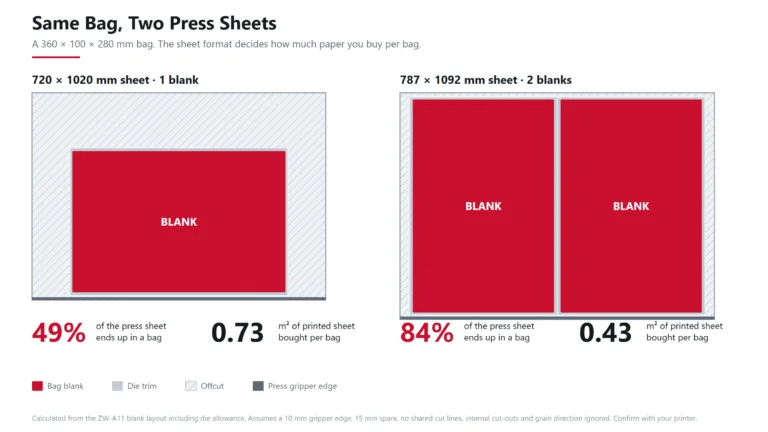
For a paper-bag-machine purchase, make the trial specification representative of the buyer's work. Agree the paper, finish, bag dimensions, handles and reinforcement before the demonstration.
Ask which steps the quoted configuration completes and which remain separate. Handle making, handle attachment, top reinforcement and bottom-card operations should not be assumed to be included in every machine.
Use the same paper bag quality control criteria for the sample run that the factory intends to apply after installation. Record any difference between demonstration materials and the planned production materials.
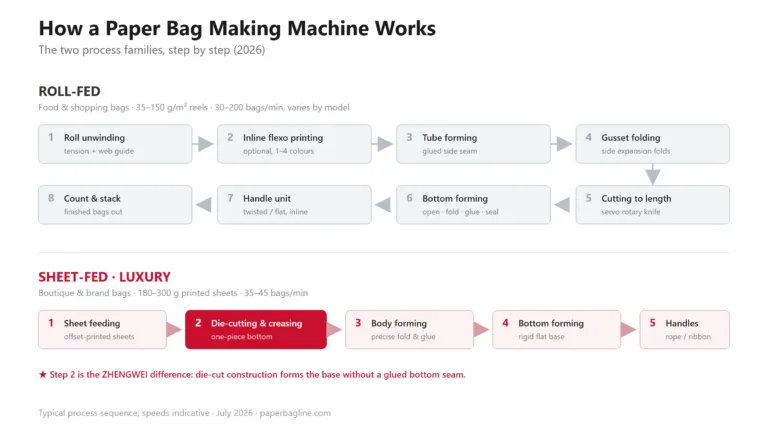
The paper bag samples can help frame that discussion. For an overview of the process stages, see how a paper bag making machine works.
Contact our team with the bag specification, representative materials and intended carrying application to discuss a sample-based acceptance plan.
Frequently Asked Questions
What should paper bag quality control include?
Paper bag quality control includes material verification, appearance, dimensions, folding, seams, bottom construction, reinforcement, handles and application-specific functional tests. Record the method and acceptance criteria for each required check.
Is there one load test for every paper bag?
No. Use the method required by the customer or applicable specification. Where none is specified, agree the bag application, test conditions and acceptance criteria before testing.
Can heavier paper guarantee a stronger bag?
No. Paper selection is one input. The bag's structure, seams, handles, reinforcement and converting quality also need to be evaluated.
Should every order use a drop test?
Only where the order requirements or intended-use evaluation call for it. Its setup and interpretation must be defined; a drop result alone does not approve the bag for every handling or shipping situation.
How is quality inspection different from machine maintenance?
Inspection assesses whether materials and finished bags meet the specification. Maintenance keeps the equipment in the required operating condition. A maintenance log does not replace finished-bag acceptance.
Technical Reference
- The Paper Bag: For High Quality and Reusability. Industry background on material, glue and construction factors in paper carrier-bag quality. The inspection framework in this article is an editorial planning aid, not a reproduction of a standardized test procedure.